
Carrageen ist ein natürliches, hydrophiles Polysaccharid-Kolloid, das aus Rotalgen gewonnen wird und in der Lebensmittel-, Pharma- und Körperpflegeindustrie weit verbreitet ist. Aufgrund seiner hohen Festigkeit und Hitzeempfindlichkeit ist es mit herkömmlichen mechanischen Mahlverfahren oft nicht möglich, Carrageen ultrafein zu vermahlen, ohne es zu beschädigen. chemisch Struktur.
Ein großer brasilianischer Hersteller von Lebensmittelzusatzstoffen hatte sich zum Ziel gesetzt, die Löslichkeit und Gleichmäßigkeit seiner Carrageenprodukte für Premiummärkte wie Instantgetränke und Präzisionsprodukte zu verbessern. Beschichtung Anwendungen. Der Kunde benötigte eine stabile Lösung, die einen d90-Wert von ≤ 150 µm bei einem Durchsatz von mindestens 40 kg/h erreicht.
Wichtigste Herausforderungen
- Hitzeempfindlichkeit: Carrageen kann sich bei erhöhten Temperaturen zersetzen oder versengen.
- Hohe Zähigkeit: Aufgrund seiner faserigen Struktur ist die Effizienz bei herkömmlichen Schleifmaschinen gering.
- Partikelgröße Kontrolle: Eine enge Partikelgrößenverteilung ist erforderlich, wobei ein Überschuss an Feinanteilen oder zu großen Partikeln vermieden werden sollte.
Technische Lösung: Episches Pulver Fließbettstrahlmühle System zur Ultrafeinvermahlung von Carrageen
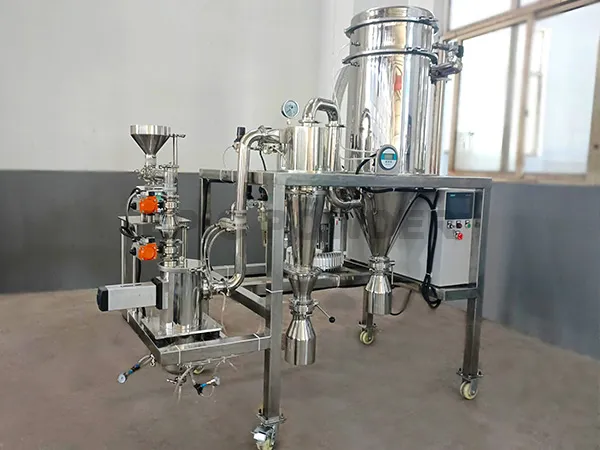
Basierend auf den Materialeigenschaften lieferte Epic Powder eine kundenspezifische Wirbelschicht-Strahlmühle (Labor-/Kleinserienmodell).
1. Gerätekonfiguration und Parameter
- Modell: MQW-Serie Wirbelschicht-Strahlmühle
- Schleifprinzip: Überschall-Luftströme beschleunigen Partikel, sodass diese in der Strahlkreuzungszone mit hoher Geschwindigkeit kollidieren, aneinander reiben und sich abscheren, wodurch eine Größenreduzierung erreicht wird.
- Klassifizierungssystem: Eingebauter hochpräziser vertikaler Turbinenklassierer, der durch Anpassung der Drehzahl eine genaue Steuerung des d90 ermöglicht.
2. Prozessvorteile
- Niedertemperaturmahlen: Der durch die adiabatische Expansion der Druckluft erzeugte Kühleffekt gleicht die beim Mahlen entstehende Wärme aus und gewährleistet so stabile physikalische und chemische Eigenschaften des Carrageens.
- Kontaminationsfrei: Keramische Auskleidungen oder hochreine Edelstahl-Kontaktteile erfüllen brasilianische und internationale Lebensmittelsicherheitsstandards.
- Hohe Effizienz: Durch die optimierte Düsenanordnung wird die Energieausnutzung deutlich verbessert und das Kapazitätsziel von 40 kg/h problemlos übertroffen.
Test- und Produktionsergebnisse
Nach Installation und Inbetriebnahme beim brasilianischen Kunden wurden folgende Leistungswerte erzielt:
| Schlüsselparameter | Kundenanforderung | Tatsächliches Ergebnis |
|---|---|---|
| Produktgröße d90 | ≤150 µm | 128 µm |
| Stundenkapazität | ≥40 kg/h | 55–60 kg/h |
| Feuchtigkeitsänderung | <1%-Variante | 0,2% (nahezu kein thermischer Effekt) |
| Partikelgrößenverteilung | Eng | Typische Normalverteilung, keine Grobpartikel |