
Einführung
When a grinding process goes wrong, the most common cause is not a bad machine. It is the wrong machine. If any one of the four key requirements, target particle size, material properties, throughput, and operating cost, does not match the equipment, you will see problems such as off-spec particle size, high energy use, heat damage, or metal contamination.
Stiftmühlen Und Luftstrahlmühlen are two widely used fine grinding machines. They work on different principles and suit different materials and applications. This article explains how each one works, compares them on the points that matter, and introduces the matching product lines from Epic Powder Machinery. It is written for technical evaluation and purchasing decisions.
What Is a Pin Mill
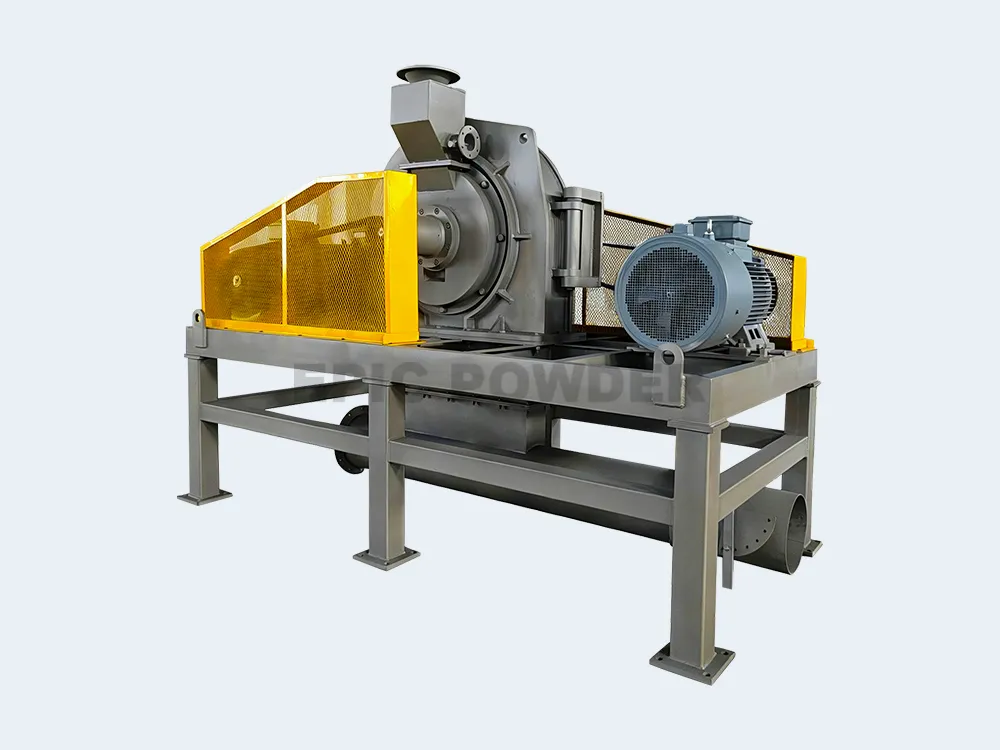
A pin mill is an impact mill. Inside the machine, a high-speed rotor carries pins arranged in concentric circles. A stationary disc carries a matching set of pins. Material enters from the center feed inlet and is driven by the rotor in a high-speed circular motion. It is repeatedly hit, sheared, and collided between the stationary and rotating pins until it is ground to the required fineness.
A pin mill covers a wide particle size range. Based on the official parameter table, the coarse powder setting runs at 20 to 200 mesh, or roughly 75 to 850 µm. The fine powder setting runs at 60 to 300 mesh, or roughly 48 to 250 µm. The ultra-fine setting runs at 100 to 2500 mesh, or roughly 5 to 150 µm. Which setting you reach depends on rotor speed, pin configuration, and the drive arrangement.
The advantages of a pin mill are clear. It offers high throughput for continuous, high-volume production. It uses less energy because mechanical impact is more efficient than accelerating gas. It costs less to buy and to run, with a simple structure that is easy to maintain and easy to service. It is efficient on medium-hard and brittle materials.
The limitations also need attention. The high-speed rotor and pins generate heat, and the temperature rise becomes noticeable when material stays longer in the grinding chamber. Heat-sensitive, low-melting, and oil-bearing materials tend to stick to the machine or degrade. In addition, mechanical contact between the pins and the material causes minor metal wear, which matters for products that cannot tolerate any metal contamination. Although the ultra-fine setting can reach around 5 µm, a pin mill cannot match a jet mill below 5 µm or in controlling a narrow particle size distribution.
Pin Mills by EPIC Powder Machinery
Der MJL-P series pin mill from Epic Powder Machinery has several clear advantages in its class.
First, it uses a pin-type grinding disc with a screen-free structure. It discharges fast, offers large capacity, and generates less heat. Compared with conventional impact mills that have screens, the screen-free design reduces the risk of blocking and wall buildup, and it is easier to clean.
Second, it is available in single-drive and double-drive configurations. The single-drive type has one moving disc and one static disc. The double-drive type has two moving discs. The double-drive type reaches a relative linear speed of up to 240 m/s, delivering stronger impact and shear force and a finer finished particle size. The ultra-fine setting corresponds to a linear speed of 200 to 240 m/s.
Third, it can be equipped with an air classifier to control finished fineness online, avoiding over-grinding and giving a more concentrated particle size distribution.
Fourth, it is compact and easy to disassemble and clean, which suits frequent material changes or hygienic production environments.
The MJL-P series covers multiple sizes from 250 to 800, with particle sizes selectable from about 5 µm up to 850 µm. The exact model depends on the hardness, specific gravity, and moisture content of the material.
What Is an Air Jet Mill
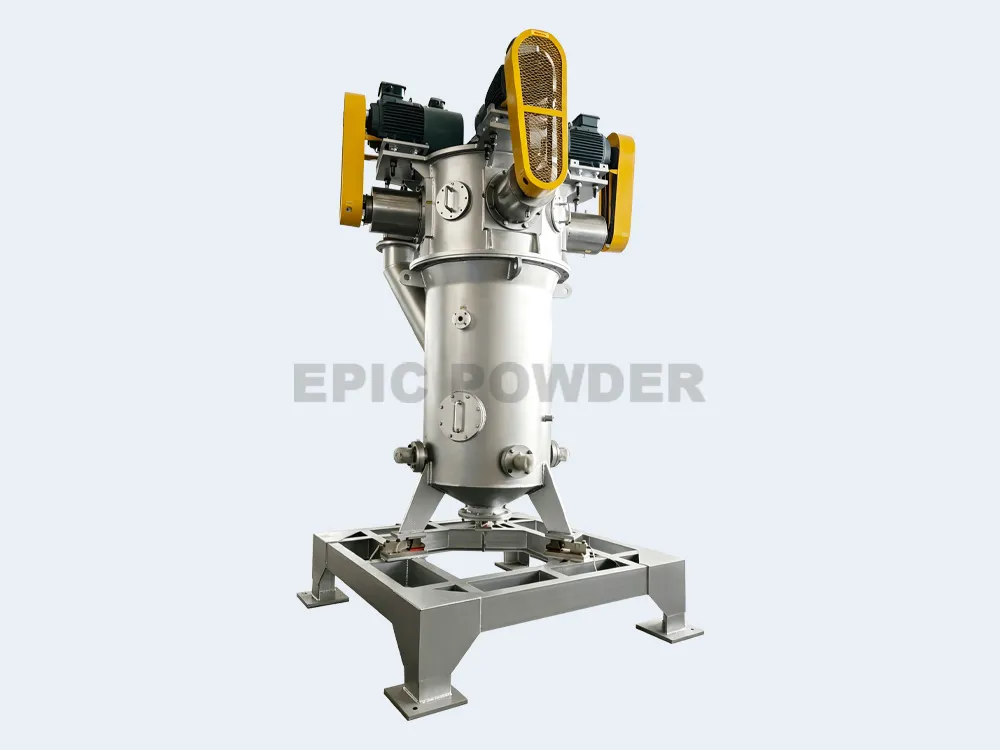
An air jet mill does not use mechanical parts to strike the material. It uses high-speed gas to accelerate the particles and breaks them by particle-to-particle collision. The two common types are the fluidized bed mill and the spiral mill. Compressed air or nitrogen is accelerated to high speed through nozzles. The material is entrained in the gas and accelerated. The particles break as they collide with each other and, to a lesser extent, with the walls. The fine powder moves with the gas into the classification wheel, where particles at the target size are separated and discharged, while coarse particles return for further grinding.
The strengths of an air jet mill are fineness and purity. It can reliably produce D97 from 1 to 20 µm, and for some materials it can reach the sub-micron range with a narrow distribution. Because the grinding relies on particle-to-particle collision rather than metal parts striking the material, the product is not contaminated by metal wear. The adiabatic expansion of the gas at the nozzles cools the chamber, so the mill is suitable for heat-sensitive, low-melting, and oxidizable materials. Nitrogen can be used for inert gas grinding to prevent oxidation or explosion.
The limits of an air jet mill are cost and throughput. Accelerating gas is less energy-efficient, so energy use per unit of output is clearly higher than mechanical grinding. The mill needs a compressed air system and a dust collection system, which raises both investment and operating cost. Throughput is relatively low, so it is better suited to high-value materials that need fine size and high purity, rather than large-volume ordinary grinding.
Jet Mills by EPIC Powder Machinery
The Epic Powder Machinery jet mill range has three series covering different structures and applications.
Der MQW series is a horizontal fluidized bed jet mill and the flagship model. Its classification wheel is installed horizontally, giving more precise control over fineness for low-density materials. The fluidized bed collision method also preserves particle shape better. The MQW can produce a D97 as low as 1 µm, making it suitable for applications with strict particle size requirements.
Der MQP series is a spiral jet mill. It classifies material inside the grinding chamber and has a simpler structure, which suits fine grinding of small batches and multiple products.
Der MQL series is a vertical fluidized bed jet mill with a small footprint, suitable for lines with space constraints.
All three series share several capabilities. They support inert gas closed-loop circulation and explosion-proof design, so they can handle flammable, explosive, oxidizable, and moisture-sensitive materials. They provide low-temperature, media-free grinding, suitable for heat-sensitive, low-melting, sugar-containing, and volatile materials. The machine can be made from carbon steel, stainless steel, or special alloys, and ceramic linings can be added for abrasive materials or materials sensitive to metal contamination.
Pin Mill vs Air Jet Mill: Key Differences
| Artikel | Stiftmühle | Luftstrahlmühle |
| Schleifprinzip | Mechanical impact, shear, and collision | High-speed gas and particle-to-particle collision |
| Finished particle size | About 5 to 850 µm, selectable by setting | D97 about 1 to 20 µm, down to sub-micron |
| Partikelgrößenverteilung | Medium | Eng |
| Energieverbrauch | Niedrig | Hoch |
| Durchsatz | Hoch | Relatively low |
| Temperature rise | Noticeable | Low, cooled by adiabatic expansion |
| Metallverunreinigung | Minor wear | Essentially none |
| Heat-sensitive / low-melting materials | Not suitable or limited | Suitable |
| Inert gas protection | Generally not supported | Supported |
| Equipment and operating cost | Niedrig | Hoch |
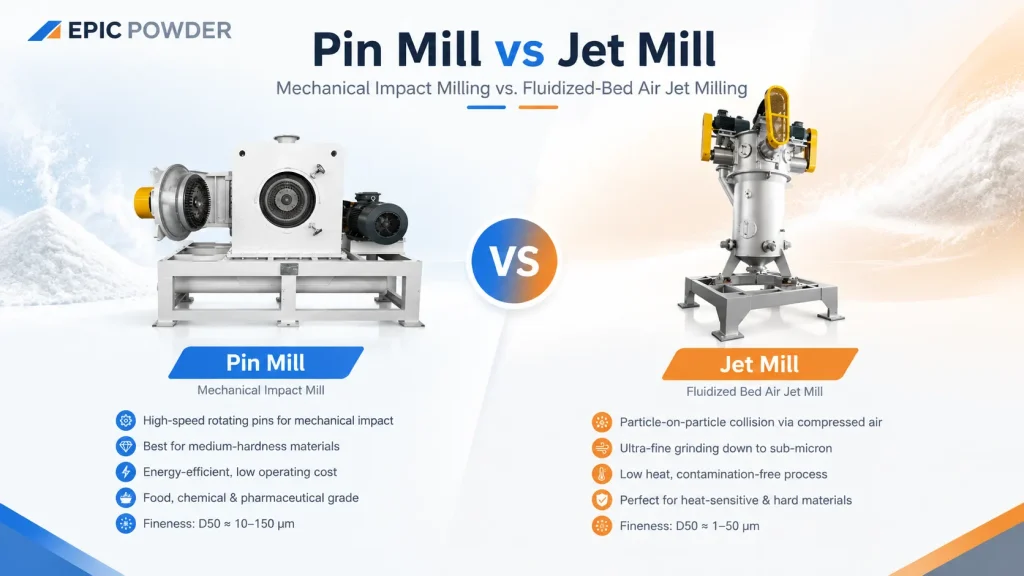
The table points to a simple conclusion. For material above 5 µm that is not heat-sensitive, with high throughput demand and a limited budget, the pin mill is the better choice. For sub-micron powder, a narrow distribution, heat-sensitive material, or high purity requirements, the air jet mill is the better choice.
Materials Suited to Each Mill
Pin mills suit medium-hard, brittle materials that do not require extreme fineness, with a target above 5 µm, such as sugar, salt, some resins, grains, spices, dyes, and some minerals. In food and chemical applications, the pin mill stands out for cost-effectiveness.
Air jet mills suit high-purity, heat-sensitive, tough, or ultra-fine materials, such as active pharmaceutical ingredients, battery materials, ceramic powders, pigments, graphite, and some functional materials. For applications sensitive to metal contamination or requiring a narrow distribution, the air jet mill offers advantages a pin mill cannot replace.
Factors to Consider When Choosing
Six factors are worth checking one by one.
The first is target particle size. Is the requirement above or below 5 µm, and does it call for a narrow distribution or sub-micron size. Ordinary fineness favors the pin mill, while sub-micron and narrow distribution favor the jet mill.
The second is material hardness and brittleness. Brittle materials are efficient in a pin mill, while tough materials are easier to grind fine in a jet mill.
The third is heat sensitivity. Will the material soften, oxidize, or degrade at grinding temperature. Heat-sensitive materials should lean toward the jet mill.
The fourth is purity requirements. Is metal wear acceptable. Where it is not, an air jet mill or a specially treated pin mill is the only choice.
The fifth is throughput. High-volume continuous production favors the pin mill, while small batches of high-value material favor the jet mill.
The sixth is total cost. Do not look at the equipment price alone. Add energy, maintenance, wear parts, and supporting systems together, and compare cost per ton rather than cost per machine.
Abschluss
There is no universal winner between pin mills and air jet mills. The difference comes down to material and target. For high volume, cost-sensitive production with a target above 5 µm, choose the pin mill. For sub-micron powder, high purity, heat-sensitive material, or a narrow distribution, choose the air jet mill.
If you are not sure which mill fits your material, the most reliable step is to run a trial with the actual material and verify the real particle size, throughput, and temperature rise before deciding. Epic Powder Machinery provides material testing and selection support. Contact us to get a test plan for your specific material.
Episches Pulver
Bei Episches Pulver, we offer a wide range of equipment models and tailor solutions to meet your specific needs. Our team has more than 20 years experience in various powders processing. Epic Powder is specialized in fine powder processing technology for mineral industry, chemical industry, food industry and pharama industry, etc.
Kontaktieren Sie uns noch heute für eine kostenlose Beratung und maßgeschneiderte Lösungen!

“Vielen Dank fürs Lesen. Ich hoffe, mein Artikel war hilfreich. Hinterlassen Sie gerne einen Kommentar. Sie können sich auch an den Online-Kundendienst von EPIC Powder wenden. Zelda ”Für weitere Fragen.“
— Emily Chen, Ingenieur