
With the continuous increase in requirements for energy density and rate performance in the new energy industry, the particle size distribution (PSD) of lithium iron phosphate (LFP) has become a key factor determining slurry coating quality and electrochemical performance.
To address these demands, a leading domestic manufacturer focused on lithium battery cathode materials grinding to achieve shorter ion diffusion paths and higher material activity. The company required its LFP material to be ground to D50 1.30μm, while strictly controlling the increase of metallic impurities (such as zinc wear) and maintaining a narrow particle size distribution.
1. Core Equipment Selection for Lithium Battery Cathode Materials Grinding
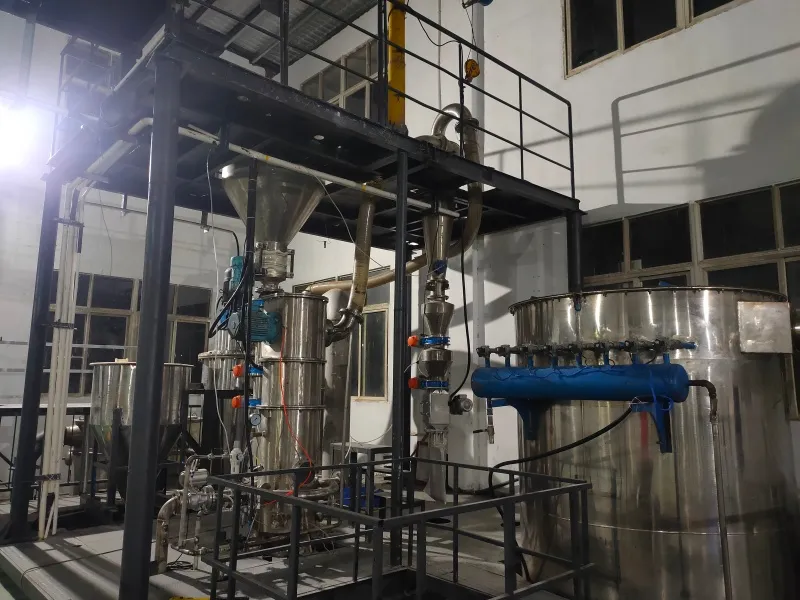
Equipment: Epic Powder MQW Series Fluidized Bed Jet Mill
Technical Features:
- Multi-nozzle collaborative design:
The MQW series adopts oppositely arranged nozzles around the grinding chamber. Supersonic airflow drives particle–particle collision and self-grinding, greatly reducing wear on equipment walls. - High-precision classification:
Equipped with a horizontal high-speed classifier wheel. By adjusting the rotational speed (RPM), oversized particles can be precisely cut. - Full ceramic protection:
For battery-grade materials, all product-contact parts (nozzles, classifier wheel, liners) are made of alumina or silicon carbide ceramic tiles, ensuring zero metal contamination.
2. Production Parameters and Measured Results
During on-site commissioning for the target of 1.30 μm, the following data were recorded:
| Item | Process Parameter / Test Result |
|---|---|
| Feed particle size | D50 ≈ 15–20 μm |
| Grinding pressure | 0.7–0.8 MPa |
| Classifier wheel speed | 3,500–4,200 RPM (adjusted according to model) |
| Final product D50 | 1.30 μm |
| PSD characteristic | Narrow distribution curve, with D100 effectively controlled |
3. Core Advantages
- Morphology protection:
Compared with mechanical mills, the MQW jet mill generates very little heat during grinding, effectively preventing damage to the carbon coating layer on LFP particles. - High-efficiency dispersion:
The jet milling process provides strong de-agglomeration, solving the agglomeration tendency of ultrafine LFP powders. - High level of automation:
The system integrates negative-pressure collection and automatic control, ensuring compliant dust emission and consistent batch-to-batch quality.
4. Conclusion
By adopting the Epic Powder MQW series jet mill, the customer successfully achieved a stable transition of lithium iron phosphate from fine to ultrafine particle size. Precise control at 1.30 μm not only improved the rate discharge performance of the battery material, but also provided strong technical support for the company’s competitiveness in the high-power battery market.