Powder Coating & Surface Modification Systems
EPIC Powder builds continuous powder surface modification lines that coat every particle with a thin, uniform layer of modifier — turning a cheap mineral filler into a functional, high-value material. With more than 20 years in ultrafine powder processing, we run four different coating principles, so the machine is matched to your powder instead of the other way round.
What Powder Surface Modification Actually Does
Surface modification (also called powder coating, surface treatment or activation) deposits a nanometre-thin organic or inorganic film onto each particle. The powder keeps its chemistry and particle size — but its behaviour in a polymer, rubber, coating or battery electrode changes completely.
The four things modification fixes
An untreated mineral filler is hydrophilic, highly polar and full of agglomerates, so it fights the polymer it is mixed into. Modification solves four separate problems at once:
- Breaks soft agglomerates and keeps them broken
- Lowers the oil absorption value, so the resin demand drops
- Turns a hydrophilic surface hydrophobic
- Lets you raise filler loading without losing impact strength
- Lower melt viscosity, faster extrusion, less screw torque
- Better flow and less caking in storage and silos
- Flame retardancy, conductivity, hydrophobicity or barrier properties
- Battery anode coatings that extend cycle life
How the result is measured
Four numbers tell you whether a coating line is working. Activation rate is the share of particles that have float on water — the standard shop-floor check. Coating rate describes how completely each individual particle is covered. Oil absorption value (g DOP per 100 g powder) drops sharply once the surface is organophilic. Finally, agglomerate content and D97 confirm that the coating machine did not re-agglomerate the product while dispersing the modifier.
Typical production window on ground calcium carbonate: 0.5–1.5 wt% stearic acid, activation 95–98%, measured at the outlet of the modification host machine.
Four Continuous Coating Systems
We do not sell one machine for every powder. The four coating principles below cover dry high-intensity mixing, wet-cake drying, high-shear impact and combined grinding-plus-coating. Pick by feed condition, target fineness and throughput — the comparison table further down does the rest.

Three-Rotor Coating Machine
CRM-3 / CRM-6 / CRM-9 · dry, self-heatingThree mixing chambers in series generate a high-speed gas–solid vortex that folds powder and molten modifier together. Friction between particles supplies the heat — no external heater is needed.
- Fineness range: 325 – 3000 mesh
- Capacity: 500 – 7500 kg/h (CRM-3 → CRM-9)
- Operating temperature: 80 – 120 °C, self-generated
- Best for stearic acid coating of GCC, PCC, talc, kaolin

Honeycomb Mill Coating Machine
MRD-1 … MRD-6 · dry + depolymerise + coatA vertical multi-stage rotor with up to 200 blades per stage. Wet filter cake or slurry enters, and drying, de-agglomeration, classification and surface treatment all happen in one housing.
- Capacity: 0.05 – 15 t/h; water evaporation up to 3 t/h
- Coating rate 99.2%, activation rate 99.8%
- Rotor tip speed up to 160 m/s, hot air up to 450 °C
- Modifier injection nozzle inside the mill cavity

Pin Mill Coating Machine
PM-250 … PM-800 · highest shearTwo pin discs rotate in opposite directions, so the relative tip speed reaches 240 m/s. A proprietary injection nozzle atomises the liquid modifier into the shear zone, where it is dispersed and pressed onto the fresh particle surface.
- Fineness: 20 – 2500 mesh depending on disc set
- Relative tip speed up to 240 m/s, two motors
- Wide-chamber housing handles moist, sticky feed
- Full-width mill door swings open for fast cleaning
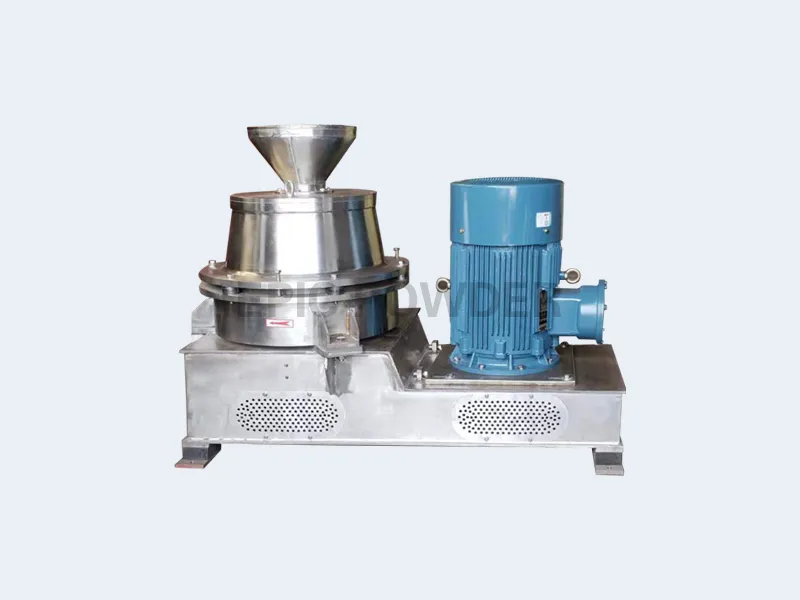
Turbo Mill Coating Machine
RTM-300 … RTM-1250 · UCOAT seriesConical rotor and stator with adjustable gap. High air volume keeps the grinding zone cool, which makes it the safe choice for heat-sensitive and fibrous materials that must not be cooked during coating.
- Fineness: 50 – 2500 mesh, gap-adjusted
- Tip speed 100 – 120 m/s; 22 – 132 kW
- Modification rate up to 99% on GCC
- Ideal for fibrous and low-melting-point materials
Side-by-Side Comparison
Use this table as the first filter. Figures are typical production values on mineral fillers; your own numbers are confirmed on a material test before we quote a line.
| Machine | Coating principle | Feed condition | Fineness | Capacity | Choose it when |
|---|---|---|---|---|---|
| Three-rotor CRM | High-speed gas–solid vortex in three chambers | Dry powder, 325–3000 mesh | 325 – 3000 mesh | 0.5 – 7.5 t/h | Stearic acid coating of GCC/PCC, talc or kaolin with no external heating |
| Honeycomb MRD | Multi-stage impact plus hot-air drying and in-mill classification | Dry powder, filter cake or slurry | Ultrafine, down to a few µm | 0.05 – 15 t/h | The feed arrives wet, or drying, de-agglomeration and coating must be one step |
| Pin mill PM | Counter-rotating pin discs, atomised liquid modifier | Dry powder, Mohs hardness ≤ 3 preferred | 20 – 2500 mesh | 0.3 – 6 t/h | You need maximum shear and the finest, most uniform film |
| Turbo mill RTM | Conical rotor/stator with high air volume | Dry powder, fibrous or heat-sensitive | 50 – 2500 mesh | 0.5 – 8 t/h | The material is heat-sensitive, fibrous or has a low melting point |
How to Choose: Four Questions
Answer these four and the machine choice is usually obvious. If two answers point in different directions, send us 5–10 kg of your powder and we will run it on more than one machine.
- Dry powder → CRM, PM or RTM
- Filter cake, slurry, > 3% moisture → honeycomb MRD dries and coats in one pass
- 325–3000 mesh dry filler → CRM three-rotor
- 50–2500 mesh, fibrous or heat-sensitive → RTM turbo mill
- Down to D97 3 µm with a very uniform film → PM pin mill
- Solid stearic acid, melted on site → heated tank + metering pump, all four machines
- Liquid silane or glycol → atomising injector on PM, or in-mill nozzle on MRD
- Resin or pitch coating (battery anode) → MRD or PM with heated dosing circuit
- Up to 1.5 t/h → PM-250/400 or CRM-3
- 1.5 – 6 t/h → CRM-6 or RTM-750
- Above 6 t/h → MRD honeycomb mill, or parallel lines
Inside a Complete Coating Line
The modification host machine is only one part of the line. A stable activation rate depends just as much on how accurately the powder and the modifier are dosed, and on how cleanly the coated product is collected.
Powder feed and modifier feed are metered and cross-checked at the same time: if either signal drifts out of band, the line alarms instead of quietly producing off-spec powder. Key rotor speed, outlet temperature, differential pressure and air volume are all logged.
Materials We Modify, and the Modifier That Works
The table below reflects the powders we see most often in our own test station. Modifier dosages are starting points — the final recipe is set after testing your material and your downstream application.
| Powder | Common modifier | What the coating achieves | Recommended machine |
|---|---|---|---|
| Ground calcium carbonate (GCC) | Stearic acid, 0.5–1.5% | Lower oil absorption, higher loading in PP/PE/PVC | CRM three-rotor, PM pin mill |
| Precipitated calcium carbonate (PCC) | Stearic acid, coupling agent | Hydrophobic surface, better dispersion in rubber and sealants | MRD honeycomb mill, CRM |
| Talc | Stearic acid, silane | Stiffness and heat resistance in engineering plastics | CRM three-rotor |
| Kaolin | Silane, stearic acid | Paper-coating rheology, rubber reinforcement | MRD, RTM turbo mill |
| Aluminium hydroxide / magnesium hydroxide | Silane, stearic acid | Flame-retardant filler that disperses instead of agglomerating | MRD (drying + coating) |
| Fumed and precipitated silica | Silane, silazane | Hydrophobicity, reinforcement in silicone rubber | RTM turbo mill, PM pin mill |
| Natural and synthetic graphite | Pitch, resin, carbon precursor | Battery anode cycle life and first-cycle efficiency | PM pin mill, MRD |
| Titanium dioxide | Silane, alumina | Weatherability and dispersion in coatings | MRD honeycomb mill |
| Gypsum, cement, fly ash, hydrated lime | Stearic acid, silane | Water repellency and free-flowing bulk powder | CRM-3 / CRM-6 |
| Silver powder and metal powders | Organic anti-oxidation agents | Oxidation resistance and paste dispersibility | CRM-3 |
| PTA and organic crystals | Liquid glycol-based modifier | Surface treatment without melting the crystal | RTM turbo mill |
| Plant fibre, cellulose | Stearic acid, coupling agent | Fibre modification and simultaneous drying | RTM turbo mill |
Related industries
Dosage is the other half of the recipe: the same 1250 mesh GCC can need 0.8 % or 1.5 % stearic acid depending on its measured surface area. If you are still choosing a figure, run it through the modifier dosage calculator before you commit to a trial.
Modified powders from these lines end up in mineral fillers, chemicals, lithium battery materials, building materials, pigments and coatings, electronic encapsulation, cosmetics and pharmaceutical production.
Surface Modification Projects in the Field
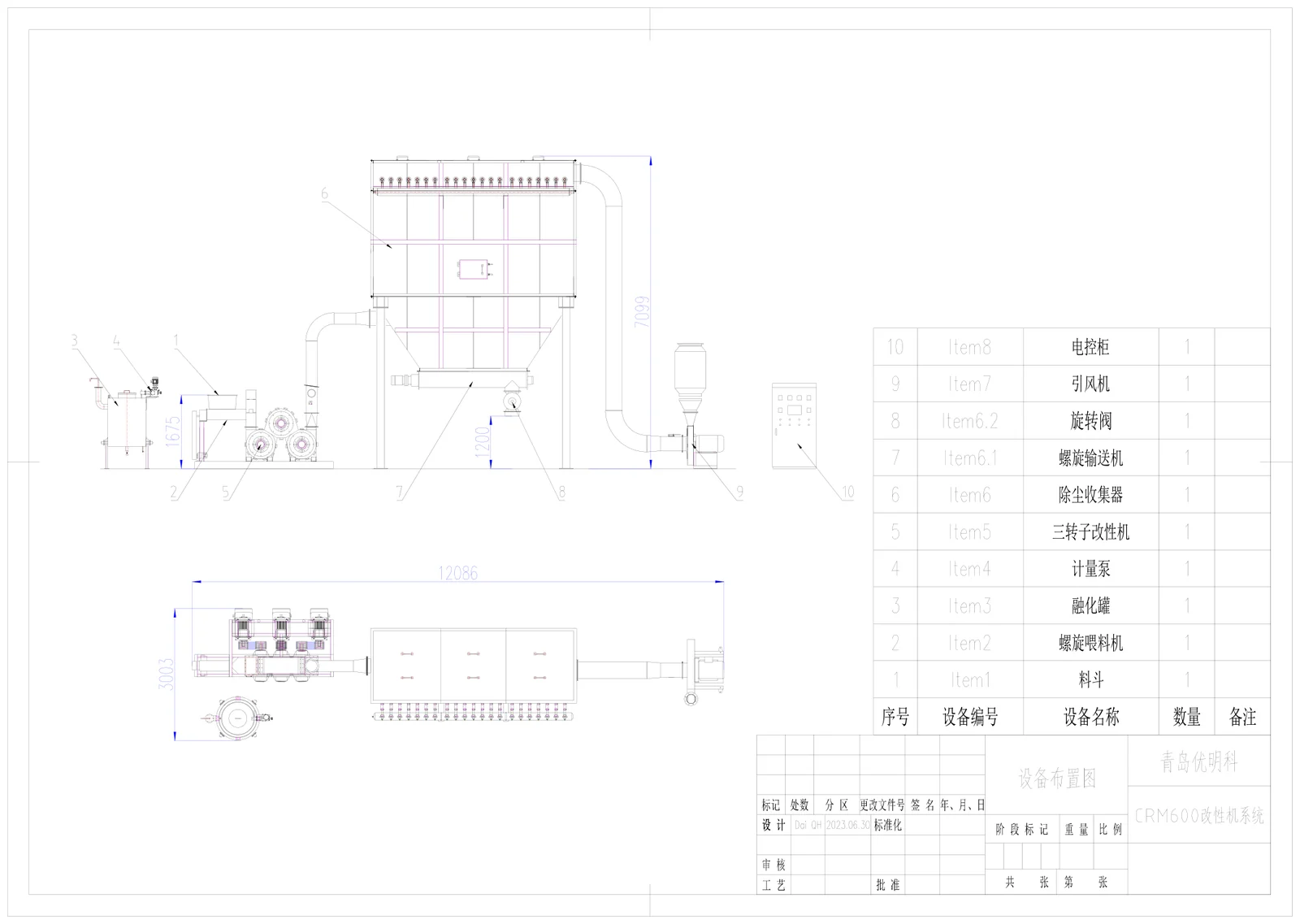
Twelve coating lines we have delivered, grouped by machine type. Customer names are withheld; the layout drawing and the machine photograph further down come from two of these projects.
Three-rotor coating lines (CRM)
Ground calcium carbonate, 800 mesh — East China
- Feed 800 mesh, moisture and SiO₂ both below 0.5 %
- Activation 95–98 % measured at the machine outlet
Limestone and river stone — Central China
- Two mineral sources run on one coating recipe
- Self-friction heating, no pre-heater on the line
Talc, 1250 mesh — North-East China
- Ultrafine talc for plastics compounding
- Closed-loop modifier dosing keeps activation flat across shifts
Dolomite and calcite — East China
- Switched between two feeds without changing hardware
- Both grades sold as plastics filler
Cement, fly ash and hydrated lime — Central China
- Three building powders, one hydrophobic treatment
- Negative-pressure operation, no dust at the operator position
Silver powder — East China
- Electronic paste grade, particle shape preserved by the gentle vortex
Gypsum, 600–1250 mesh — Central China
- Full line: dosing, coating, collection and PLC control
Pin mill coating lines (PM)
Ground calcium carbonate — Egypt
- Customer benchmarked several suppliers, then ran trial batches on our machine
- Result: higher-value GCC and noticeably better dispersion in the compound
Ground calcium carbonate — Vietnam
- Second overseas pin mill line on the same platform
- Counter-rotating discs supply the shear for a uniform stearic film
Ground calcium carbonate, PM630C — East China
- Twin counter-rotating pin discs, 240 m/s relative tip speed
- Painted and photographed on the assembly frame before shipment
Ground calcium carbonate and graphite — East China
- One mill, two modifier recipes
- Graphite run at reduced throughput to protect flake shape
GCC dispersion and modification line — India
- Dispersion and continuous modification engineered as one line
Drawings are issued per project with the customer's own layout, utility connections and civil loads. More project references are published under Cases.
Frequently Asked Questions
Coating quality and process questions
What activation rate can I expect, and how is it checked?
On mineral fillers such as GCC, PCC and talc, our lines run at 95–98% activation in continuous production, and honeycomb mill lines reach 99.8%. The shop-floor check is the float test: a weighed sample is stirred into water and the fraction that stays on the surface is the activation rate. We recommend cross-checking with oil absorption value, because activation alone does not tell you how evenly the modifier is distributed.
How much modifier does one tonne of powder need?
For stearic acid on calcium carbonate the usual window is 0.5–1.5% by weight. The exact figure depends on the specific surface area of your powder — a 3000 mesh product needs noticeably more modifier than an 800 mesh product — and on what your downstream customer specifies. Accurate dosing matters more than the absolute number: a heated, traced metering pump keeps the dose constant as the tank level falls.
Do I have to pre-heat the powder before coating?
Not with a three-rotor CRM machine. The rotors generate enough friction heat to bring the powder to the 80–120 °C working range, so no pre-heater and no separate cooling section are required. For pin mill lines we recommend a feed temperature above 65 °C, which is usually reached by the mill itself or by a simple upstream heater.
Can one machine dry, grind and coat at the same time?
Yes — the honeycomb mill MRD series is built exactly for that. It takes filter cake or slurry, evaporates up to 3 t/h of water, de-agglomerates the particles, classifies them with an integral classifier and applies the modifier through a nozzle inside the mill cavity. Typical coating rate is 99.2% with hot-air temperatures up to 450 °C.
Fineness, testing and support
What is the finest powder you can coat?
Dry coating on the three-rotor and pin mill platforms covers 325–3000 mesh, and we have coated products down to D97 3 µm. Below roughly 5 µm the difficulty is no longer the coating itself but keeping the powder de-agglomerated, which is why ultrafine jobs are usually run on the honeycomb mill with its built-in classification.
Is the system dust-free and does it meet emission limits?
The whole line runs under negative pressure and the product is collected in a pulse bag filter with PE membrane needle felt. Measured dust emission at the outlet stays below 30 mg/m³, which is below the limit in most markets we deliver to. Differential pressure across the filter is monitored and displayed on the HMI.
Can I test my own material before ordering?
Yes, and we strongly recommend it. Send 5–10 kg of your powder together with the target fineness, capacity and modifier, and we will run it on the machine we propose. Capacity figures quoted in catalogues are always confirmed against a test, because feed moisture, particle shape and hardness shift the result more than any datasheet can capture.
What does installation and after-sales support include?
Every line ships with process description, flow diagram, layout drawing, foundation and installation drawings, electrical diagrams, spare parts list and operating manuals. Our engineers supervise installation and run commissioning and operator training on site. Standard warranty is 15 months from shipment or 12 months from commissioning, whichever comes first.
Further Reading
- How stearic acid surface-modified calcium carbonate is made
- The five most common surface modifiers for calcium carbonate
- How to choose and use powder surface modifiers
- Dry surface modification of heavy calcium carbonate: a complete guide
- PCC production and surface modification technology
- Surface modification of silica explained
- Four surface modification methods for graphite anode material
- Modification of lithium battery anode materials
- Modifier dosage calculator — how much stearic acid or silane per tonne
- Mesh to micron calculator
Tell Us Your Powder. We Will Tell You the Machine.
Send us the material name, feed fineness, target capacity and the modifier you plan to use. Our engineers reply within 6 hours with a recommended machine, an expected activation rate and an invitation to send a sample for testing.