
Door de voortdurende toename van de eisen aan energiedichtheid en rendement in de nieuwe energiesector, deeltjesgrootte verdeling (PSD) van lithiumijzerfosfaat (LFP) is een belangrijke factor geworden bij het bepalen van de mest. bekleding kwaliteit en elektrochemische prestaties.
Om aan deze eisen te voldoen, richtte een toonaangevende binnenlandse fabrikant zich op het slijpen van kathodematerialen voor lithiumbatterijen om kortere ionendiffusiepaden en een hogere materiaalactiviteit te bereiken. Het bedrijf eiste dat zijn LFP-materiaal werd geslepen tot een D50-waarde van 1,30 μm, waarbij de toename van metaalverontreinigingen (zoals zinkslijtage) strikt werd gecontroleerd en een smalle deeltjesgrootteverdeling werd gehandhaafd.
1. Kernapparatuurselectie voor het slijpen van kathodematerialen voor lithiumbatterijen
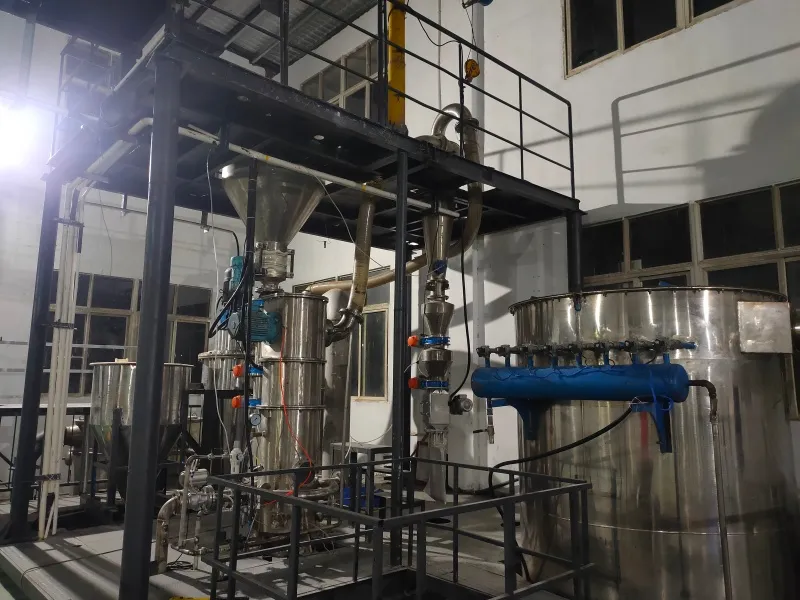
Apparatuur: Episch poeder MQW-serie Wervelbedstraalmolen
Technische kenmerken:
- Samenwerkingsontwerp met meerdere sproeiers:
De MQW-serie maakt gebruik van tegenover elkaar geplaatste sproeiers rond de maalkamer. De supersonische luchtstroom zorgt voor botsingen tussen de deeltjes en zelfvermaling, waardoor de slijtage van de wanden van de apparatuur aanzienlijk wordt verminderd. - Zeer nauwkeurige classificatie:
Uitgerust met een horizontaal, sneldraaiend sorteerwiel. Door de rotatiesnelheid (RPM) aan te passen, kunnen te grote deeltjes nauwkeurig worden gesorteerd. - Volledige keramische bescherming:
Voor materialen van batterijkwaliteit zijn alle productcontactonderdelen (sproeiers, classificatiewiel, voeringen) gemaakt van keramische tegels van aluminiumoxide of siliciumcarbide, wat garandeert dat geen metaalverontreiniging.
2. Productieparameters en gemeten resultaten
Tijdens de inbedrijfstelling op locatie voor de streefwaarde van 1,30 μm werden de volgende gegevens geregistreerd:
| Item | Procesparameter / Testresultaat |
|---|---|
| Deeltjesgrootte van het voer | D50 ≈ 15–20 μm |
| Maaldruk | 0,7–0,8 MPa |
| Classificatiewielsnelheid | 3.500–4.200 toeren per minuut (aangepast aan het model) |
| Eindproduct D50 | 1,30 μm |
| PSD-kenmerk | Smalle distributiecurve, waarbij D100 effectief wordt beheerst. |
3. Kernvoordelen
- Morfologische bescherming:
Vergeleken met mechanische maalinstallaties, de MQW straal molen Er wordt tijdens het malen zeer weinig warmte gegenereerd, waardoor schade aan de koolstofcoatinglaag op de LFP-deeltjes effectief wordt voorkomen. - Hoogefficiënte verspreiding:
De straalfrezen Het proces zorgt voor een sterke de-agglomeratie, waardoor de neiging tot agglomeratie van ultrafijne LFP-poeders wordt opgelost. - Hoge mate van automatisering:
Het systeem combineert onderdrukafzuiging met automatische regeling, waardoor conforme stofemissies en een constante kwaliteit van batch tot batch worden gewaarborgd.
4. Conclusie
Door de Episch poeder Met de MQW-serie straalmolen heeft de klant met succes een stabiele overgang van lithiumijzerfosfaat van fijne naar ultrafijne deeltjesgrootte gerealiseerd. Nauwkeurige controle op 1,30 μm verbeterde niet alleen de afvoersnelheid, maar ook de prestaties van de batterijmateriaal, Maar het bedrijf bood ook sterke technische ondersteuning voor zijn concurrentiepositie op de markt voor krachtige accu's.