
The Advanced Materials Lab in Korea is dedicated to developing high-performance anode materials for リチウムイオン電池. 多孔質炭素, with its high specific surface area (>1500 m²/g) and abundant micro/mesoporous structure, can significantly enhance the cycling stability of silicon–carbon composite anodes. However, traditional mechanical grinding methods often cause particle agglomeration, pore collapse, and metallic contamination, making them unsuitable for laboratory-scale research that demands high purity and structural integrity.
Project Requirements
The client required an ultrafine grinding solution capable of operating under low-temperature and contamination-free conditions. The target 粒子サイズ was D50 ≤ 3 μm, while maintaining the original pore structure and preventing metal contamination. The equipment also needed to support small-batch, multi-material R&D use with easy operation and cleaning.
Technical Solution
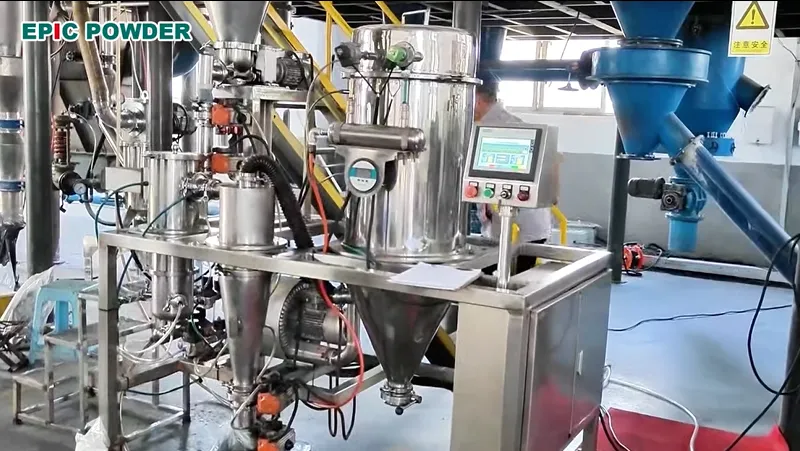
装置: MQW-03 Laboratory Jet Mill (processing capacity 50–500 g/h, compressed air pressure 0.7–0.85 MPa).
プロセス:
- Pre-treatment: Biomass-derived porous carbon (apricot shell-based) activated at 800 °C, BET surface area of 1800 m²/g.
- ジェットミル: Conducted under nitrogen protection; feed size <50 μm → final product D90 = 0.8 μm; grinding chamber temperature <45 °C (with cold air circulation).
- Online 分類: High-precision turbo classifier ensuring a narrow PSD (span <1.2).
Project Results
After commissioning, the porous carbon powder achieved a stable particle size distribution with D50 controlled at 2.8 μm. Both porosity and specific surface area remained well-preserved. According to client feedback, the processed carbon material exhibited excellent electrochemical performance, significantly improving capacitance and cycling stability.
エピックパウダー’s laboratory jet mill system enabled the Korean client to achieve high-purity, low-damage ultrafine preparation of porous carbon materials, providing reliable equipment support for advanced energy storage material research.