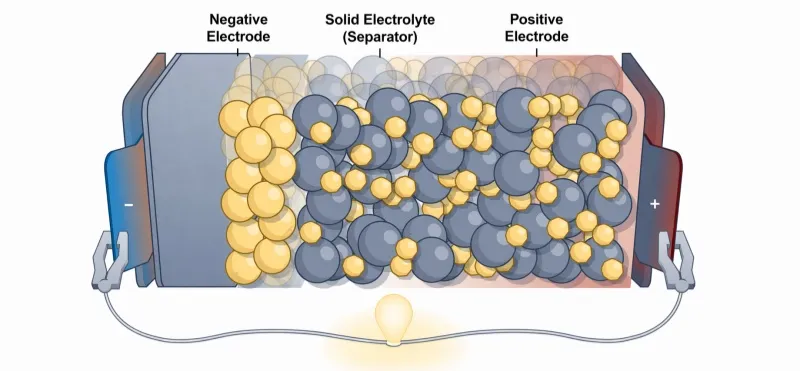
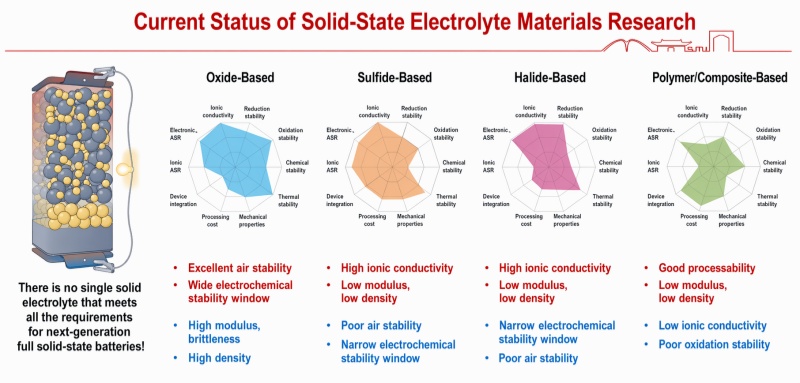
In the research and industrialization of All-Solid-State Batteries (ASSBs), Inorganic Solid Electrolytes (ISEs) are regarded as the core key materials. Whether they belong to the oxide system (e.g., LLZO), the sulfide system (e.g., Li3PS4、Li10GeP2S12), or the halide system, their physical morphology, 粒子サイズ distribution, and specific surface area directly determine the final performance of the battary. 超微粉砕—usually referring to reaching micrometer or even nanometer scales—is the necessary path to achieving high-performance solid electrolytes. Despite the emergence of new grinding equipment, traditional ball mills (including planetary ball mills and drum ball mills) remain the mainstream choice in research and industrial production. They are favored for their low cost, simple operation, and adjustable energy density. This article will explore in depth how to use traditional ball milling processes to achieve efficient ultra-fine grinding of inorganic solid electrolytes.

1. Why Do Inorganic Solid Electrolytes Need “Ultra-fine Grinding”?
Before divie into the process, we must understand the purpose of grinding. For solid electrolytes, reducing particle size is not just about being “fine.” It is about solving the following core issues:
- Reducing Interface Impedance: Solid-state batteries rely on “solid-solid” contact. A smaller particle size means a larger specific surface area. When mixed with the cathode active material, it forms a tighter contact network. This significantly reduces the interface charge transfer impedance.
- Improving Electrolyte Membrane Density: During the pressing or tape-casting process, ultra-fine powders have fewer pores. This results in higher density, which effectively prevents the penetration of lithium dendrites.
- Promoting Reaction Kinetics: For materials requiring subsequent heat treatment, ultra-finization shortens the atomic diffusion distance. This can lower the sintering temperature or shorten the reaction time.
2. Physical Mechanisms of Traditional ボールミル
The ball milling process is not simply “smashing” materials. It involves complex mechanochemical actions. The main forces include:
- Impact Force: The balls drop from a height or collide with the material due to centrifugal force. This generates immense instantaneous pressure, causing particles to break.
- Shear Force: This is the grinding effect produced by the relative sliding between balls and between the balls and the mill wall.
- Friction: Under high filling rates, the friction caused by balls squeezing the material contributes to the grinding effect.
For inorganic solid electrolytes—especially brittle oxides or sulfides that are soft but easily deformed—balancing shear and impact forces is the key to achieving ultra-fine grinding.
3. Tuning Key Process Parameters for Efficient Grinding
To maximize the efficiency of a traditional ボールミル, the following variables must be precisely controlled:
3.1 Ball-to-Powder Ratio (BPR) and Filling Rate
The BPR refers to the mass ratio of the grinding media (balls) to the material (powder).
- Efficiency Suggestion: For ultra-fine grinding, a high BPR is usually used (e.g., 20:1 or even 40:1).
- Logic: More balls mean a higher frequency of impacts on the material per unit of time. However, an excessively high ratio leaves insufficient space in the jar, which can hinder ball movement.
3.2 Size Configuration of Grinding Media
“Size grading” is the soul of ultra-fine grinding.
- Large Balls for Shaping: Large balls have high kinetic energy. They are responsible for the initial breakdown of large chunks of material.
- Small Balls for Fine Grinding: When particles shrink to the micrometer level, the gaps between large balls become too wide, and the material “slips through.” At this stage, a large number of small balls (e.g., 0.1mm – 0.5mm) are needed to increase contact points for final nanometer-scale griding.
- Graded Ball Method: It is recommended to use a stepped combination of diameters ranging from 10mm down to 1mm or smaller.
3.3 Optimization of Rotation Speed
Faster is not always better.
- Critical Speed: If the rotation is too fast, the centrifugal force keeps the balls pinned against the jar wall. They do not fall, and the grinding efficiency drops to zero.
- Efficiency Zone: Usually set at 70% to 85% of the critical speed. In this range, the balls produce a “cascading motion,” creating the strongest impact energy.
4. Dry Milling vs. Wet Milling: How to Choose?

This is the most common choice faced when implementing ultra-fine grinding.
Dry Milling
- 利点: Simple process. No need for subsequent solvent removal. No risk of 化学薬品 degradation induced by solvents.
- デメリット: Severe agglomeration. When the powder reaches a certain fineness, intermolecular forces (Van der Waals forces) cause particles to re-bond into clumps. This creates a bottleneck where the powder cannot get any finer.
- 応用: Initial crushing or materials extremely sensitive to all solvents.
ウェットミリング
- 利点: The liquid medium effectively disperses the powder and prevents agglomeration. The liquid acts as a “grinding aid” by reducing the surface energy of particles. Grinding efficiency can be several times higher than dry milling.
- Key Point: Selection of Solvent.
- For sulfide electrolytes, anhydrous non-polar solvents (e.g., heptane, toluene, xylene) must be used. Otherwise, violent hydrolysis will occur.
- For oxides (e.g., LLZO), one must guard against proton exchange reactions (Li+/H+ exchange). Anhydrous isopropanol or ethanol is typically chosen.
5. Advanced Techniques to Overcome “Efficiency Bottlenecks”
In practice, even with correct parameters, grinding efficiency may plateau. Here are several methods to break through:
5.1 Adding Grinding Aids
Adding small amounts of surfactants or specific organic molecules can help. These molecules adsorb onto the surfaces of particle cracks, preventing the cracks from healing. They also reduce electrostatic attraction between particles. This is particularly effective in dry milling.
5.2 Energy Density Management: Intermittent Milling
Continuous high-speed grinding generates significant heat. For sulfide solid electrolytes, heat can cause the material to soften or even undergo a phase transition (from crystalline to glass state).
- Strategy: Use a cycle like “10 minutes of grinding followed by 5 minutes of rest.” Combine this with a water-cooling system. This keeps the material under stress while cold, utilizing its brittleness for rapid breakage.
5.3 Material Matching: Avoiding Contamination
Wear and tear of the balls and the jar are inevitable during ultra-fine grinding.
- 原理: The hardness of the grinding media must be higher than that of the material.
- Top Choice: Zirconia (ZrO₂). Zirconia has extremely high hardness and toughness. Furthermore, trace amounts of zirconium wear are relatively less harmful to the electrochemical performance of most lithium battery electrolytes.
6. Specific Optimization Advice for Different Electrolyte Systems
6.1 Oxide Systems (e.g., LLZO, LATP)
Oxides have extremely high hardness and are difficult to grind.
- 解決: A two-step “Dry then Wet” approach is suggested. First, use large balls for dry milling to reach about 10μm. Then, add solvent and use small balls for extended wet milling to reach below 500nm.
6.2 Sulfide Systems (e.g., Li2S-P2S5)
Sulfides have low hardness but are extremely prone to oxidation and agglomeration.
- 解決: Full glovebox operation (under inert gas atmosphere) is mandatory. Wet milling must be used. Grinding temperatures must be strictly controlled to prevent a decrease in ionic conductivity due to local overheating.

7. まとめ アウトルック
Achieving efficient ultra-fine grinding of inorganic solid electrolytes using traditional ball mills is an art of balance. It requires balancing kinetic energy consumption with thermal effects, balancing breakage with agglomeration, and balancing fineness with purity.
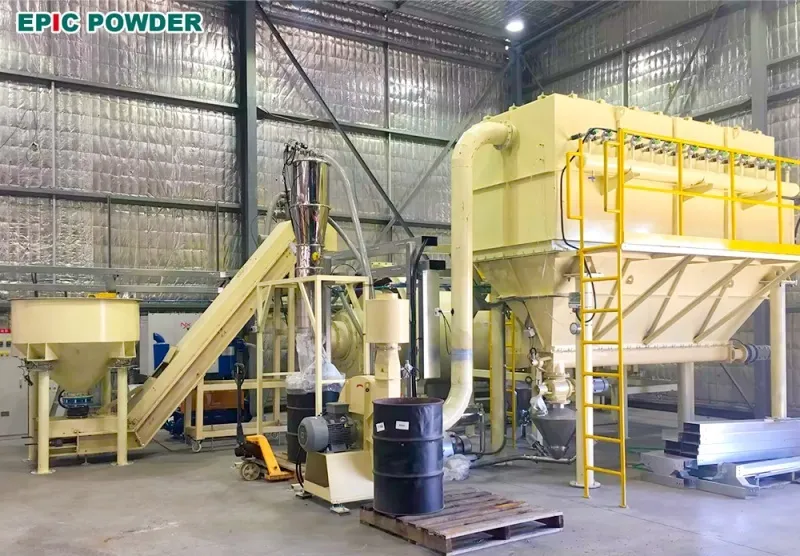
Through high ball-to-powder ratios, multi-stage ball grading, optimized speeds, and scientific selection of wet media, traditional ball mills are fully capable of producing high-quality ultra-fine powders. These powders meet the requirements for laboratory and even pilot-scale production.
However, as industrialization demands narrower particle size distributions and continuous production, ball milling processes will increasingly integrate and complement technologies like Bead Milling or ジェットミリング.
For every engineer engaged in solid-state battery R&D, mastering the “temperament” of the ball mill is vital. Finding that set of “golden parameters” through continuous experimentation is the key to the door of high-performance solid-state batteries.

読んでいただきありがとうございます。この記事がお役に立てれば幸いです。ぜひ下のコメント欄にご意見をお寄せください。また、ご質問等ございましたら、Zeldaのオンラインカスタマーサポートまでお問い合わせください。
— 投稿者 エミリー・チェン