
カラージルコニア:すごくクール!

With the development of electronic communication and improved living standards, colored zirconia ceramics are used more widely in daily life. They are favored for their biocompatibility, excellent metallic luster, and strong mechanical properties. Applications include dental restorations, jewelry, and mobile smart devices. However, adding color to zirconia is not an easy task. Preparation of Colored Zirconium Oxide Currently, the colored zirconia we see on the market mainly presents various colors due to the addition of different rare earth elements, metals, and oxides. The difficulty in preparing colored zirconia lies in the fact that its sintering temperature is typically between 1550°C and 1650°C. At high temperatures, many colorants or coloring agents […]
キャッサバ粉の用途や産業応用についてご存知ですか?

Cassava, also known as manioc, yuca, or manioca, is revered as the “king of starch.” It has a wide range of uses, high yield, and is widely cultivated in tropical regions. Cassava powder is classified into two types based on its uses: edible and industrial. The tubers of edible cassava are rich in starch, making them an important raw material for the pharmaceutical and food industries, as well as a key source for developing biomass. There are over 2,000 industrial products made from cassava. It plays a significant role in crop distribution, animal feed production, and industrial applications, and has become a widely cultivated crop for processing starch and animal […]
負極材料の製造工程の分析

The main types of lithium battery negative electrode materials include graphite-based materials (such as artificial graphite and natural graphite) and non-graphite-based materials (such as silicon-based anode materials). Below is the common production process for these materials: Production Process of Artificial Graphite Negative Electrode Material Pre-treatment Graphite raw materials and asphalt are mixed according to product requirements, such as 100: (5-20). The mixture is transferred to a hopper via a vacuum feeder. From there, it enters an air jet mill for air flow grinding. The raw and auxiliary materials, initially 5-10mm in size, are ground to 5-10 microns. After grinding, a cyclone dust collector is used to gather the desired particle […]
硫酸バリウムは二酸化チタンの代替となり得るか?

The main white pigments used in coatings include titanium dioxide, lithopone, and zinc oxide. Titanium dioxide is divided into rutile and anatase, each with different crystal structures. Rutile titanium dioxide has a dense structure and excellent weather resistance. Anatase is more prone to powdering when used outdoors. Lithopone tends to darken and powder easily due to the presence of zinc sulfide. Zinc oxide is an active pigment. It can cause gelling in water-based coating systems. The main purpose of white pigments in coatings is to provide opacity (covering power). The uniform distribution of titanium dioxide particle size impacts the opacity and color reduction of the coating. Precipitated barium sulfate cannot […]
岩石百科事典:玄武岩

Basalt, one of the most common volcanic rocks on Earth, has become a hotspot of geological research due to its unique properties and wide range of applications. This article will provide a detailed exploration of basalt from multiple dimensions, including its basic information, formation process, and main uses, unveiling the mysteries of basalt. Basic Information of Basalt Basalt is a basic extrusive rock formed when magma from a volcanic eruption cools and solidifies on the surface. It is a type of igneous rock with a dense or foamy structure.Basalts often has a porous, almond-shaped, or porphyritic texture, sometimes containing large mineral crystals. Unweathered basalt is mainly black or gray, but […]
シリコン系陽極材料製造のための主要設備
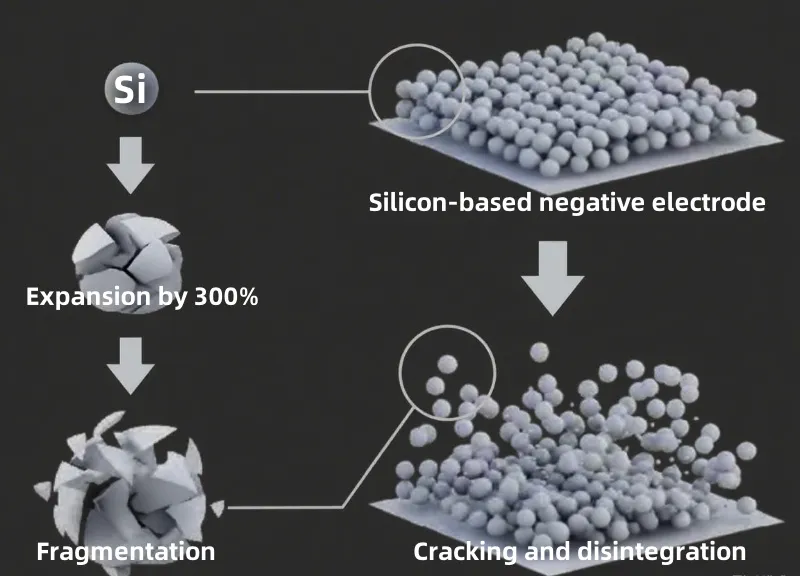
In the production process of silicon-based anode electrodes, special equipment selection and configuration directly affect product quality and production efficiency. Compared with traditional graphite negative electrode production, silicon-based anode electrode production equipment has higher technical requirements. It also has stricter control accuracy. Silicon-oxygen and silicon-carbon negative electrodes have different process characteristics. Their core equipment also differs to some extent. But some general equipment can be shared. The following will detail key equipment and technical characteristics in silicon-based negative electrode production. The Sublimation Furnace System The sublimation furnace system is the core equipment for preparing silicon-oxide anode precursors. It is primarily used for synthesizing silicon monoxide (SiOx). Modern sublimation furnaces typically […]
エネルギー貯蔵に革命を起こす:シリコン酸素アノードのための最先端の製造プロセスと装置

Silicon-oxygen anodes are an important branch of silicon-based anodes. Their production process has unique technical characteristics and requirements. The core raw material is silicon monoxide (SiOx). Its preparation and processing form the foundation of the entire production process. Silicon-oxygen anodes can be classified into three types: regular, pre-magnesium, and pre-lithium. Each type has a different focus in its production process. Preparation of Silicon Monoxide Precursors The preparation of silicon monoxide (SiOx) precursors is the primary step in producing silicon-oxygen anodes. The industrial method for producing SiOx mainly uses high-temperature sublimation. Photovoltaic waste silicon powder and quartz sand are mixed in a weight ratio of 1:1.2 to 2. This mixture is […]
炭素材料の主な3つのカテゴリーとは何ですか?

Carbon is a magical element. As a fundamental building block, it serves as the skeleton element of all living organisms on Earth and is the most important element in the human body. Carbon materials are also unique in their ability to combine opposites and unity. They can be as thin as a hair, as light as a feather, and stronger than steel. Carbon materials are both insulators and conductors, both heat-insulating and heat-conducting, and both fully light-absorbing and fully light-transmitting. This versatility makes carbon materials ever-changing and one-of-a-kind in their properties and applications. The Difference Between “Charcoal” and “Carbon” Carbon refers to materials, which are solid substances with carbon as […]
タルク原石から粉末製品まで―完全概観
Talc is a phyllosilicate mineral, a hydrated magnesium silicate. Pure natural talc is rare, and most of it is accompanied by other mineral impurities. Common associated minerals include chlorite, serpentine, dolomite, tremolite, and calcite. Talc is usually white, light green, slightly pinkish, or light gray in color. The more impurities it contains, the darker the color, ranging from dark gray to black. The talc mineral often appears in foliated, fibrous, or dense block forms, with a pearly or greasy luster. Its Mohs hardness is 1, and its density is about 2.7 g/cm³. Talc has a slippery feel and exhibits a significant thermal effect when heated. It loses adsorbed water between […]