
Cocoa powder is one of the most essential ingredients in chocolate production, baking, and beverage preparation. It not only determines the flavor depth and color intensity but also directly affects the final product’s texture and appearance. Among all the parameters of cocoa powder, the most frequently mentioned distinctions are “Natural Cocoa Powder” and “Dutch-processed Cocoa Powder” (also known as alkali-processed cocoa powder), as well as their particle fineness determined by “Air Classifier Mill” during processing.
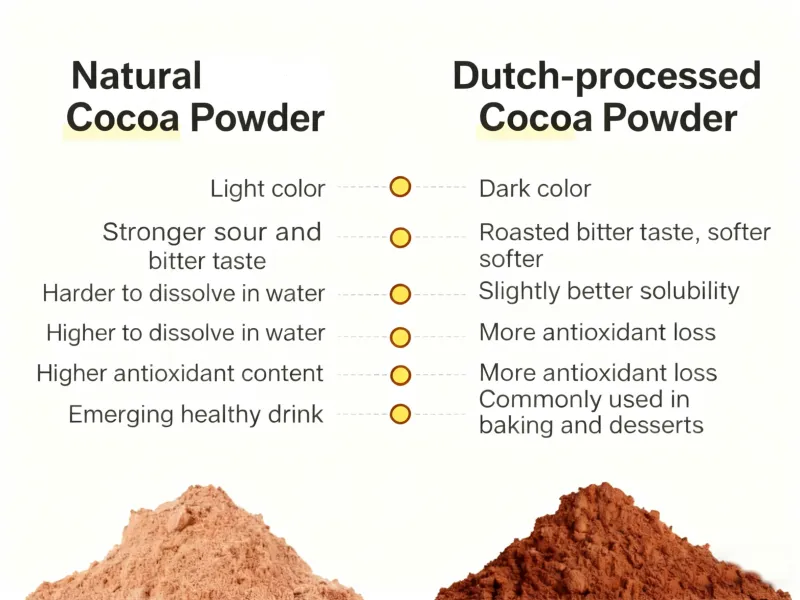
Natural Cocoa Powder
Natural cocoa powder is the closest form to the original flavor of cocoa beans. The production process is relatively simple:
- Roast cocoa beans → Shell removal → Grind into cocoa liquor
- High-pressure extraction of cocoa butter, leaving solid cocoa cake
- Crush, sift, and finely mill the cocoa cake → Obtain natural cocoa powder
Characteristics:
- Color: Light brown to reddish-brown (pH about 5.0–5.8, slightly acidic)
- Flavor: Strong, slightly fruity, with a noticeable bitterness and the original cocoa aroma
- In baking: Contains natural acidity that reacts with baking soda (sodium bicarbonate) to release carbon dioxide, helping cakes rise
Applications: American brownies, chocolate cakes (where baking soda is needed), devil’s food cake, and some traditional European recipes.
Dutch-processed Cocoa Powder
In 1828, Dutchman Coenraad Johannes van Houten invented the Dutching process, forever changing the history of cocoa powder. He treated cocoa cake with potassium carbonate or sodium carbonate solution to neutralize the acidity while allowing chemical changes to occur in the pigments (anthocyanins).
Characteristics:
- Color: Dark brown to almost black (pH about 6.8–8.0 or higher)
- Flavor: Softer and more mellow, with significantly reduced bitterness and acidity, leaving a nutty, caramel-like aftertaste
- In baking: Almost no reaction with baking soda, usually paired with baking powder
Dutching Levels:
- Lightly Dutched: Reddish-brown color, retains some natural flavor
- Moderately Dutched
- Heavily Dutched: As used in Oreo cookies with “black cocoa powder,” extremely dark in color
Applications: European-style chocolate cakes, mousses, hot chocolate drinks, and desserts needing a dark appearance (such as Oreo-flavored cookies).
Air Classifier Mill: The Invisible Hero of Taste

Whether natural or Dutch-processed, the particle fineness is a key indicator of quality, which involves “graded milling” technology.
Traditional cocoa powder fineness usually passes 99.0%–99.5% through a 200-mesh sieve (about 74 microns), but high-end brands achieve:
- 99.9% passing through 200 mesh
- Even 99.97%–99.99% passing through 325 mesh (about 44 microns or below)
The Finer the Particles:
- Dissolves faster in the mouth, creating a smoother texture
- Better dispersibility in liquids, not prone to clumping
- Hot chocolate with almost no gritty texture
Examples:
- Regular supermarket cocoa powder: Fineness 98–99%, slight grittiness when mixed
- Professional baking cocoa (like Cacao Barry Extra Brute): Over 99.9%, extremely smooth
- Top-quality hot chocolate powder: Fineness up to 99.99%, nearly “zero-grit”
How to Choose? A Quick Reference Table
| Need Scenario | Recommended Type | Typical Leavening Agent | Color Requirement |
|---|---|---|---|
| American Brownies, needing acidity | Natural Cocoa Powder | Baking Soda | Light reddish-brown |
| European dark cakes, mousses | Moderately to Heavily Dutched | Baking Powder | Dark brown to black |
| Hot chocolate drinks | Heavily Dutched + Ultra-fine Milling | None required | Deep black |
| For the most original flavor | Natural + High Fineness | Baking Soda | Red-brown |
Conclusion
Natural and Dutch-processed cocoa powder are not a matter of “which is better,” but “which is more suitable.” Natural cocoa retains the raw, wild essence of cocoa, while Dutching makes it smoother and more approachable. Regardless of the type, only those meticulously graded and milled can truly be considered “premium cocoa powder.” Next time you write “20g cocoa powder” in your recipe, think about whether you want that raw acidic punch or the velvet-smooth depth. The answer lies in every finely ground particle.

“Thanks for reading. I hope my article helps. Please leave a comment down below. You may also contact Zelda online customer representative for any further inquiries.”
— Posted by Emily Chen