
Project Background
Denmark is recognized worldwide as a leading source of high-quality diatomaceous earth (diatomite). This material features high purity, an excellent porous structure, and low crystalline silica content. It also offers superior adsorption and filtration performance. Consequently, it is widely used in food-grade filter aids, functional fillers, and cosmetic raw materials. It also serves as a key component in environmental adsorption products, high-end coatings, and pesticide carriers.
A well-known Danish diatomite deep-processing company aimed to increase the added value of its raw ore. Their goal was to upgrade conventional 325–1250 mesh products to an ultrafine level (D50 around 5–6 μm) to target the high-end functional materials market. Achieving this fineness placed extreme demands on the equipment. The system required high grinding precision, strict particle size distribution control, and consistent production stability. Most critically, the Diatomaceous Earth ultrafine grinding equipment had to preserve the material’s structure by avoiding the destruction of the diatom shell’s delicate porous architecture.
Equipment Selection & Technical Solution
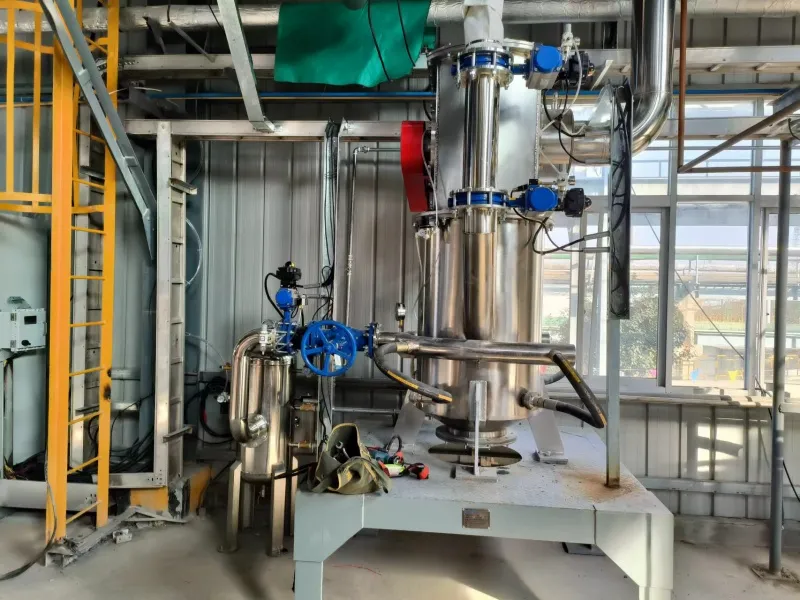
After multiple rounds of comparative trials and process validation, the customer ultimately selected the MQW Series Fluidized Bed Opposed Jet Mill from EPIC Powder Machinery as the core Diatomaceous Earthiatomaceous Earth ultrafine grinding equipment.
Key operating parameters (stable field data):
- Final product fineness:D50 = 5.2 μm
- Throughput:280 kg/h (stable measured value)
- Feed size:D50 ≈ 15–25 μm (pre-processed by Raymond mill or cyclone mill)
- Compressed air pressure:0.8–1.0 MPa
- Main wear parts:Ceramic lining (alumina or silicon nitride optional) + high-precision turbine classifying system
- System configuration:MQW jet mill main unit + high-precision classifier + efficient cyclone + bag filter + intelligent PLC control system
Core Technical Advantages Demonstrated
1. Precise Particle Size Control and Narrow Distribution
The MQW series combines fluidized bed opposed jet milling with an integrated high-precision dynamic classifying wheel. This setup delivers excellent D97 control. In this project, the product achieved a very uniform distribution (D50 = 5.2μm , D90≈ 12.5 μm, D10 ≈1.8 μm). This perfectly meets strict requirements for a “sharp fine peak with minimal coarse particles.”
2. Protection of Porous Structure
Jet milling relies primarily on high-speed particle-to-particle collisions. This process involves virtually no media wear or mechanical shear heat. Because the temperature rise is minimal (< 15°C), the system prevents the collapse of diatom frustules. This preserves the maximum specific surface area and maintains high filtration performance.
3. Balanced High Capacity and Low Energy Consumption
Achieving a stable 280 kg/h output at such fineness is possible through EPIC’s optimized Laval nozzle design and large-flow classifying wheel. Compared with conventional jet mills, this system increases capacity by approximately 25–35% while maintaining the same energy consumption.
4. High Purity and Clean Production
Critical contact parts are lined with wear-resistant ceramics. Additionally, the system uses full stainless steel construction. This keeps metal contamination at extremely low levels, complying with stringent food-grade and cosmetic-grade purity requirements.
Customer Actual Feedback (After 6 Months of Operation)
- Extremely high product consistency — batch-to-batch D50 variation < 0.3 μm
- Filtration performance improved by approximately 40–50% compared with the previous 325 mesh product, showing outstanding results in beer and fruit juice filtration applications
- Energy consumption reduced by about 18% compared with a previously imported European-brand jet mill of similar specification
- Long maintenance intervals — ceramic liners have exceeded 4,500 hours of operation with no obvious wear