
3D-printen met poederbedtechnologie verlaat het prototype-laboratorium en gaat over naar serieproductie. Het poeder dat deze printers voedt, is de snelstgroeiende schakel in die toeleveringsketen. Volgens Global Market Insights groeide de markt voor additieve productie met metaalpoeders van 650,8 miljoen dollar in 2025 naar naar schatting 813,8 miljoen dollar in 2026, met een verwachte omzet van 2,9 miljard dollar in 2035 en een samengestelde jaarlijkse groei van 15,4 procent. Poeder is tevens de dominante materiaalsoort, met een aandeel van 63,7 procent in de markt voor 3D-metaalprinten in 2026, waarbij poederbedfusie een toonaangevende technologie is.
Die groei legt de lat hoger voor de poederkwaliteit. Een printer kan immers maar zo goed zijn als het poeder dat hij gebruikt. Poeder dat te grof is, een te grote korrelgrootte heeft of verontreinigd is, resulteert in ruwe oppervlakken, zwakke lagen of mislukte prints. Naarmate de productievolumes toenemen, zijn deze defecten geen klein ongemak meer voor het laboratorium, maar een reëel kostenprobleem.
Dit is waar de straal molen Het is hét standaardgereedschap om poedervormig uitgangsmateriaal om te zetten in het fijne, schone, printklare poeder waar poederbed 3D-printers en hun gebruikers op vertrouwen.
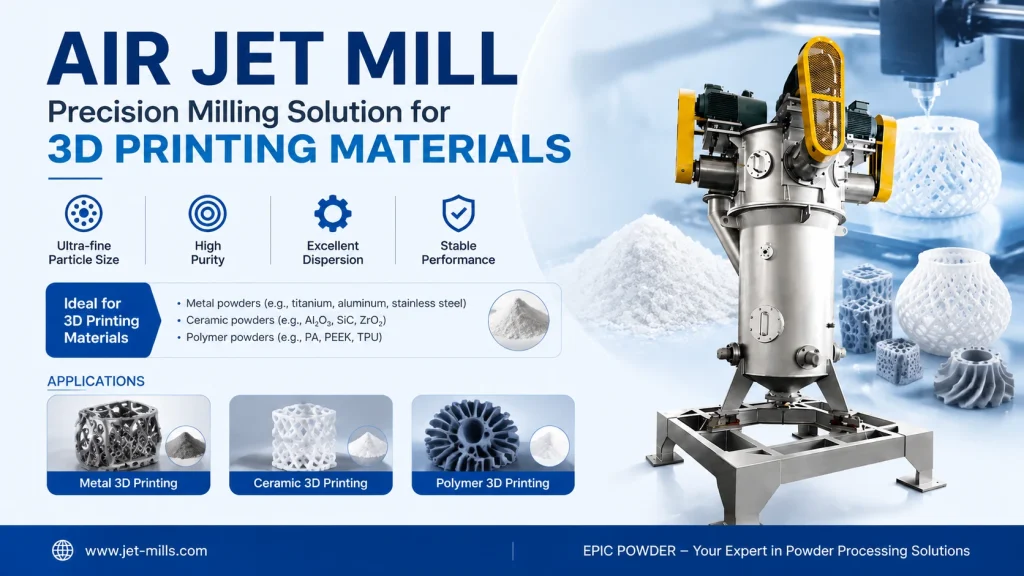
Wat is een 3D-printmateriaalstraalfrees?
De term combineert twee ideeën, dus het is handig om ze van elkaar te scheiden.
Het eerste aspect is het 3D-printmateriaal. Poederbedprocessen zoals selectief lasersmelten (SLM), direct metaallasersinteren (DMLS) en binder jetting bouwen allemaal onderdelen op uit een poederbed. Het poeder wordt in dunne lagen verspreid en vervolgens gesmolten door een laserstraal, een elektronenstraal of een bindmiddel. Omdat elke laag dun is, moet het poeder binnen een gecontroleerde grootte vallen. Metaalpoeders voor lasersystemen hebben doorgaans een grootte tussen 15 en 45 micron. Polymere poeders voor SLS hebben meestal een grootte van 40 tot 80 micron. De deeltjes moeten ook nagenoeg bolvormig zijn, zodat ze gelijkmatig vloeien en zich goed verpakken.
Het tweede idee is de straalmolen. Een straalmolen, ook wel vloeistofenergiemolen genoemd, gebruikt perslucht, stikstof of een ander gas in plaats van maalkogels. Het gas wordt met supersonische snelheid door sproeiers geperst, waardoor de deeltjes versnellen totdat ze met elkaar botsen. Deze botsingen tussen de deeltjes breken het poeder af tot fijnere deeltjes. Een sorteerwiel in de machine sorteert de output, waarbij fijne deeltjes worden afgevoerd en grove deeltjes worden teruggevoerd voor een volgende maalgang. Er komen geen metalen maalonderdelen in contact met het poeder, waardoor er geen slijtage van de maalkogels en geen kruisbesmetting optreedt.
Combineer die twee en je krijgt een 3D-printmateriaal-jetmill, een machine die de deeltjesgrootte van printpoeder verfijnt en verkleint, terwijl het proces schoon en gecontroleerd blijft. De machine neemt een vernevelde of gemalen grondstof en levert een poeder dat gelijkmatig verspreidt en consistent smelt.
Twee veelgestelde vragen over straalfrezen voor 3D-printpoeders
Welke deeltjesgrootte heeft een 3D-printpoeder nodig, en waarom is de deeltjesgrootteverdeling zo belangrijk?
De exacte streefwaarde hangt af van de printer. Metaalpoeders voor lasersystemen hebben over het algemeen een deeltjesgrootte van 15 tot 45 micron, met strengere specificaties voor fijn detailwerk. Polymeerpoeders voor SLS hebben meestal een deeltjesgrootte van 40 tot 80 micron. Net zo belangrijk als de mediane deeltjesgrootte is hoe smal de spreiding is.
Een poeder met een breed deeltjesgroottebereik veroorzaakt zichtbare problemen. Wanneer de rol of het mes van de poedercoater een laag van 20 tot 50 micron aanbrengt, sleept elk deeltje dat groter is dan de laag door het bed en laat strepen en holtes achter. Te fijne deeltjes kunnen weggeblazen worden of ongelijkmatig oxideren. Een smalle deeltjesgrootteverdeling, gedefinieerd door een kleine kloof tussen D10 en D90, zorgt ervoor dat elke laag zich vlak verspreidt en met een vergelijkbare snelheid smelt. Dat is het verschil tussen een dicht onderdeel met een glad oppervlak en een poreus onderdeel dat de inspectie niet doorstaat.
Kan een straalmolen reactieve of warmtegevoelige 3D-printpoeders beschermen?
Ja, en dit is een van de belangrijkste redenen waarom straalmalen wordt gebruikt in plaats van mechanisch malen. Een straalmaler kan werken op stikstof of argon in een gesloten circuit, waardoor reactieve metalen zoals titanium worden afgeschermd van zuurstof. Het gas zet ook uit wanneer het de spuitmond verlaat, en die uitzetting koelt de maalzone af. Hierdoor kunnen warmtegevoelige en oxidatiegevoelige poeders zoals titaniumlegeringen, aluminium en bepaalde polymeren worden verkleind zonder oververhitting of degradatie.
Omdat er geen maalkogels aanwezig zijn, voegt de molen vrijwel geen metaalverontreiniging toe. Met keramische of siliciumcarbide voeringen kunnen straalmolens de metaalverontreiniging onder de 5 ppm houden, wat belangrijk is voor poeders van medische, ruimtevaart- en sieradenkwaliteit waar zuiverheid een essentieel onderdeel van de specificaties is.
Waarom straalfrezen de kwaliteit van 3D-printpoeder verbetert
Voor een technicus of een koper is het voordeel van een straal molen Het voordeel ten opzichte van andere methoden voor het verkleinen van de omvang komt neer op vier punten.
- Smalle en instelbare deeltjesgrootte. De gasdruk, de toevoersnelheid en de snelheid van het classificatiewiel bepalen de uiteindelijke D50 en de breedte van de verdeling. Eén machine kan aan verschillende specificaties voor verschillende printers voldoen.
- Geen besmetting. Door het malen zonder maalmiddel blijft het poeder schoon, en het gebruik van inert gas beschermt het tegen oxidatie. Het resultaat is een poeder dat voldoet aan strengere zuiverheidseisen.
- Verwerking bij lage temperaturen. Het koelende effect van gasexpansie voorkomt warmteophoping, waardoor de eigenschappen van warmtegevoelige en reactieve materialen behouden blijven.
- Consistente batches. Het malen en sorteren worden in één bewerking gecombineerd, en dankzij inline zeven en maatcontrole blijven de resultaten van batch tot batch consistent. Voor een inkoopteam betekent die herhaalbaarheid minder verrassingen op de productievloer.
Deze voordelen worden steeds belangrijker naarmate poederbedprinten wordt opgeschaald van prototypes naar serieproductie. Gladde, dichte oppervlakken zijn nu essentieel voor duizenden onderdelen, niet slechts voor een handvol proefexemplaren. Bij poederbedprinten begint die oppervlaktekwaliteit met poeder dat zich gelijkmatig verspreidt en samensmelt, en dat is precies wat smalle, schone deeltjes leveren.
Hoe produceer je 3D-printpoeder met een straalmolen?
Het proces is eenvoudig zodra de parameters zijn ingesteld. Zo verloopt een typische productierun.
Stap 1. Kies de freesmachine en het doel. Selecteer een wervelbedfreesmachine met tegengestelde jets die qua formaat geschikt is voor uw output, en definieer het vereiste D50- en D10/D90-bereik voor de beoogde printer, of dit nu SLM, DMLS, SLS of binder jetting is.
Stap 2. Bereid de grondstof voor. Begin met een verneveld of voorgemalen poeder en controleer het vochtgehalte. Vochtige of geoxideerde grondstof stroomt niet goed door de molen en kan het uiteindelijke poeder bederven.
Stap 3. Stel de maalparameters in. Pas de gasdruk, de toevoersnelheid en de snelheid van het classificatiewiel aan. Een hogere druk en een lagere toevoersnelheid produceren fijner poeder. De snelheid van het classificatiewiel bepaalt het snijpunt van het poeder dat de kamer verlaat.
Stap 4. Selecteer het procesgas. Gebruik perslucht voor niet-reactieve materialen. Schakel over op stikstof of argon in een gesloten circuit voor titanium, aluminium en andere reactieve of oxidatiegevoelige poeders.
Stap 5. Malen en sorteren. Laat het poeder door de molen lopen. Fijne deeltjes passeren de sorteerder en worden opgevangen, terwijl grove deeltjes terugkeren voor een tweede doorgang in hetzelfde gesloten systeem.
Stap 6. Verifiëren en vastleggen. Controleer de output met laserdiffractie voor de deeltjesgrootte, en voer indien nodig zeef-, stroom- en zuurstofmetingen uit. Registreer de batch voor traceerbaarheid, met name voor metaalpoeders die in gereguleerde industrieën worden gebruikt.
Twee praktijkvoorbeelden
Geval 1. Sieradenmetaalpoeder
Een Europees atelier voor op maat gemaakte sieraden, dat overstapte van machinaal gemalen naar straalgemalen titanium- en goudpoeder, meldde een verbetering van 40 procent in de printresolutie en vrijwel geen mislukte prints meer. Het fijnere, schonere poeder maakte delicate filigraan-, raster- en holle ontwerpen mogelijk die met gieten en CNC-bewerking niet te realiseren waren.
Casus 2. Titaniumlegeringspoeder voor SLM
Bij het vermalen met inert gas kan titaniumlegeringspoeder worden verkleind en geclassificeerd tot een deeltjesgrootteverdeling rond D10 (18 tot 22 micron), D50 (30 tot 40 micron) en D90 (50 tot 60 micron). Deze smalle band is gelijkmatig verdeeld en compact, wat zorgt voor een hogere dichtheid van de onderdelen en gladdere oppervlakken bij laserpoederbedfusie.
Als je een nodig hebt straal molen Voor de productie of verfijning van 3D-printpoeders kunt u contact opnemen met Qingdao EPIC Powder Machinery. Wij ontwerpen wervelbed-straalmolens voor metaal-, polymeer- en keramische poeders en kunnen proefmalen uitvoeren op uw materiaal.
Episch poeder
Epic Powder heeft meer dan 20 jaar ervaring in de ultrafijnpoederindustrie. Wij zetten ons actief in voor de toekomstige ontwikkeling van ultrafijn poeder, met een focus op het breken, malen, classificeren en modificeren ervan. Neem contact met ons op Vraag een gratis adviesgesprek en oplossingen op maat aan! Ons team van experts zet zich in voor het leveren van hoogwaardige producten en diensten om de waarde van uw poederverwerking te maximaliseren.
Qingdao EPIC Powder Machinery Co., Ltd. | www.epicmilling.com

“"Bedankt voor het lezen. Ik hoop dat mijn artikel nuttig is. Laat gerust een reactie achter. Voor verdere vragen kunt u ook contact opnemen met Zelda, een medewerker van de online klantenservice van EPIC Powder."”
— Jason Wang, Ingenieur
Fout: Contact formulier niet gevonden.