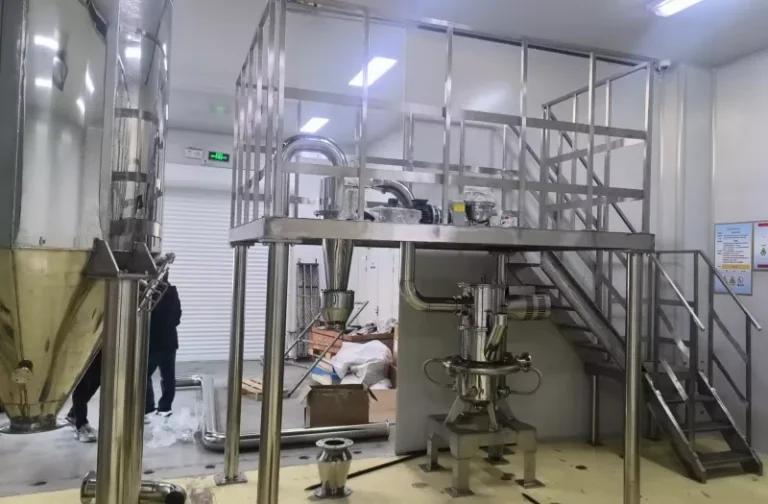
MQP-schijfstraalmolen, ook wel spiraalstraalmolen genoemd, het basisprincipe is: gebruik de negatieve druk die wordt gegenereerd door perslucht om het materiaal in de trechter in de vlakke maalkamer te zuigen; De hogesnelheidsluchtstroom (sonische snelheid of zelfs supersonische snelheid) botst en verplettert elkaar, en de materialen die een bepaalde deeltjesgrootte bereiken, zullen het midden van de maalkamer naderen als gevolg van de vermindering van de middelpuntzoekende kracht, en zullen worden afgevoerd uit de maalkamer met de luchtstroom en ga vervolgens de cycloon en stofafscheider in.
Wervelbed-tegen-luchtstraalmolen: Nadat de perslucht is gefilterd en gedroogd, wordt deze met hoge snelheid via het Laval-mondstuk in de maalkamer gespoten. Op het kruispunt van meerdere hogedrukluchtstromen worden de materialen herhaaldelijk tegen elkaar aan gebotst, gewreven en gescheurd om te worden verpletterd. De verpletterde materialen stijgen met de zuigkracht van de ventilator. De luchtstroom beweegt naar de classificatiezone. Onder invloed van de sterke middelpuntvliedende kracht die wordt gegenereerd door de snel roterende classificatieturbine, worden de grove en fijne materialen gescheiden. De fijne deeltjes die aan de vereisten voor de deeltjesgrootte voldoen, komen via het classificatiewiel de cycloonafscheider en de stofafscheider binnen om te worden verzameld, en de grove deeltjes dalen af naar de breekzone en worden verder verpletterd.
| Parameter/model | MQP01 | MQP02 | MQP03 | MQP06 | MQW10 | MQW15 | MQW20 | MQW30 | MQW40 | MQW60 |
|---|---|---|---|---|---|---|---|---|---|---|
| Voedingsgrootte (mm) | < 2 | < 2 | < 5 | < 2 | < 3 | < 3 | < 3 | < 3 | < 5 | < 5 |
| Deeltjesgrootte (D97: μm) | 8~150 | 8~150 | 8~150 | 8~150 | 8~100 | 8~150 | 8~150 | 10~150 | 10~150 | 10~150 |
| Productiecapaciteit (kg/u) | 5~15 | 5~100 | 10~200 | 20~400 | 50~800 | 150~1500 | 300~2000 | 150~1500 | 300~2000 | 300~2000 |
| Luchtverbruik (m³/min) | 1 | 2.5 | 3 | 6 | 10 | 15 | 20 | 30 | 40 | 60 |
| Luchtdruk (MPa) | 0.7~0.85 | 0.7~0.85 | 0.7~0.85 | 1.0~0.85 | 0.7~0.85 | 0.7~1.0 | 0.7~0.85 | 0.7~0.85 | 0.7~0.85 | 0.7~0.85 |
Opmerking: De productiecapaciteit hangt nauw samen met de deeltjesgrootte, het soortelijk gewicht, de hardheid, het vocht en andere indicatoren van de grondstoffen. Het bovenstaande is alleen ter selectiereferentie.
By working with a tolling partner’s technical team, you will gain efficiency. They will help choose the best mill type. They will also pick the right speed and feed rate. They will also cover any special project needs.
The team brings focused insights and extensive experience to the table. However, you should also expect to provide safety data sheets and answer a few questions, such as:
A jet mill is a type of ultrafine grinding equipment. It is a machine that uses a lot of energy. Therefore, the feed particle size of the air flow mill should be as fine as possible. It is recommended that the feed particle size be less than 80 mesh. Under normal circumstances, the feed particle size needs to be less than 1 mm.
Jet milling usually makes particles that are 1 to 10 microns in size. This is referred to as micronization.
Some product formulations require particles as small as 200 nanometers. The material's properties determine how small these sizes can be. You can make them smaller by increasing the mill's power. Additionally, by increasing the time the material spends in the milling chamber.
Some products require particles larger than 10 microns. This can be achieved by reducing the power to the mill or increasing the feed rate to the equipment.
In both circular and fluidized bed mills, jets of air or steam are made by gas. The gas is compressed to a gauge pressure of 50 to 120 psig. The most common gas used is commercially compressed air.
Superheated steam (392–980°F) is compressed to 100–220 psig. It can also be used on raw feed materials that are not heat-sensitive. Some of the other gases used include:
Nitrogen, which can protect materials from oxidation and/or fire
Argon, another inert option, though more expensive than nitrogen
Helium, used to achieve higher-velocity impact between particles
A great deal of energy is needed to create enough momentum to cause particles to break on impact. The compressor and nozzles turn high air pressure into energy. They do this within the mill. Large particles recirculate, and multiple high-velocity collisions progressively reduce their mass.
WhatsApp ons
Vul dan onderstaand formulier in.
Onze experts nemen binnen 6 uur contact met u op om uw wensen op het gebied van machines en processen te bespreken.
Fout: Contact formulier niet gevonden.