
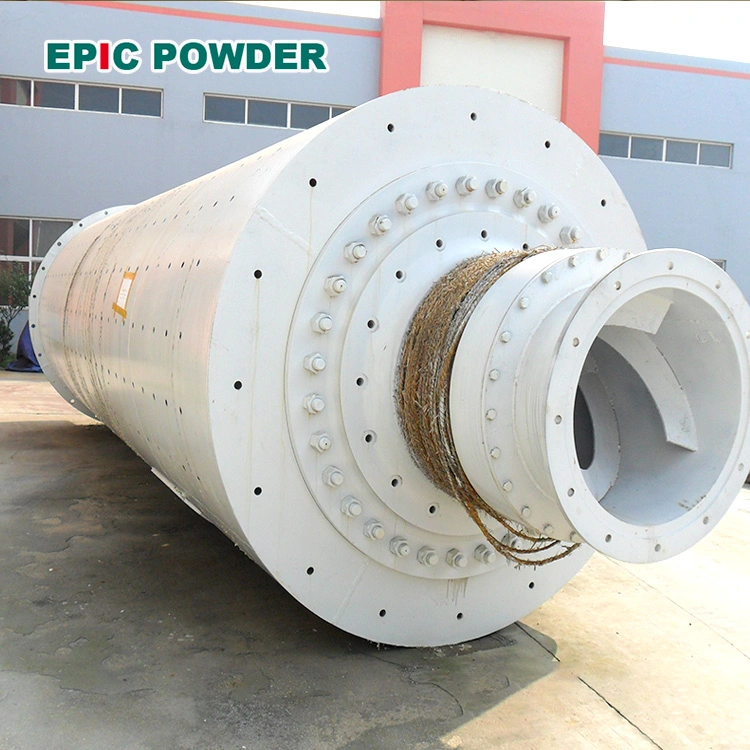
Common methods for preparing silicon-carbon negative electrode materials include mechanical ボールミル, spray drying, chemical vapor deposition (CVD), etc. Mechanical ball mill crushes bulk materials into fine particles by colliding with rotating balls. The process is simple and the cost is low, but the particle agglomeration phenomenon is serious. In addition, excessive grinding will destroy the crystallinity and surface of graphite, leading to side reactions.
Spray drying is to use heated gas to quickly dry liquid solutions to make dry powders. It is simple, continuous and scalable, but this method has high energy consumption and high instrument requirements.
CVD is a process in which gaseous or vaporous substances react in the gas phase or gas-solid interface to generate solid deposits. This method has relatively low equipment requirements, simple and controllable processes, and can achieve high-quality deposition. At the same time, it has strong scalability and is easy to industrialize. Silicon-carbon negative electrode materials prepared by CVD usually have high first charge and discharge efficiency and good cycle stability, showing great development prospects.
The CVD method is used to prepare silicon-carbon negative electrode materials. The main process is: feeding → activation → silicon deposition → carbon deposition → mixing → electromagnetism removal → screening → packaging.
Feeding
The porous carbon raw material is used as a precursor and is fed into a feeding system. The feeding system uses a negative pressure pumping method to transport the raw material to a reactor in the next process through a closed pipeline for activation.
Activation
The feeding system uses negative pressure pumping to deliver porous carbon into the reactor through a closed pipeline. Then, nitrogen protective gas is introduced into the reactor, and the temperature is gradually raised to the activation temperature (800-1000°C) and kept for 10 hours. Under nitrogen protection, the carbon is oxidized to obtain a porous carbon skeleton.
Deposited Silicon
After the activation reaction, a porous carbon skeleton material is obtained. It is transported to a chemical vapor deposition furnace, and then nitrogen protective gas is introduced, and the temperature is gradually raised to the temperature required for the deposition reaction (400~800℃) and kept warm for 5~10h. During the nitrogen protection and insulation period, silane gas is introduced into the high-temperature furnace for decomposition. The autoignition temperature of silane is 435℃.
Most of the silane gas can self-ignite in the furnace, and there will be no large amount of silane gas leakage. The furnace ensures negative pressure cracking, and no explosion area is formed outside the high-temperature furnace. When silane decomposes, the porous carbon skeleton stays in the high-temperature furnace, and the silane gas undergoes high-temperature decomposition to generate nano-silicon. The nano-silicon particles are deposited on the surface of the porous carbon skeleton and embedded in the gaps of the porous carbon skeleton to realize the silicon deposition process. After the silicon deposition is completed, the silane is turned off.
The chemical reaction equation involved in the silicon deposition process is: SiH4→Si+2H2↑
Mixing
After the silicon deposition is completed, the silicon-carbon composite material obtained enters the mixer through a closed pipeline pumped by negative pressure. The materials are mixed evenly to improve the uniformity of the batch. The materials are mixed for about 1 hour under the high-speed operation of the mixer to achieve a fully mixed effect. The mixer is fully enclosed, and no dust is generated during the transportation and mixing process. Only a small amount of feeding dust will be generated when the materials enter the feeding area for feeding. The dust and waste gas of the feeding process are collected, treated and discharged together.
Electromagnetic Demagnetization
Considering that the raw materials may contain a small amount of magnetic substances such as iron. The presence of magnetic substances will seriously deteriorate the cycle performance and safety performance of lithium-ion batteries. Therefore, the prepared silicon-carbon composite material needs to be demagnetized and needs to enter the demagnetizer for magnetic separation.
Screening
The demagnetized material is pneumatically conveyed through a sealed pipe to a vibrating screen for screening. Then the large particles in the material are removed.
Detection
The qualified materials are sampled and tested. The unqualified products are treated as general solid waste together with the unqualified materials in the screening process.
Packing and Warehousing
The qualified products are sent to the automatic packaging system and sealed by the sealing machine. The materials go directly into the packaging bag through the pipeline, which is a closed package.
エピックパウダー
Epic Powderは、超微粉末業界で20年以上の実績を誇ります。超微粉末の粉砕、研磨、分級、改質プロセスに注力し、超微粉末の将来的な発展を積極的に推進しています。無料相談とカスタマイズソリューションについては、お気軽にお問い合わせください。当社の専門チームは、お客様の粉体加工の価値を最大限に高めるため、高品質な製品とサービスを提供することに尽力しています。Epic Powder ― 信頼できる粉体加工のエキスパート!
エラー: コンタクトフォームが見つかりません。