
Bentonite is widely acclaimed as the “Universal Clay,” with its core mineral constituent being Montmorillonite. This layered silicate, forged from volcanic ash over millions of years, spans two vastly different worlds: from $10-a-bag cat litter to high-precision chemical additives. This versatility is not merely a result of its natural chemistry, but rather a masterpiece of human engineering in bentonite ultrafine grinding and surface chemical modification.
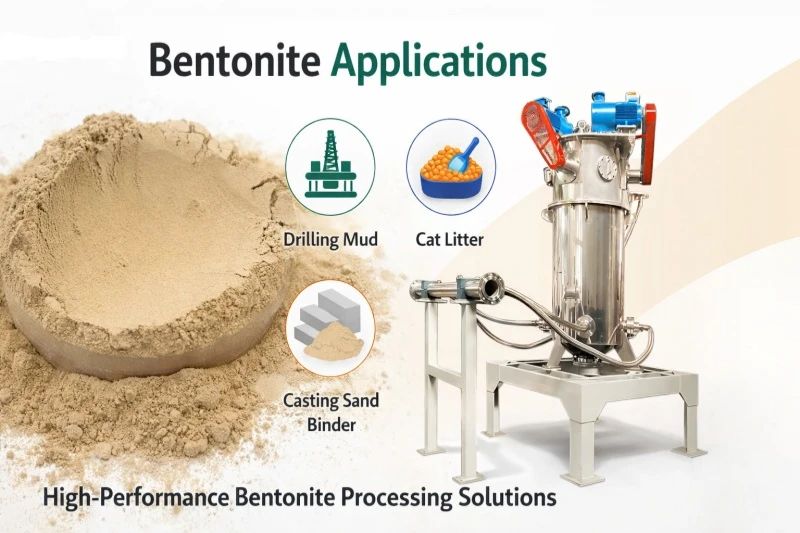
I. Natural Bentonite: The “Super Sponge” Defined by Scale
The performance of natural bentonite depends heavily on its Specific Surface Area (SSA) and Cation Exchange Capacity (CEC). By applying mechanical crushing and precise classification, bentonite is processed into various dimensions to meet demands ranging from macro-absorption to micro-carriers.
1. Macro-Scale (1.0 – 4.0 mm): The Clumping Expert
In the pet care sector (cat litter), the focus is on granulation technology and dust suppression.
- Physical Mechanism: It utilizes the capillary action between granules and the interlayer adsorption within the montmorillonite crystal lattice.
- Process Essentials: Premium cat litter must be strictly screened to 1–4 mm using crushers and vibrating screens. This ensures high clump strength (to prevent breakage) while using dedusting equipment to minimize respiratory irritation for pets.
2. Micro-Scale (200 – 1250 Mesh): The Industrial “Purifier”
As bentonite is ground to 10μm – 75μm , its hidden surface area begins to unlock.
- Skincare & Pharmaceuticals: In clay masks or medicinal ointments, micron-sized particles penetrate pores to physically adsorb excess oils and toxins.
- Refining & Clarification: In the processing of fruit juices, wines, and vegetable oils, its electronegativity is harnessed to adsorb impurities, proteins, and pigments.
- Processing Equipment: This stage typically employs Raymond Mills or Vertical Roller Mills. To achieve higher purity, hydro-classification (wet beneficiation) is often used to remove “hard” impurities like quartz and feldspar, preventing wear on downstream equipment.
II. Advanced Processing: Ultra-Fine Grinding and the “Invisible Skeleton”
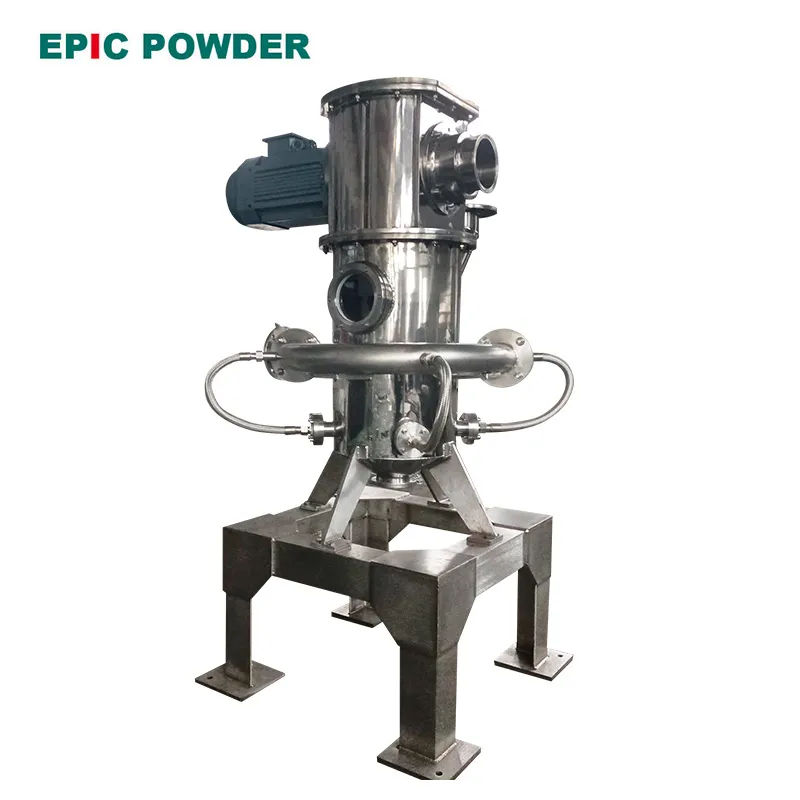
In the realms of high-end coatings, composite materials, and precision inks, standard micron-level powders fall short. Here, bentonite ultrafine grinding is introduced to push the material into the “Nano-World,” utilizing the Exfoliation effect to fundamentally alter the rheology of substances.
1. The Core of Thixotropy: Nano-Layer Delamination
The secret to paint that is “easy to brush” yet “non-sagging” lies in completely breaking down the stacked structure of montmorillonite.
- Ultra-Fine Process: Utilizing Fluidized Bed Jet Mills or Mechanical Impact Mills. Jet milling uses supersonic air streams to cause particle-on-particle collisions, compressing the size to under 1–5 μm without metallic contamination.
- “House of Cards” Structure: In a solvent, nano-scale montmorillonite platelets carry a positive charge on the edges and a negative charge on the planes.
- At Rest: Electrostatic attraction builds a 3D “House of Cards” network that locks the liquid in place.
- Under Stress: Shearing forces cause the network to align parallel instantly, causing viscosity to drop for easy application.
2. Enhanced Composites: Strengthening Physical Properties
In polymer engineering, ultra-fine bentonite acts as a nano-filler to significantly improve flame retardancy and gas barrier properties. The extreme fineness ensures uniform distribution, creating a dense “nano-barrier” that slows oxygen penetration and flame spread.
III. Modification Equipment: The Chemical “Tailoring” of Powders
Natural bentonite is inherently hydrophilic (water-loving), whereas modern industrial systems (synthetic resins, inks, oil drilling) are largely organic/oil-based. Following bentonite ultrafine grinding, the clay must undergo Surface Modification to bridge this gap.
1. The Chemistry of Organoclay
By exploiting the exchangeable cations between the montmorillonite layers, Quaternary Ammonium Salts or other surfactants are introduced via modification equipment.
- Polarity Reversal: The hydrophilic “head” of the modifier bonds with the clay surface, while the long-chain organic “tail” extends outward, transforming the clay from “oil-fearing” to “oil-loving.”
- Interlayer Expansion: Post-modification, the d-spacing expands from 1.2 nm to 2.5 – 4.0 nm, enabling exfoliative dispersion in organic solvents.
2. Comparison of Key Modification Equipment
- Wet Modification (Reactor Vessels / Colloid Mills):
- Process: Conducted in a water-slurry state; modifiers are added under agitation and heat to complete ion exchange.
- Advantage: Extremely thorough reaction, ideal for High-Purity Organoclays used in premium cosmetics and electronics coatings.
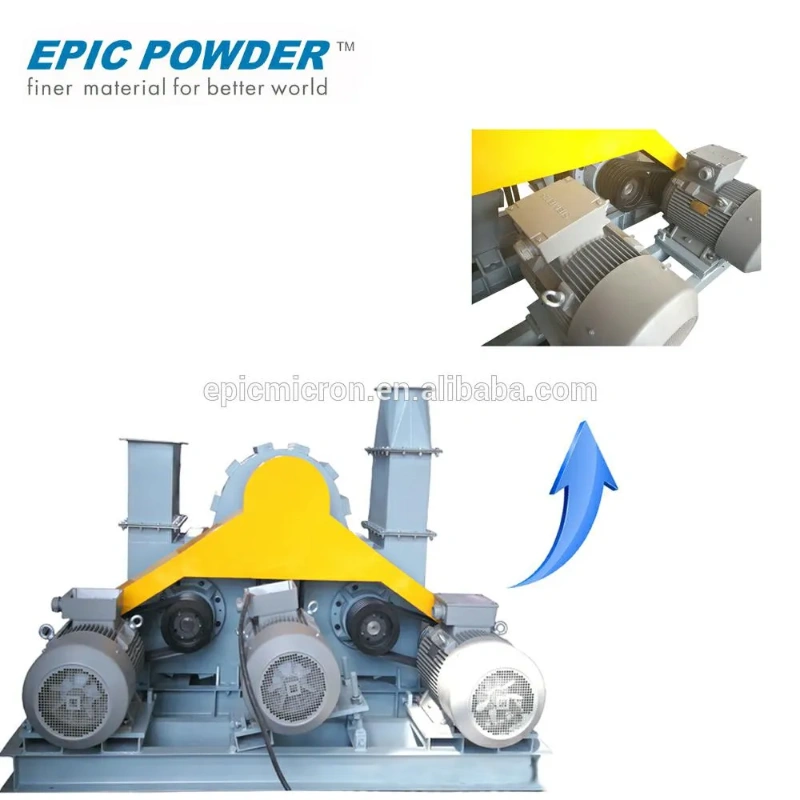
- Dry Modification (High-Speed Continuous Modifiers / Honeycomb Mills):
- Process: Utilizing a Honeycomb Mill to perform ultra-fine grinding and chemical spraying simultaneously.
- Advantage: Integrates grinding, drying, modification, and dispersion. The mechanochemical effect generates localized high temperatures that “activate” the powder surface, ensuring a firm coating of the modifier. This is highly efficient for construction and oil-drilling grades.
IV. Summary: The Value Chain of Material Transformation
The leap from raw ore to high-end additive is a journey of Spatial Scale and Interface Engineering:
| Grade | Physical Form | Core Equipment | Key Metrics | End-Use Applications |
| Basic | Granules / Coarse Powder | Crushers, Raymond Mills, Kilns | Particle Size, Methylene Blue Adsorption | Cat litter, Casting, Civil engineering |
| Fine | Ultra-fine Powder | Jet Mills, Hydro-classifiers | Specific Surface Area, Whiteness | Paper coating, Food decolorization, Pharma |
| High-End | Organomodified Clay | Reactors, Honeycomb Mills, Filter Press | d-spacing (d001), Viscosity | Aerospace coatings, Precision inks, Shale gas |
Through the precision of bentonite ultrafine grinding and the magic of chemical modification, this humble clay—with an addition rate of usually only 1%—5%—serves as the “invisible skeleton” supporting the modern industrial world.

“Thanks for reading. I hope my article helps. Please leave a comment down below. You may also contact Zelda online customer representative for any further inquiries.”
— Posted by Emily Chen