
In recent years, new material development has accelerated worldwide. Materials research is moving toward extreme states and higher performance. Among emerging materials, ultrafine powders have attracted significant attention.
Current research on ultrafine powders mainly focuses on four aspects: preparation methods, microstructure, macroscopic properties, and applications. Among these, preparation technology is the most critical factor.
There are many methods for producing ultrafine powders. Based on the state of matter involved, they can be classified into solid-phase methods, liquid-phase methods, and gas-phase methods. This article introduces the main ultrafine powder preparation techniques and recent progress.
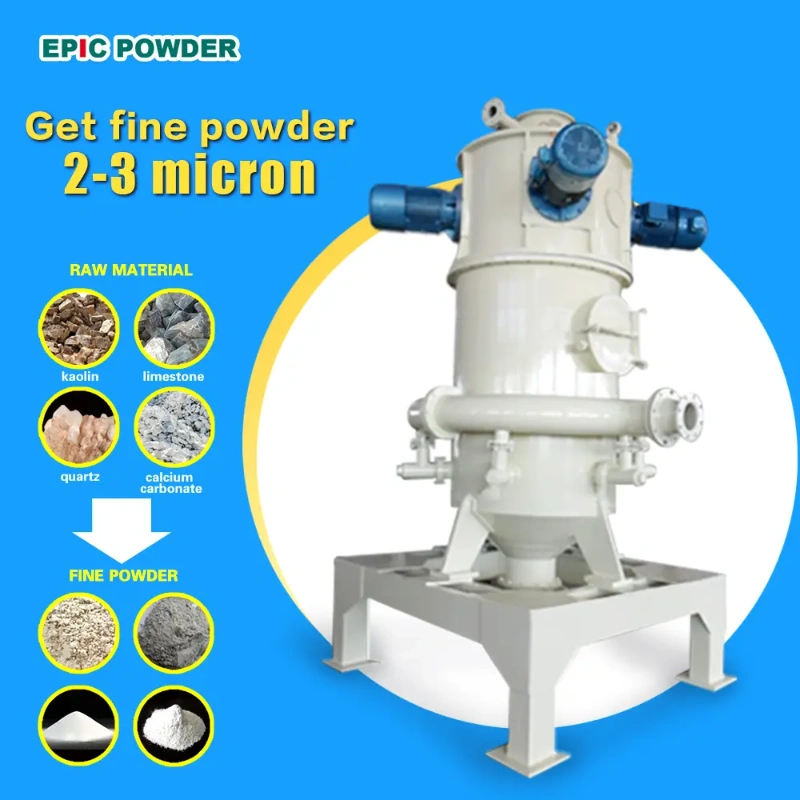
Solid-Phase Methods
Solid-phase processing is a traditional powder production method. It features low cost, large output, and simple processes. With the development of high-energy ball milling and combined jet grinding and classification, this method is still widely used in applications where ultra-high purity and strict particle size control are not required. Solid-phase methods are mainly used for producing ultrafine powders of brittle materials.
Mechanical Grinding
Mechanical grinding reduces particle size through applied mechanical forces. Solid materials deform and fracture under stress, producing finer particles.
The main grinding mechanisms include: compression, shear, impact, and abrasion.
The grinding limit depends on multiple factors, such as:
- Material properties
- Applied mechanical stress
- Grinding method
- Process conditions
- Grinding environment
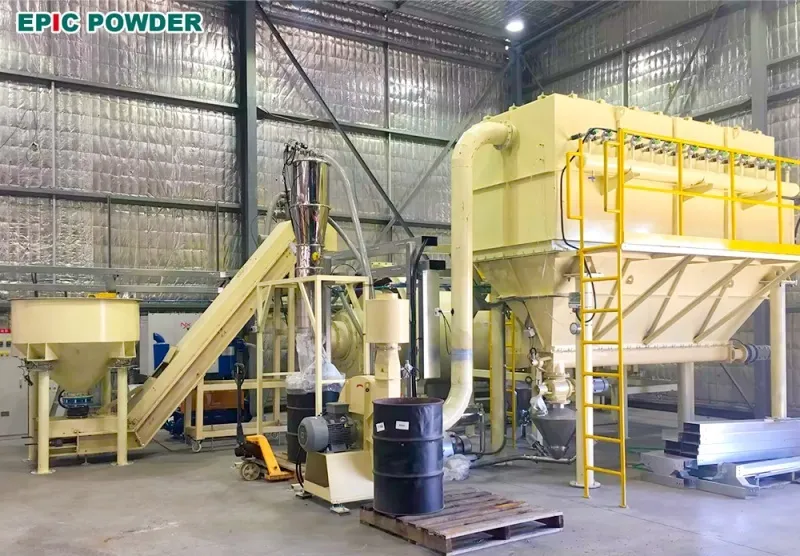
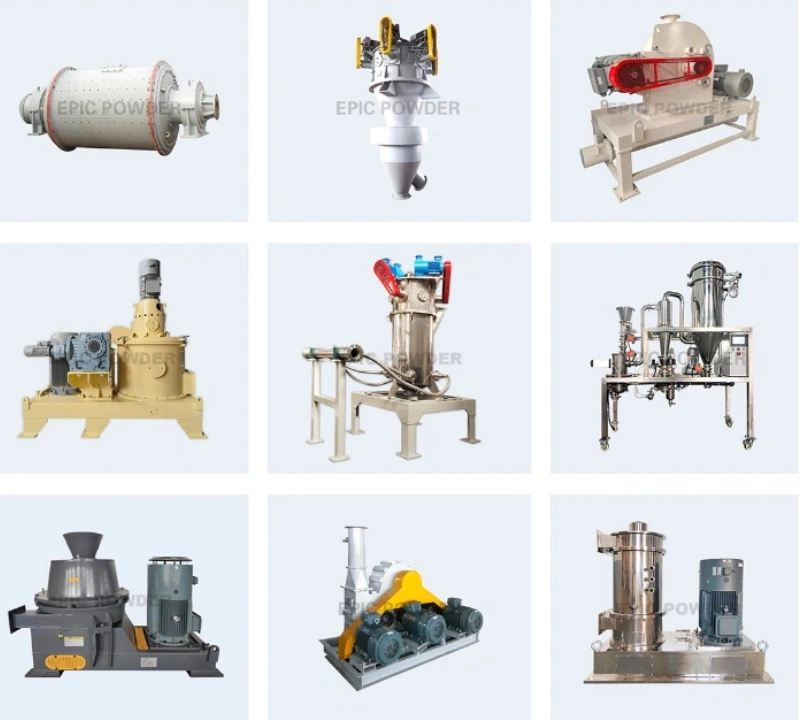
Typical grinding equipment includes: jet mills, ball mills, stirred mills, airflow mills, and colloid mills.
Typical Operating Ranges of Ultrafine Grinding Equipment
| Equipment Type | Feed Size (mm) | Product Size (μm) | Applicable Hardness | Grinding Mode |
|---|---|---|---|---|
| High-speed impact mill | < 8 | 3–74 | Medium / soft | Dry |
| Jet mill | < 2 | 1–30 | Medium / soft | Dry |
| Vibration mill | < 6 | 1–74 | Hard / medium / soft | Dry / wet |
| Stirred mill | < 1 | 1–74 | Hard / medium / soft | Dry / wet |
| Ball mill | < 10 | 1–100 | Hard / medium / soft | Dry / wet |
| Colloid mill | < 0.2 | 1–20 | Medium / soft | Wet |
Advantages:
- Large production capacity
- Low cost
- Simple process
- Mechanical–chemical activation improves powder reactivity
Disadvantages:
- Lower purity
- Limited fineness
- Poor particle shape control
This method is suitable for large-scale industrial production, such as mineral deep processing.
Ultrasonic Pulverization
Ultrasonic pulverization uses high-frequency vibration to break solid particles. The material is usually dispersed in a liquid medium, most commonly water.
An ultrasonic generator transfers energy into the liquid. When the accumulated energy inside particles exceeds their binding energy, fracture occurs.
Ultrasonic grinding is only effective for loosely structured particles. It is mainly used to disperse agglomerated ultrafine particles in liquids. Therefore, it is often referred to as an ultrasonic dispersion system rather than a true grinding method.
Thermal Decomposition Method
This method produces new solid phases through thermal decomposition of solid precursors. Typical decomposition reactions involve solid and gaseous phases. Thermal decomposition equipment is simple. Conventional resistance heating is sufficient. The process is easy to control.
However, this method is generally limited to oxide powders. The resulting particles are often coarse or heavily agglomerated. Additional grinding is usually required to obtain ultrafine powders.
High-Temperature Solid-State Reaction
This method starts by designing the composition and ratio of raw materials. Common reactants include oxides, carbonates, and hydroxides. The materials are uniformly mixed and pressed into compacts. They are then calcined at high temperature to form the desired phase. The sintered product is finally ground to the target particle size. This method is widely used for complex electronic ceramic powders.
Key considerations include:
- The choice of starting materials strongly affects reaction conditions and products.
- The reaction sequence influences the final powder properties.
Advantages:
- Suitable for mass production
- Relatively low cost
Disadvantages:
- Particle size is difficult to reduce below 0.5–1 μm
- Mechanical grinding may introduce impurities
Liquid-Phase Methods
Liquid-phase methods offer flexible processes, easy operation, and precise particle size control. They allow composition control and easy doping. Mixing can occur at the molecular or atomic level. The resulting powders exhibit high surface activity. These methods are widely used in laboratories and industry for producing metal oxide ultrafine powders.
Precipitation Method
Precipitation is one of the most common liquid-phase synthesis methods.
Soluble salts react in solution to form insoluble compounds, such as:
- Hydroxides
- Carbonates
- Sulfates
- Oxalates
The precipitate is then decomposed by heating or direct treatment to obtain the final product.
Main precipitation techniques include:
- Direct precipitation
- Co-precipitation
- Homogeneous precipitation
- Complex precipitation
- Hydrolysis precipitation
Advantages:
- Simple reaction process
- Low cost
- Easy industrial scaling
- Suitable for single or composite oxides
Disadvantages:
- Difficult filtration
- Residual precipitating agents as impurities
- Product loss during washing
Hydrothermal Method
The hydrothermal method operates in a sealed system under high temperature and high pressure. Reactions occur in water, aqueous solutions, or steam.
This method produces powders with:
- Small particle size
- High purity
- Good dispersion
- Narrow size distribution
- Controlled crystal structure
- Minimal agglomeration
It can avoid phase transformation, decomposition, or volatilization problems seen at high temperatures.
Common hydrothermal techniques include:
hydrolysis oxidation, hydrothermal precipitation, synthesis, dehydration, decomposition, crystallization, anodic oxidation, and arc-active electrode methods.
This method shows strong development potential.
Microemulsion (Reverse Micelle) Method
Microemulsions are thermodynamically stable systems composed of: water, oil, surfactants, and co-surfactants. W/O microemulsions act as micro-reactors. They restrict particle growth at the nanoscale.
Since the reaction occurs in tiny water nuclei, the growth of the reaction products is limited by the radius of the water nuclei. Therefore, the size of the water nuclei directly determines the size of the ultrafine powder particles. By selecting different surfactants and co-surfactants, different sizes of water nuclei are formed, thus allowing the synthesis of ultrafine powders with different particle sizes.
This method has been used to synthesize: nano-Fe₂O₃, nano-Al(OH)₃, nano-CdS, and nano-Fe–B composites.
Sol–Gel Method
The sol–gel method converts metal-organic or inorganic precursors into solids through:
solution → sol → gel → heat treatment.
Based on gelation mechanisms, it includes:
- Colloidal sol type
- Inorganic polymer type
- Complex type
This method produces:
- Spherical particles
- Narrow size distribution
- Minimal agglomeration
- Amorphous or nanocrystalline oxides
It also lowers sintering temperature and accelerates densification kinetics.
Solvent Evaporation Method
This method removes solvent from a solution. Supersaturation causes solute precipitation. To maintain uniformity, solutions are dispersed into fine droplets. Spray techniques are commonly used.
Main variants include:
- Freeze drying
- Spray drying
- Hot kerosene drying
- Spray pyrolysis
Spray pyrolysis process:
- Solvent evaporates from droplet surfaces
- Droplets shrink in volume
- Solute diffuses toward the center
- Heat transfers from gas phase to droplets
- Heat conducts inside droplets
Advantages:
- Produces spherical powders
- Good flowability
- Suitable for complex oxides
- High purity
Disadvantages:
- Applicable only to soluble salts
Gas-Phase Methods
Gas-phase methods form ultrafine particles directly in the gas phase.
They are divided into:
- Physical processes (evaporation–condensation)
- Chemical processes (gas-phase reactions)
Heating methods include:
resistance heating, flame synthesis, plasma, and laser heating.
Key features:
- High purity
- Narrow particle size distribution
- Excellent dispersion
- Very small particle size
Evaporation–Condensation in Low-Pressure Gas
Any solid material can form nanoparticles through evaporation and condensation.
Different heating sources and atmospheres lead to various processes.
Heating methods include:
resistance heating, arc discharge, plasma, induction heating, laser heating, and electron beam heating. Plasma, induction, and laser methods are especially promising for industrial applications.
Chemical Vapor Deposition (CVD)
CVD uses volatile metal compounds as precursors. These compounds decompose or react in the gas phase to form nanoparticles.
It is highly effective for high-melting-point materials.
Based on heating mode, CVD includes:
- Thermal CVD
- Plasma-enhanced CVD
- Laser CVD
Advantages:
- Extremely high purity
- Precise process control
- Atomic-level interface control
- Flexible composition and crystal structure
CVD is widely used in microelectronics, functional coatings, and ultrafine particle synthesis.
Sputtering Method
In sputtering, a glow discharge is generated between electrodes. Ions bombard the target material, ejecting atoms. The sputtered atoms cool and condense or react to form ultrafine powders.
This method can produce:
- High-melting-point metal powders
- Compound powders
- Composite powders
Advantages:
- Narrow particle size distribution
Disadvantages:
- Very low production yield
Other methods include template synthesis, metal vapor synthesis, and gas-phase condensation.
Conclusion
Research on ultrafine powder preparation is rapidly increasing. New technologies continue to emerge, while traditional methods are constantly upgraded. In practice, processes are selected or combined based on target powder requirements. Material selection and parameter optimization further improve powder performance. Compared with developed countries, China’s powder manufacturing industry still faces challenges. Key issues include oxidation, agglomeration, and moisture absorption. Solving these problems is essential for achieving large-scale industrial production of ultrafine powders.

“Thanks for reading. I hope my article helps. Please leave a comment down below. You may also contact Zelda online customer representative for any further inquiries.”
— Posted by Emily Chen