
Bentonite processing refers to the comprehensive upgrading, purification, modification, and high-value application technologies applied to bentonite, a hydrated clay rock mainly composed of montmorillonite. Bentonite possesses excellent swelling capacity, adsorption, cation exchange capacity, catalytic activity, bonding performance, suspension stability, and plasticity. It is widely known as “all-purpose clay.”
Natural bentonite often contains gangue minerals such as quartz, feldspar, and mica. Therefore, beneficiation, purification, and modification processes are usually required to meet the demands of modern industrial production.
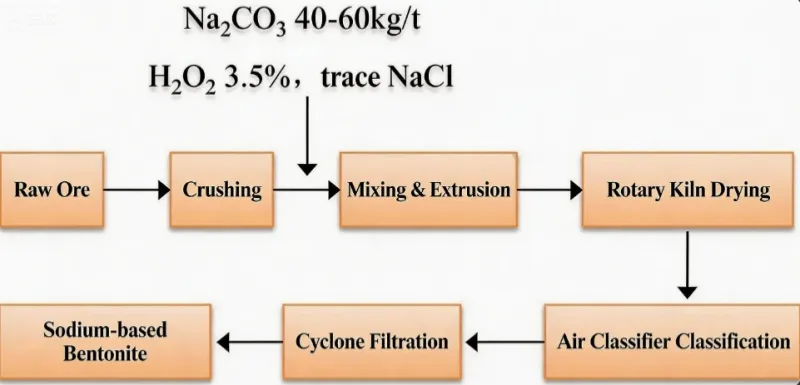
1. Preparation of Sodium Bentonite from Calcium Bentonite
The technological performance of sodium bentonite is significantly superior to that of calcium bentonite. However, calcium-based bentonite dominates most deposits. Therefore, sodium activation is one of the primary technologies in bentonite processing.
Sodium modification replaces exchangeable Ca²⁺ or Mg²⁺ in the montmorillonite interlayer with Na⁺, converting calcium bentonite into sodium bentonite. Sodium salts (typically Na₂CO₃) are added to trigger ion-exchange reactions. The main methods include suspension method (wet process), stockpile aging method, and extrusion method.
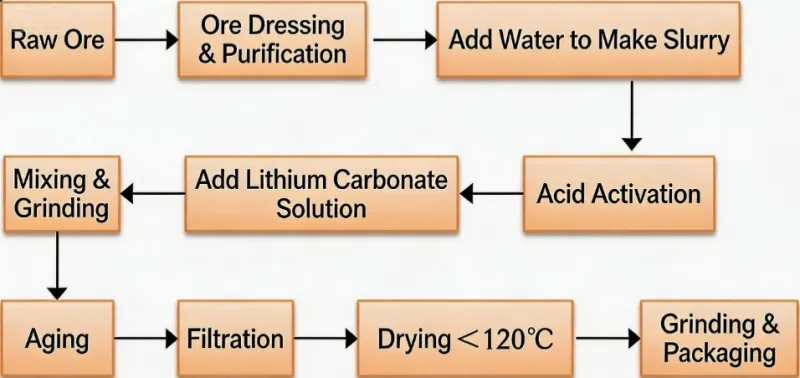
2. Preparation of Lithium Bentonite from Calcium Bentonite
Lithium bentonite can form gels in organic solvents and can replace organobentonite. Artificial lithiation is the primary preparation method.
Lithium ions replace exchangeable Ca²⁺ or Mg²⁺ between montmorillonite layers, converting calcium bentonite into lithium bentonite.
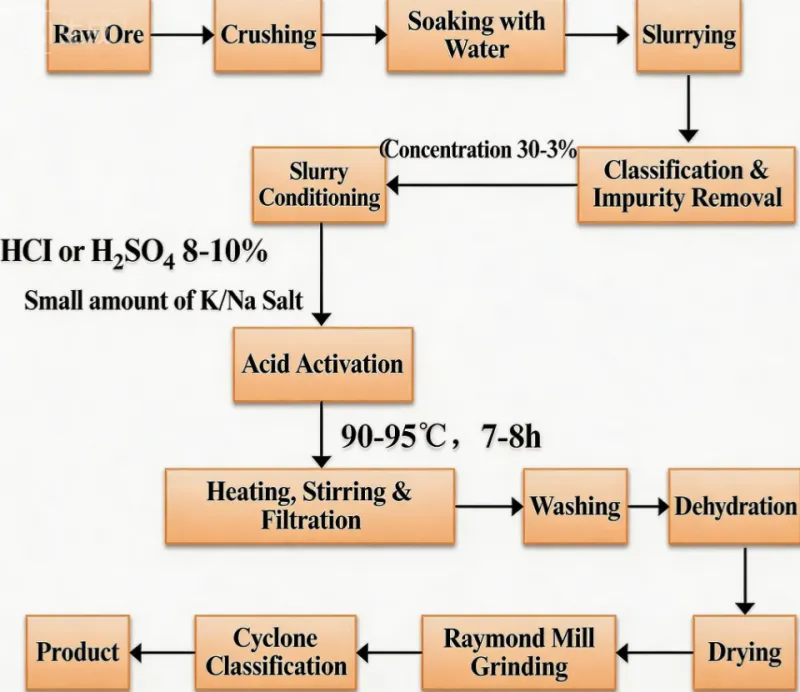
3. Acid Activation of Bentonite to Produce Activated Bleaching Earth
Although sodium bentonite has better physicochemical properties than calcium or magnesium bentonite, its specific surface area and adsorption capacity are still inferior to acid-activated products. Therefore, activated bleaching earth remains an important product line in advanced bentonite processing.
Activated bleaching earth is produced by inorganic acid or salt treatment of clay (mainly bentonite). It is a porous white to gray-white powder with a microporous structure, large specific surface area, and strong adsorption capacity.
Production processes include wet, dry, and semi-wet methods. The wet method provides higher decolorization power and stable quality and is most widely adopted.
4. Preparation of Organobentonite
Organobentonite is produced by replacing exchangeable cations in montmorillonite with organic ammonium cations. These cover the montmorillonite surface, block water adsorption centers, eliminate hydrophilicity, and convert the material into a hydrophobic and organophilic complex.
Preparation methods include wet, dry, and pre-gel processes.
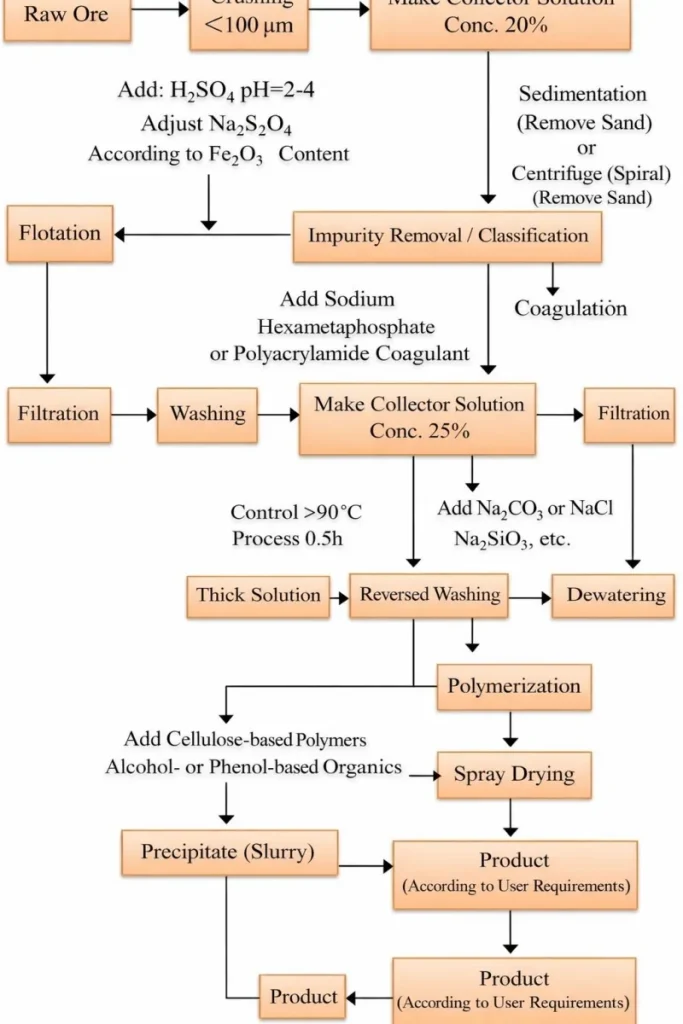
5. Preparation of Inorganic Gel
Inorganic gel is a high-value colloidal product produced through purification, sodium modification, phosphating modification, and gelation steps within the bentonite processing workflow. It has thickening, thixotropic, electrolyte-resistant, acid-resistant, and alkali-resistant properties. It is widely used in daily chemicals, pharmaceuticals, detergents, ceramics, glass, papermaking, foundry, and battery industries.
6. Preparation of Pillared Montmorillonite
Pillared montmorillonite is produced by inserting pillaring agents (crosslinkers) into the interlayer space of montmorillonite in a “pillar-like” manner, increasing basal spacing. It features large pore size, high surface area, high microporosity, strong surface acidity, and good thermal stability. It is a novel ion–molecular sieve and highly efficient catalyst with broad industrial prospects.
7. Preparation of Bentonite Desiccant
Bentonite desiccants are widely used in the United States, United Kingdom, France, and other countries. They feature high surface area, strong moisture adsorption, non-toxicity, odorlessness, non-corrosiveness, and reusability. They can replace silica gel and are used in military, pharmaceutical, and food industries.
8. Preparation of Mineral Decolorizing and Clarifying Agent
After purification and modification, bentonite can be used as a decolorizing and clarifying agent for glucose, monosodium glutamate, alcoholic beverages, and other products.
9. Preparation of Synthetic Zeolite
Due to its high silica and alumina content, bentonite can serve as raw material for synthetic zeolite molecular sieves. After acid treatment (typically with H₂SO₄), active silicic acid reacts with sodium aluminate in strong alkaline solution to form zeolite.
10. Preparation of Shampoo
Adding purified and modified high-quality bentonite to shampoo improves thixotropy and viscosity while enhancing washing performance. It enables combined cleansing and conditioning functions.
11. Preparation of Drilling Mud
Bentonite is treated with composite inorganic salts using the formula: sodium carbonate 2%, magnesium salt 0.5%, polymer (carboxymethyl cellulose) 0.5% (4:1:1). The product meets API-grade bentonite standards. Production uses conventional Raymond mills and drying equipment, with simple process and low investment.
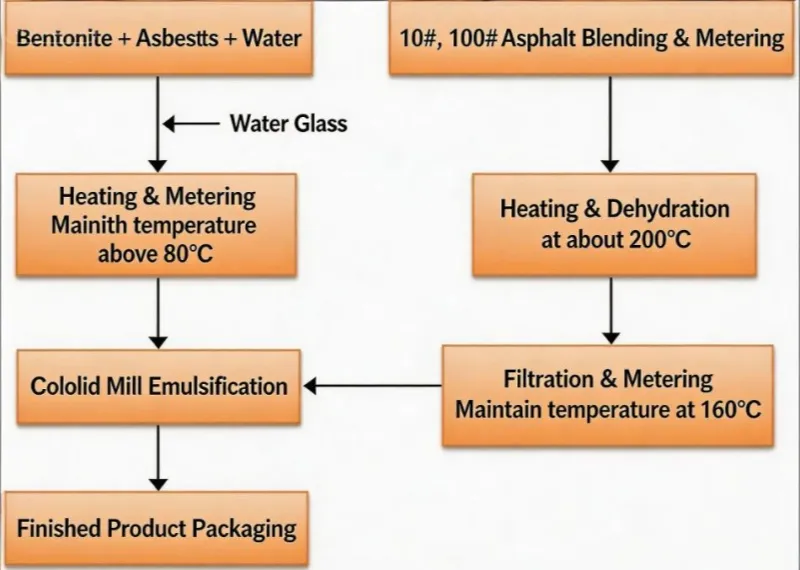
12. Preparation of Asbestos Emulsified Asphalt Roofing Waterproof Coating
Formulation:
Solution A (wt%): Sodium bentonite 15, water 30, asbestos 10, sodium silicate 15.
Solution B (wt%): 10# asphalt 25, 100# asphalt 60, other asphalt 15.
13. Preparation of Interior Wall Coating
In “803” interior wall coating, bentonite functions as binder, adsorbent, emulsifier, and filler. Bentonite slurry is prepared at a 1:1.15 bentonite-to-water ratio.
Example formulation (parts by weight):
“801” glue 70; bentonite slurry 95.4; lithopone (300 mesh) 14; talc (300 mesh) 13.2; tributyl phosphate 0.3; sodium hexametaphosphate 0.3; carboxymethyl cellulose 1; appropriate water.
Bentonite replaces titanium dioxide pigment, improves gloss, scrub resistance, and water resistance, and reduces formaldehyde pollution.
14. Preparation of Water Purification Agent
Bentonite slurry is mixed with flocculants (e.g., aluminum chloride, aluminum sulfate, or aluminum nitrate), filtered, washed, mixed with dispersant, dehydrated, dried at 100–110°C, and pulverized.
Example: Crush 3 kg of bentonite to -200 mesh, disperse in water, let stand for 24 hours, stir for 30 minutes, then let stand again for several hours. Extract the upper suspension, filter it. Redisperse the filter cake in water, mix with 10.2 g aluminum sulfate to flocculate, filter, dewater, mix with sodium hexametaphosphate, dry at 100–110°C, and crush to the required particle size to obtain the water purifying product.
15. Preparation of Composite Coagulant (for Printing and Dyeing Wastewater)
Raw materials: sodium bentonite (40–80%), FeSO₄·7H₂O (10–15%), MnSO₄·7H₂O (0.6–30%).
The product effectively treats dye-containing wastewater, especially cationic and reactive dye wastewater, offering strong decolorization and high COD removal.
16. Preparation of Liquid Textile Softener and Detergent
Formulation (wt%):
Sodium dodecylbenzene sulfonate 7–11%; C12–13 alkyl polyoxyethylene sulfonate 2–3%; auxiliary agents (sodium tripolyphosphate + sodium carbonate 2–6:1) 5–20%; sodium bentonite 12–15%; water 50–70%.
Provides stable viscosity, cleaning, and softening effects.
17. Preparation of Fire Extinguishing Agent
Formula: water 100 parts; bentonite 5; polyacrylamide 0.5; ammonium sulfate 10; sodium bicarbonate 7; Aerosol-22 1.
The agent flows easily, wets surfaces rapidly, releases CO₂, and prevents re-ignition.
18. Bentonite as Binder for Wood-Based Activated Carbon Composite
Grind wood-based activated carbon to -200 mesh, add 5–75% (by weight) sodium-based or calcium-based bentonite, mix evenly with appropriate water, extrude, press, or mold into shaped composite particles, dry in an oven to remove moisture, then calcine at 371–982°C in an inert gas (e.g., N₂) atmosphere to obtain shaped porous wood-based activated carbon composite material.
This product is used in fuel vapor pollution control devices to adsorb gasoline vapors from automobile carburetors or fuel tanks, or as a catalyst.
19. Preparation of Porous Ceramic Composite Filter Material
Raw materials: serpentine (34–80%), bentonite (5–20%), quartz sand (14–40%), dolomite/magnesite/chalk (1–6%), water 7–9%.
After molding and firing at 1250–1300°C for 2–3 hours, products feature high permeability, compressive strength, acid resistance, and heat resistance.
20. Preparation of Mineral Feed Additive
Bentonite contains essential trace elements such as K, Na, Ca, Mg, Al, Si, P, Fe, Mn, Ti, and V. It is an excellent natural feed additive.
Adding 3–5% bentonite powder (-150 mesh) to poultry feed can increase egg production by 25–27%, broiler weight gain by 8%, and survival rate by 6–7%. It improves digestion, regulates protein metabolism, supplements nutrients, and reduces antibiotic usage.
Together, these technologies form a complete industrial chain covering purification, modification, activation, compounding, and functional product manufacturing—representing the full scope of modern bentonite processing.

“Thanks for reading. I hope my article helps. Please leave a comment down below. You may also contact Zelda online customer representative for any further inquiries.”
— Posted by Emily Chen