
The global food supply chain is undergoing significant changes, driven by rising population and increasing demand for sustainable protein sources. Traditional livestock farming, which requires vast amounts of land and water, can no longer meet this demand alone. As a result, alternative protein sources—such as plant-based, mushroom, insect, algae, and bacterial fermentation biomass—are becoming crucial for future food security. Among the key technologies enabling this shift is the air classifier mill in protein powder processing, which offers an efficient and sustainable method for producing high-quality plant protein.
Currently, the mainstream approach involves extracting protein from soybeans through wet processing, which requires large amounts of water, chemicals, and energy-intensive drying. This method is not only resource-heavy but also time-consuming and complex. In contrast, dry fractionation technology, particularly when utilizing an air classifier mill in protein powder processing, provides a more sustainable and efficient solution.
Table 1 – Wet vs. Dry Fractionation: A Side‑by‑Side Comparison
| Feature | Wet Processing (Conventional) | Dry Fractionation (Air Classifier Mill) |
|---|---|---|
| Water consumption | High (large volumes required) | None / Minimal |
| Chemicals / solvents | Required (e.g., hexane, alkali) | None – purely mechanical |
| Energy intensity | Very high (multiple drying steps) | ~30% lower energy consumption |
| Protein functionality | Can be denatured by heat/chemicals | Preserved – native state intact |
| Process complexity | Multi‑step, time‑consuming | Simple, continuous, fast |
| Co‑product quality | Starch often damaged | High‑quality starch fraction preserved |
| Environmental footprint | High carbon & water footprint | Low carbon, zero process water |
Dry Fractionation Technology
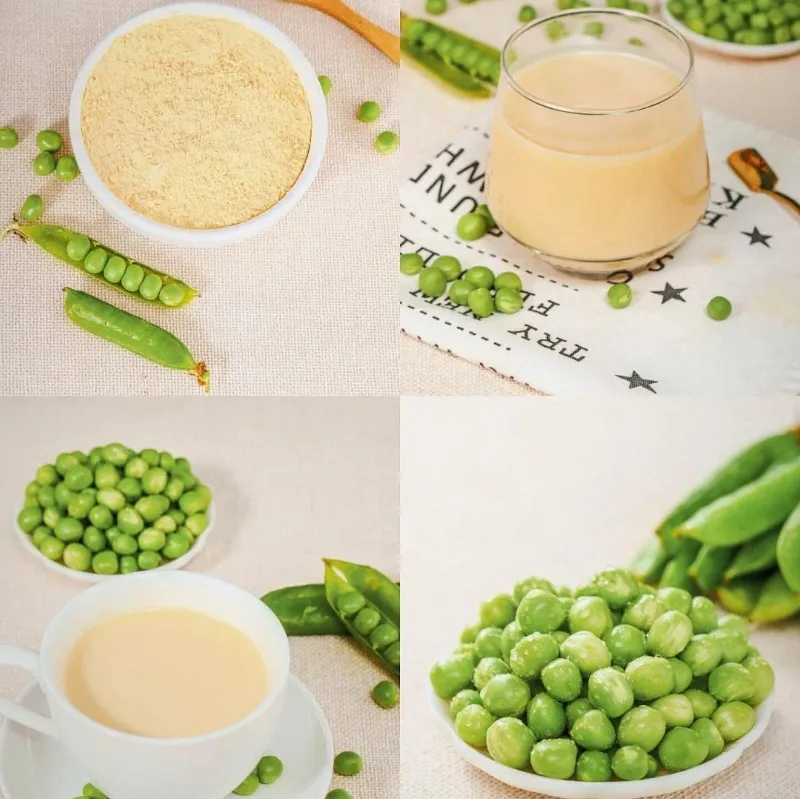
This method involves crushing raw materials and subsequent classification to obtain plant protein powder with a much higher protein content than the initial material. The process begins with dehulled peas, mung beans, or fava beans, and involves only mechanical processing. The protein remains intact in its functional and native state. The result is a high-protein powder.
To understand the main principles of the protein transfer process, we need to look at the characteristics of the crushed powder from suitable legumes (like peas): the significant size difference between large, elastic starch granules (40 microns) and small protein particles (3-10 microns) is a key factor.
Table 2 – Key Particle Characteristics in Legume Dry Fractionation
| Parameter | Starch Granules | Protein Particles |
|---|---|---|
| Typical particle size | ~40 µm | 3–10 µm |
| Shape / density | Large, elastic, relatively dense | Small, irregular, lighter |
| Behavior in air classification | Move outward under centrifugal force | Remain in airflow for fine collection |
| Target separation result | Low‑protein starch fraction | High‑protein concentrate (>85% purity) |
| Ideal grinding size (d90) | 40–60 µm (to avoid starch damage) | – |
Processing Steps
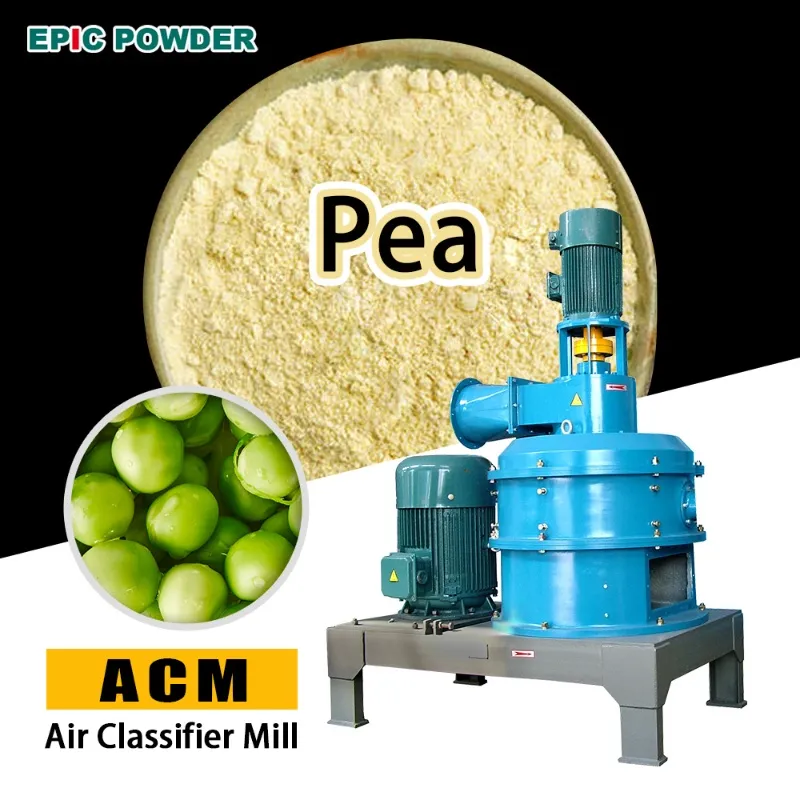
This process begins after the legumes are cleaned and dehulled. The crushing process separates relatively large starch particles from smaller protein particles. In addition, to preserve starch quality, it is important to avoid damaging the starch. An effective and gentle method is to use Epic Powder’s air classifier mill for impact grinding. The ideal particle size is 40-60 µm (d90).
The resulting pea powder is then separated into high-protein and low-protein components (the “starch fraction”). Since this particle size range exceeds the separation limits of traditional flour sifters, dynamic air classifiers are required. The classification mill with an integrated high-efficiency fine classifier ensures high output and minimizes protein loss.
The crushed product is sent into an air-ring gap for excellent dispersion. The ring gap accelerates the circulation of the two particles, and the additional centrifugal force separates them. Compared to traditional classifiers, this design improves particle separation, resulting in higher protein content and yield.
Epic Powder‘s Technological Promise
As a leader in powder engineering, Epic Powder integrates high-speed impact grinding with advanced turbine classification to deliver a three-in-one solution for plant protein production:
- Low-temperature crushing – Preserves protein functionality.
- Precise air classification – Maximizes protein purity and yield.
- Energy-efficient processing – Reduces carbon footprint.
By optimizing classifier wheel dynamics and airflow design, Epic Powder’s air classifier mill in protein powder processing enables:
- Protein purity above 85% – Meeting industry demands for high-quality ingredients.
- 30% lower energy consumption – Enhancing sustainability.
- Flexible production scalability – Supporting zero-carbon manufacturing goals.
Table 3 – Performance Metrics Achieved with Epic Powder’s Air Classifier Mill
| Performance Indicator | Achieved Value | Benefit for Protein Processors |
|---|---|---|
| Protein purity | >85% | Meets high‑quality ingredient standards |
| Energy saving | 30% lower consumption | Reduces operating costs & carbon footprint |
| Protein yield | Significantly improved (minimized loss) | Higher profitability from same raw material |
| Processing temperature | Low (cool grinding) | Retains native protein functionality |
| Production scalability | Flexible – lab to industrial scale | Supports zero‑carbon and capacity expansion goals |
With dry fractionation and air classifier mill technology, the alternative protein industry is poised for a cleaner, more efficient future—ushering in a new era of sustainable food production.

“Thanks for reading. I hope my article helps. Please leave a comment down below. You may also contact EPIC Powder online customer representative Zelda for any further inquiries.”
— Emily Chen, Engineer