
With the accelerating wave of retired power batteries from new energy vehicles, the recycling and reuse of Lithium Iron Phosphate (LiFePO₄, LFP) has become a major industry focus. A well-known domestic advanced materials company specializes in the repair and regeneration of cathode materials from spent batteries.
During the recycling process, recycled LFP materials—typically in lump or coarse powder form—must be ground to a specified particle size to enable subsequent impurity removal, surface coating, or resintering processes. Efficient and contamination-controlled Grinding of Recycled Lithium Iron Phosphate (LFP) Materials directly determines the final electrochemical performance of regenerated cathode products.
Customer Pain Points
- High abrasiveness
LFP causes severe wear on metal components, easily leading to excessive metallic contamination, which negatively affects electrochemical performance. - Strict particle size distribution requirements
The customer requires 100% passing 50 mesh, with a uniform particle size distribution and minimal over-grinding. - Harsh production environment
Recycled powders are prone to dusting, placing high demands on equipment sealing performance and automation level.
Solution: Epic Powder Turbo Mill (Vortex Mill)
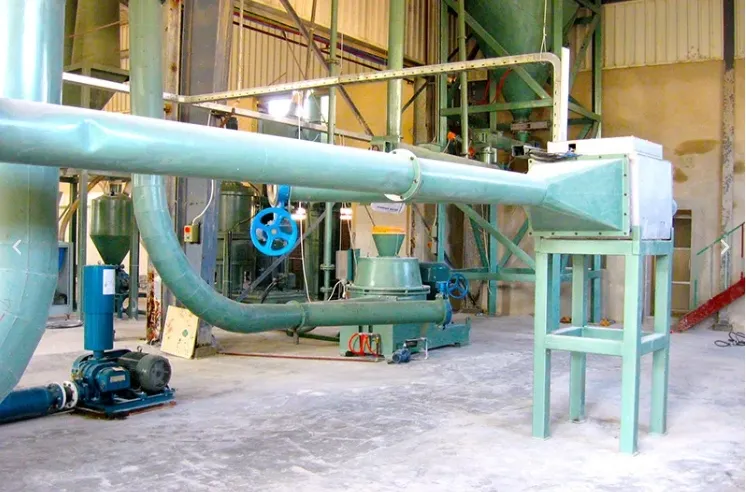
Based on the physical characteristics of recycled LFP materials, the customer adopted Epic Powder’s Turbo Mill series ultrafine grinding system, specifically optimized for the Grinding of Recycled Lithium Iron Phosphate (LFP) Materials.
1. Core Operating Principle
The Turbo Mill uses a high-speed rotating rotor to drive airflow into an intense vortex. Materials undergo strong impact, shear, and friction within the high-velocity air stream, achieving efficient size reduction.
2. Targeted Design Features
- Wear-resistant protection
To address the high abrasiveness of LFP, all internal contact parts (such as the rotor and liners) are treated with ceramic coatings or made from high-hardness wear-resistant alloys, significantly reducing the introduction of metallic impurities (Fe/Cr/Ni). - Precise classification
Combined with an in-line or external classification system, the mill ensures 100% compliance with the 50-mesh requirement while maintaining good particle morphology. - Low-temperature operation
The Turbo Mill’s large-volume airflow efficiently removes heat generated during grinding, preventing physical changes in residual organic components within the recycled material.
Process Flow Overview
- Feeding
Recycled material is evenly fed into the Turbo Mill grinding chamber via a metered screw feeder. - Grinding
The material is pulverized within a very short residence time under high-intensity vortex action. - Collection
Fine powder is carried by airflow into a cyclone collector and pulse dust collector, achieving over 99.9% product recovery. - Monitoring
The system is equipped with automated pressure and temperature sensors to ensure stable continuous operation.
Operating Results and Value Delivered
| Parameter | Customer Target | Actual Performance |
|---|---|---|
| Final fineness | 100% passing 50 mesh (≤300 μm) | Fully compliant, with concentrated particle size distribution |
| Metal contamination increase | Extremely low | With ceramic lining, iron contamination controlled at PPM level |
| Energy efficiency | Stable throughput of 2 t/h | Power consumption reduced by ~15–20% compared with conventional mechanical mills |