
Hard carbon has become one of the most promising next-generation anode materials for lithium-ion batteries due to its high capacity, strong rate performance, and excellent low-temperature characteristics. However, because of its complex structure and wide particle size distribution, hard carbon must undergo precise particle classification. Without accurate control, issues such as inconsistent compaction density, excessive side reactions, and unstable electrochemical behavior may arise. Therefore, integrating an 공기 분류기 into the hard-carbon production process is essential for achieving stable material performance.
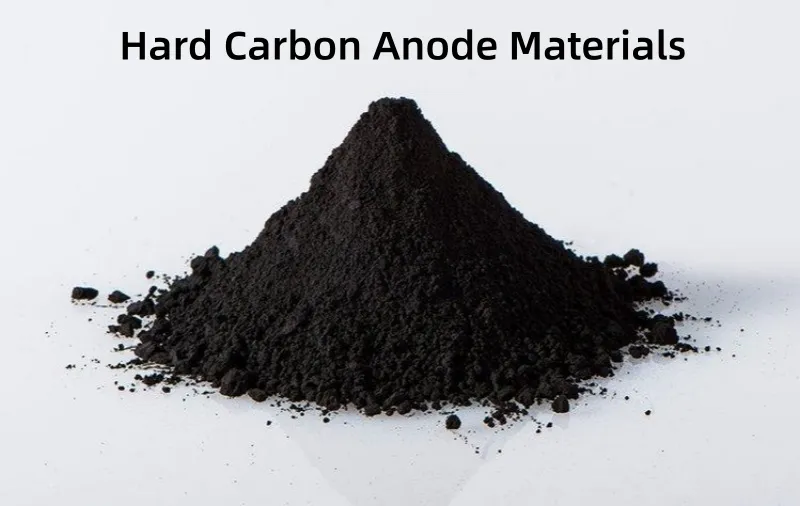
Why Do Hard Carbon Materials Require Air Classification?
After grinding and crushing, hard carbon powder typically ranges from 1–50 μm. Without classification, it often exhibits:
- Wide particle size distribution and unstable compaction density
- Excessively fine particles causing strong side reactions and thick SEI film
- Coarse particles reducing kinetic performance and rate capability
The air classifier uses high-speed airflow and a precision turbine classifier wheel to control D97 and D50 values, achieving narrow particle distribution and improved product stability, which directly enhances battery performance.
Advantages of Air Classifiers in Hard Carbon Processing
Accurate Control of D50, D90, and D97
Different applications require different particle sizes, such as:
- D50: 8–12 μm
- D90 < 18 μm
- Removal of <3 μm fines to reduce side reactions
Improved Compaction and Tap Density
Narrower particle size distribution improves packing behavior, resulting in:
- Higher compaction density
- Higher volumetric capacity
- Increased energy density
Reduced Fine Powder, Higher ICE
By eliminating excessive fines (<3 μm), air classification helps:
- Reduce SEI formation
- Lower irreversible capacity loss
- Improve initial coulombic efficiency (ICE)
Closed-loop and Contamination-free
Ceramic classifier wheel options prevent metal contamination, meeting battery-grade hard carbon standards.
Mainstream Equipment and Application Features
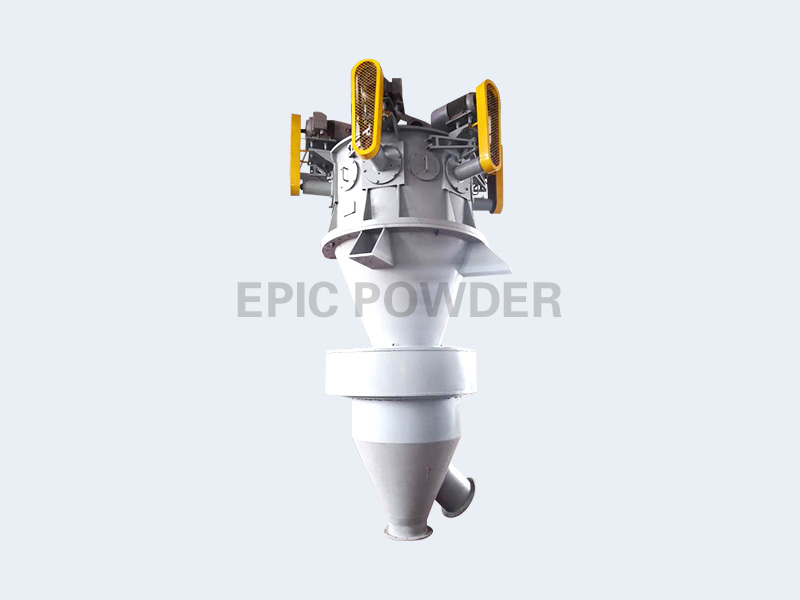
In the field of hard carbon, the commonly used high-precision air classifiers include:
HTS Air Classifier
특징:
Designed for high-efficiency dry classification of ultrafine powders in the range of D97 3 μm to D97 45 μm. It provides excellent classification accuracy and achieves an extremely narrow particle size distribution. Suitable for hard carbon powders with strict quality requirements and relatively small batch production.
장점:
Ideal for controlling hard carbon powder with D50 in the range of 5 μm to 20 μm.
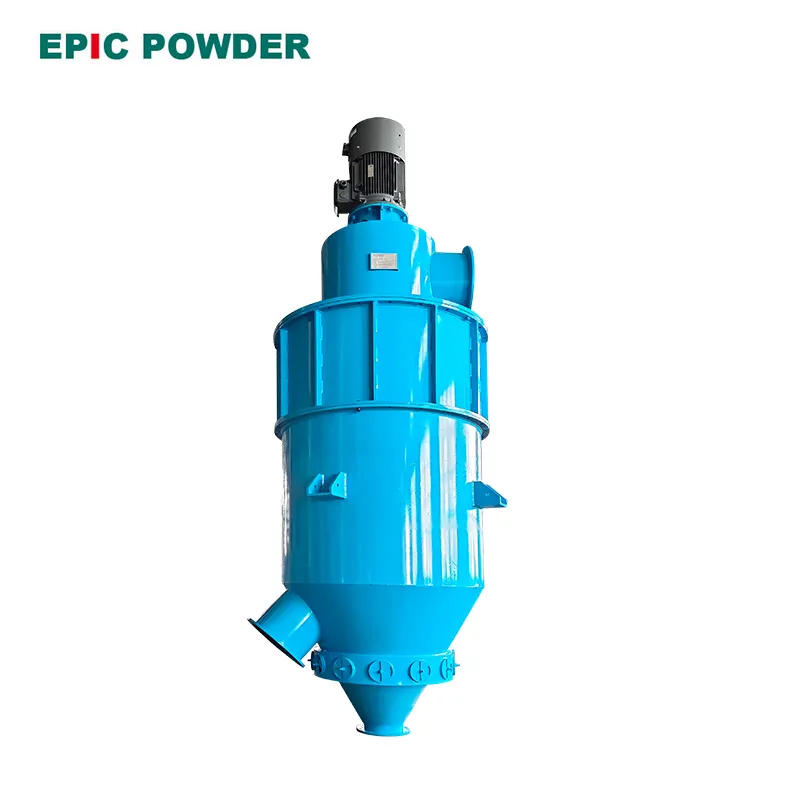
ITC Air Classifier
특징:
Designed for high-efficiency dry classification of powders from D97 5 μm to D97 200 μm. It offers large processing capacity and relatively low energy consumption, making it suitable for large-scale industrial production.
Challenges in Actual Production and Solutions
Hard carbon powders have characteristics such as low density, high friction, and strong agglomeration tendency, which bring challenges to the classification process:
| 도전 | Impact | 해결책 |
|---|---|---|
| Agglomeration tendency | Fine particles form soft agglomerates before classification, reducing classification accuracy. | Use an efficient powder dispersion system (such as a high-speed air disperser) to fully deagglomerate particles at the feeder inlet. |
| Low density | Particles are highly sensitive to airflow and easily generate turbulence in the classification zone. | Optimize equipment structure to ensure a stable airflow field and control feed uniformity. |
| Wear and contamination | Long-term high-speed operation causes wear on classifier wheels, affecting precision and introducing possible contamination. | Use wear-resistant ceramic or special alloy materials for key components to reduce metal contamination risk. |
에픽 파우더 Air Classification Solutions for Hard Carbon
Epic Powder provides air classifier systems tailored for hard carbon and battery materials, featuring:
- High-speed ceramic classifier wheel for precise cut-point control
- Fully sealed negative-pressure system
- Operable in closed loops with jet mills or mechanical mills
- Capacity range from 50 kg/h to 3 t/h
- Optional inline particle size monitoring
These systems have been widely applied in carbon-material factories and battery-material processors, significantly enhancing consistency and electrochemical performance.

“"읽어주셔서 감사합니다. 제 글이 도움이 되었으면 좋겠습니다. 아래에 댓글을 남겨주세요. 추가 문의 사항이 있으시면 젤다 온라인 고객 상담원에게 연락하셔도 됩니다."”
— 게시자: 제이슨 왕