
1. 프로젝트 배경
Driven by the rapid growth of the European new energy battery and supercapacitor markets, a leading materials science laboratory in France (hereinafter referred to as the “Client”) is developing a novel high-performance porous carbon precursor. This material, characterized by its high specific surface area and unique pore structure, is a critical component for next-generation energy storage devices.
However, during the transition from R&D to pilot-scale production, the Client encountered significant technical challenges:
- Traditional mechanical milling caused the collapse of the porous carbon structure, significantly reducing the specific surface area.
- Existing 제트밀 equipment failed to stably control the 입자 크기 distribution (D50) within the narrow range of 5-8 μm while maintaining a high throughput of 10-15 kg/h.
- Low yield of fine powder was a persistent issue.
Consequently, the Client sought a customized dry pulverization and classification system capable of achieving low-damage grinding, narrow particle size distribution control, and high energy efficiency.
2. 기술적 과제
- Material Sensitivity: Porous carbon is brittle yet structurally fragile; excessive impact can destroy the microporous structure, compromising final electrochemical performance.
- Stringent Particle Size Requirements: The target D50 is 5-8 μm with a narrow distribution (low Span value). This is essential to prevent large particles from affecting electrode 코팅 uniformity and to minimize agglomeration caused by overly fine dust.
- Balancing Throughput and Precision: Maintaining high classification precision at a pilot/small-batch production rate of 10-15 kg/h proved difficult.
- Fine Powder Recovery: Due to the fine target particle size, traditional cyclone separators struggled to effectively capture powders in the 5-8 μm range, leading to product loss and environmental concerns.
3. 해결책: 에픽 파우더 Customized 제트밀 System for Porous Carbon Ultra-Fine Pulverization
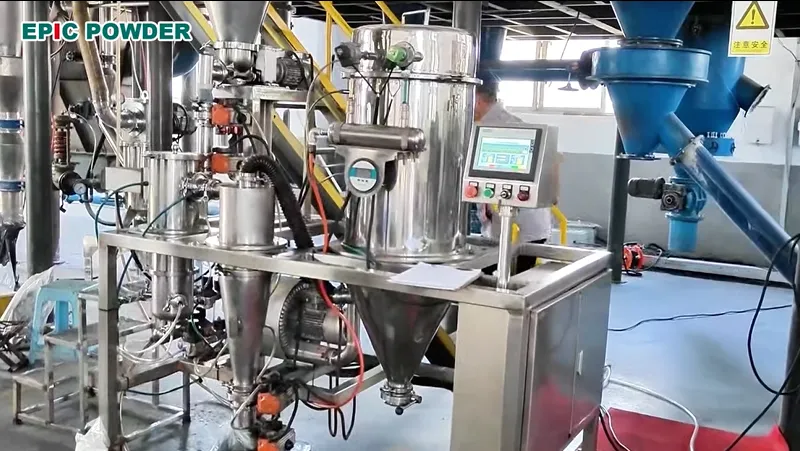
To address these pain points, we provided an integrated solution based on 에픽 파우더 core technology. The system comprises three key modules:
3.1 Core Pulverization Unit: Epic Powder Jet Mill
- 원칙: Utilizes supersonic gas collision. Materials are crushed by colliding with each other while carried by high-speed gas streams, rather than impacting the chamber walls.
- 장점:
- Zero Wear & Low Contamination: Eliminates metal wear contamination, crucial for high-purity carbon materials.
- 저온 분쇄: Leverages the cooling effect of gas expansion to prevent structural changes or oxidation risks in porous carbon due to temperature rise.
- Controllable Intensity: Crushing energy is precisely controlled by adjusting nozzle pressure and feed rate, protecting the pore structure.
3.2 Precision Classification Unit: High-Efficiency Turbo Air Classifier
- Configuration: A high-precision turbo classifier integrated directly with the jet mill.
- 기능: Real-time separation of coarse and fine particles. Only fine powder meeting the D50 5-8 μm standard passes through the classifier wheel into the collection system, while coarse particles automatically return to the grinding chamber for secondary milling.
- Effect: Achieves an extremely narrow particle size distribution, ensuring strict control of D90 with no oversized particles.
3.3 Innovative Collection Unit: Cyclone Separator with Secondary Air
- Technical Highlight: This is the core innovation of this case. To address the difficulty of capturing 5-8 μm fine powder, we introduced Secondary Air technology to the bottom of a standard cyclone separator.
- 작동 원리:
- Secondary air is injected tangentially or axially from the lower part of the cyclone cone, creating an upward air curtain.
- This air curtain prevents settled fine powder from being re-entrained by the central rising (Re-entrainment) and optimizes the internal flow field by reducing turbulence interference.
- It significantly improves the collection efficiency for micro-fine powders in the 5-10 μm range, boosting the total system yield to over 98%.
4. Process Parameters and Operational Data
After on-site commissioning and optimization, the porous carbon ultra-fine pulverization system operates stably under the following parameters:
| 매개변수 | 설정/결과 | 비고 |
|---|---|---|
| Material Processed | French Porous Carbon Precursor | Initial D50 ≈ 40-50 μm |
| Target Particle Size (D50) | 6.2 μm | Stably controlled within 5-8 μm range |
| 처리량 | 12.5 kg/h | Meets the design requirement of 10-15 kg/h |
| Classification Precision (Span) | < 1.2 | Extremely narrow distribution |
| System Yield | > 98.5% | Attributed to the Secondary Air Cyclone technology |
| Specific Surface Area Retention | > 99% | Negligible loss in BET surface area post-milling |