
Polyetheretherketone (PEEK) is a high-performance specialty engineering plastic. It is renowned for its excellent heat resistance, chemical resistance, wear resistance, and mechanical strength. As a result, PEEK is widely used in aerospace, medical devices, automotive, and electronics industries. With the continuous upgrading of application demands, the need for ultrafine PEEK powders is steadily increasing. This trend is especially evident in 3D printing, composite prepregs, coatings, and injection molding. Ultrafine powders generally refer to particle sizes below 10 μm. In some advanced applications, particle sizes are even required to reach the submicron range of 1–5 μm. These requirements place strict demands on grinding processes. The process must achieve precise particle size control. At the same time, it must maintain high material purity. Thermal degradation and contamination must also be strictly avoided. The main challenges in ultrafine PEEK grinding arise from several intrinsic material properties.
PEEK has high toughness and a high melting point of approximately 343 °C. It is also thermally sensitive and subject to very strict purity standards. Traditional mechanical grinding methods, such as ball mills or hammer mills, are therefore unsuitable. These processes tend to generate excessive heat during operation. This heat can cause material degradation. In addition, mechanical wear may introduce metal contamination into the powder.
As a result, the industry has gradually shifted toward non-contact, low-temperature dry grinding technologies. Among these, the jet mill and the air classifier mill (ACM) are the most widely used solutions. The jet mill is also commonly known as a fluidized-bed opposed-jet mill. This article compares the working principles of these two technologies. It also analyzes their respective advantages and limitations. Finally, it evaluates which process is better suited for ultrafine PEEK grinding.
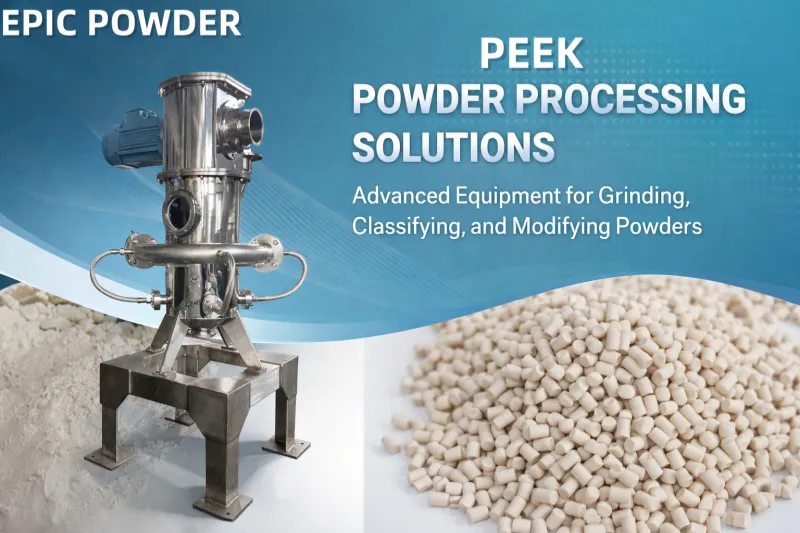
Principle Comparison: Jet Mill vs. Air Classifier Mill
Jet Mill:
High-pressure compressed air or steam is accelerated through nozzles to generate supersonic airflow (300–500 m/s). Particles collide with each other at high speed inside the grinding chamber, achieving size reduction through inter-particle impact. There are no mechanical moving parts. An internal or external dynamic classifier ensures precise particle size separation. Common types include fluidized-bed opposed-jet mills and loop mills. The grinding process is inherently low-temperature due to gas expansion cooling, which can reach below −20 °C, and involves no metal contact.
Air Classifier Mill (ACM):
This system combines mechanical impact grinding with air classification. Material is first broken down by high-speed rotating hammers or pin discs, then classified by an integrated air classifier wheel. Fine particles are carried out with the airflow, while coarse particles are returned for further grinding. ACMs are suitable for medium-fine grinding and offer relatively high throughput.
| Item | Jet Mill | Air Classifier Mill (ACM) |
|---|---|---|
| Grinding principle | High-speed particle–particle collision, no moving parts | Mechanical impact + air classification, rotating parts |
| Particle size range | 0.5–10 μm (submicron easily achievable) | 10–100 μm (ultrafine <5 μm is difficult) |
| Heat generation | Extremely low (airflow cooling) | Moderate (mechanical friction) |
| Contamination risk | Very low (no metal contact) | Medium (component wear may introduce impurities) |
| Energy consumption | Medium to high (compressed air demand) | Relatively low (mechanical drive) |
| Throughput | Medium (precision, small-to-medium scale) | High (large-scale production) |
| Suitable materials | Heat-sensitive, high-purity, hard and tough materials | General materials, sticky or medium-hard materials |
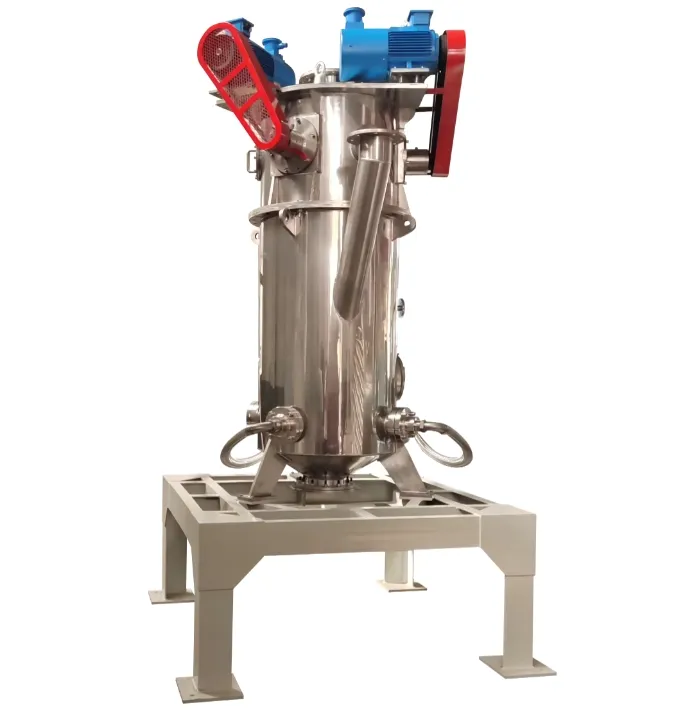
Process Requirements for Ultrafine PEEK Grinding
As a semi-crystalline thermoplastic, PEEK tends to generate heat during grinding, which may cause melting, agglomeration, or degradation. Moreover, medical and aerospace applications impose extremely strict purity requirements, prohibiting metal ion contamination. Ultrafine PEEK powders are commonly used in:
- 3D printing (laser sintering or fused deposition, requiring narrow particle size distribution and good flowability, preferably spherical or near-spherical particles);
- Composite reinforcement (such as carbon fiber/PEEK prepregs);
- Coatings and injection molding fillers.
Industry practice shows that jet milling is the mainstream process for ultrafine PEEK grinding, for the following reasons:
- Low temperature and no contamination: Jet mills rely on particle-to-particle collisions without mechanical components, resulting in minimal heat generation and no metal wear, effectively preventing thermal degradation and ensuring high purity.
- Excellent ultrafine capability: Jet mills can easily achieve d97 < 10 μm, and even 1–5 μm with a narrow particle size distribution, meeting the needs of high-precision applications. International processors (such as Jet Pulverizer) widely use jet mills for PEEK powders in aerospace and 3D printing.
- Good particle shape control: Fluidized-bed jet mills can produce near-spherical particles, improving powder flowability.
- Advantages for heat-sensitive materials: Although PEEK has a high melting point, it can soften locally under overheating. The expansion cooling effect of jet milling is ideally suited for such materials.
In contrast, although air classifier mills offer higher throughput and lower energy consumption, their mechanical impact mechanism tends to generate heat and introduce contamination. Therefore, they are not ideal for high-purity ultrafine PEEK. ACMs are more suitable for applications requiring medium particle sizes (such as 20–50 μm) in general plastics or food-grade materials.
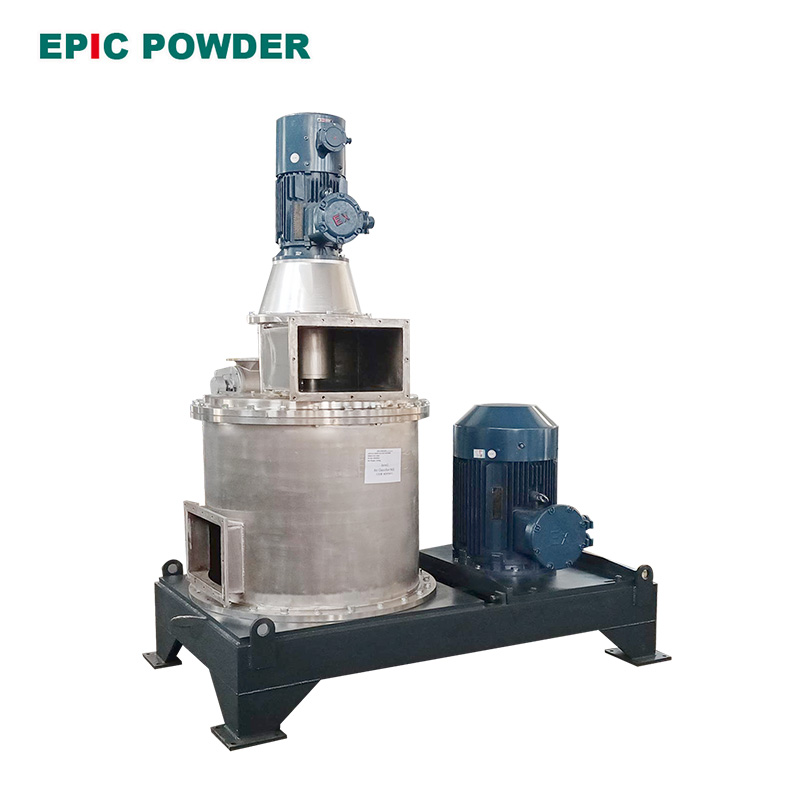
Conclusion: Jet Milling Is the Optimal Solution for Ultrafine PEEK Grinding
In summary, for ultrafine PEEK grinding—especially when producing high-purity powders below 10 μm—the jet mill (particularly the fluidized-bed opposed-jet type) is the optimal process. It offers the best balance of fineness, purity, low-temperature operation, and particle size distribution control, effectively avoiding the thermal and contamination risks associated with air classifier mills. Although jet mills involve higher initial investment and energy consumption, they provide superior cost-effectiveness for high-value PEEK applications.
For extremely high throughput requirements, jet mills can be combined with external classifiers for further optimization. For non-ultrafine products (above ~20 μm), air classifier mills may serve as an alternative. However, in high-end applications, jet milling remains irreplaceable. With future advancements such as energy-efficient nozzles and intelligent classification control, jet mills will play an even greater role in PEEK powder processing.

“Thanks for reading. I hope my article helps. Please leave a comment down below. You may also contact Zelda online customer representative for any further inquiries.”
— Posted by Emily Chen