
Talc, a mineral often overlooked, ranks dead last on the Mohs hardness scale, yet its “softness” delivers remarkable “hardcore” strength. As the softest known mineral, talc plays important roles not only in daily life but also shines across multiple industries. However, its true potential is often unlocked through the process of producing ultrafine grinding talc, where advanced machinery transforms raw ore into specialized powders with particle sizes measured in microns. So why is this “soft girl” so widely favored in such a refined state? Let’s explore its unique appeal from various angles.
How does Talc Become “Soft”?
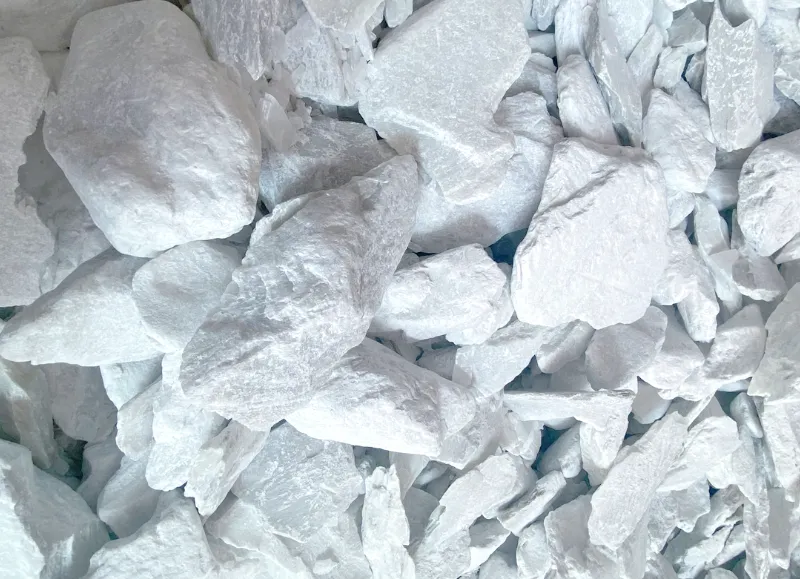
Talc’s chemical composition is hydrated magnesium silicate, with the formula Mg₃Si₄O₁₀(OH)₂. Its crystal structure is a classic layered silicate, resembling thin “molecular sandwiches” stacked layer upon layer. The layers are held together by weak van der Waals forces, allowing them to slide easily against each other under force. This gives talc its exceptionally slippery feel and allows it to be readily scratched into powder—even by a fingernail—securing its permanent spot at 1 on the Mohs hardness scale (the softest mineral).
Talc formation is closely linked to hydrothermal alteration: Magnesium-rich ultramafic rocks (such as peridotite or serpentinite) react with high-temperature hydrothermal fluids, where original minerals (olivine, pyroxene, etc.) undergo hydrolysis and metasomatism, gradually transforming into talc.
Talc’s “Slipperiness” Is Its Innate Superpower
Skin-feel Master” in Cosmetics
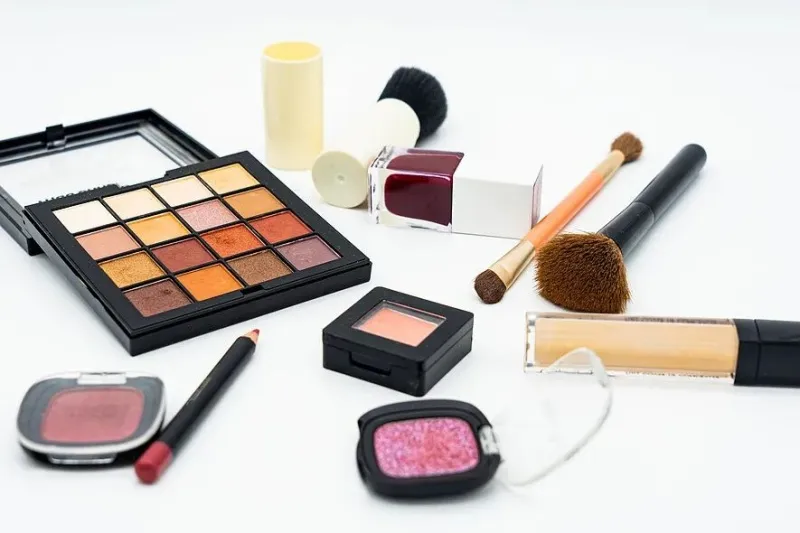
Talc powder is almost ubiquitous in body powder, foundation, eyeshadow, loose powder, and similar products. It makes powders finer and silkier, glides smoothly during application without caking, and efficiently absorbs excess oil and sweat for excellent oil control and long-lasting makeup. In recent years, concerns have arisen because some talc deposits may contain trace asbestos (a carcinogen). Today, reputable cosmetic-grade talc undergoes strict purification and testing to ensure asbestos levels are below detection limits (typically <0.1% or undetectable). Consumers should prioritize well-known brands with testing reports.
Lubricant” in the Pharmaceutical Field
Pharmaceutical-grade talc powder boasts extremely high purity and is commonly used as a tablet coating material, glidant, or filler to make tablets smooth and easy to swallow. In surgery, it serves as a sterile lubricant inside gloves to reduce friction during donning. Pharmaceutical-grade talc has stringent controls on heavy metals, bacteria, mold, etc., offering higher safety.
Release Agent Expert” in Industry
In rubber and plastic molding, applying a layer of talc powder to mold surfaces prevents products from sticking. In ceramics production, adding talc reduces body shrinkage, improves surface smoothness, and minimizes firing cracks. In paints, it acts as an extender pigment to enhance hiding power and leveling. In cable insulation, it improves electrical insulation performance.
Don’t Just Think of Talc as Powder—Its “Transformation” Abilities are Impressive
- Block talc → Talc jade: Dense, pure block talc (often white, light green, or gray-white) is called “talc jade.” Though low in hardness, it has good toughness and is easy to carve without staining. It is commonly made into decorative ornaments, seals, landscape plaques, etc. Yunnan and Qinghai in China have long traditions of talc jade carving, with finished pieces offering a warm, delicate luster similar to a understated version of Hetian jade.
- Additive in papermaking: Talc powder added as a filler to pulp significantly improves paper whiteness, opacity, and smoothness while reducing water absorption, resulting in clearer color printing and better ink adhesion.
- Little helper in agriculture: Used as a carrier and diluent for pesticides and fertilizers to ensure even adhesion to crop surfaces; added to feed, it adsorbs toxins and aids digestion.
- ·Other transformations: Filler in waterproof coatings/membranes (improves aging resistance), insulating materials, textile auxiliaries, etc.
Interactive Q&A: Talc Knowledge Mini-Test
Q: What is talc’s Mohs hardness?
A: 1—it is currently the softest known mineral.
Q: What is the main role of talc powder in body powder?
A: Absorbs sweat, reduces friction, and makes skin feel refreshingly smooth.
Q: Why is talc easily scraped into powder?
A: Its layered crystal structure has weak interlayer bonding, allowing easy sliding and exfoliation.
Q: What hardcore equipment is needed to process talc into “ultrafine powder”?
A: Although talc has low hardness, it is tough and flaky, making ordinary ball mills insufficient for ultrafine levels.
- Raymond mill: Suitable for conventional coarse powder at 200–400 mesh.
- Ultra-fine ring roller mill: Highly efficient, reliably producing 800–1250 mesh fine powder.
- Air jet mill (Jet Mill): For 3000 mesh or even 10,000 mesh+ ultrafine powder (often required for high-end paints and plastics), high-speed airflow accelerates particles to collide with each other. This preserves particle activity and the flaky structure without damage.
Q: What is the “fineness code” for talc powder in different industries?
A: Fineness is measured in mesh (higher mesh = finer particles). Requirements vary widely across sectors—the finer the powder, the silkier the feel, but processing costs rise accordingly. Common correspondences include:
- Rubber/cable: 200–325 mesh — basic filling, insulation, and mold release
- Papermaking/ceramics: 325–600 mesh — improves whiteness and flatness
- Paints/coatings: 800–1250 mesh — strong hiding power, prevents film cracking
- Plastic modification: 1250–2500 mesh — enhances mechanical properties (rigidity)
- Cosmetics/pharmaceuticals: 2500–5000 mesh — ultimate silky touch and strong absorption
Q: Does whiter talc powder always mean higher quality?
A: Not entirely. While whiteness is an important grade indicator (usually requiring ≥90%), for industrial uses, silicon content and iron content are more critical. For example, excessive iron in plastics can cause yellowing/degradation; in ceramics, impurities directly affect final color after firing.
How Does Ultrafine Grinding Technology Enable Talc, the “Soft Mineral,” to Cross into High-end Manufacturing Fields?
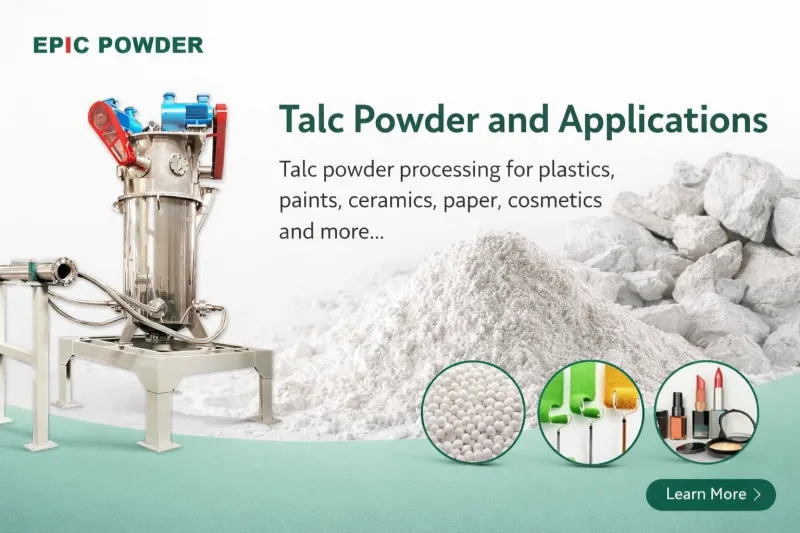
Talc’s natural softness and layered structure make it challenging to grind to extreme fineness using conventional mechanical methods—ordinary mills often destroy the desirable plate-like morphology or introduce contamination. Ultrafine grinding technology, especially fluidized bed opposed jet mills (air jet mills), overcomes this by using high-speed supersonic airflow (up to 1000 mph) to fluidize particles and cause particle-to-particle collisions instead of mechanical impact. This preserves talc’s flaky shape (key for slipperiness, oil absorption, and reinforcement), achieves D97 fineness down to 1–5 μm (often 3000–10,000 mesh or higher), and produces high-purity powder without iron contamination—ideal for demanding applications.
Thanks to this technology, ultrafine grinding talc enters high-end fields such as:
- Premium cosmetics (ultra-smooth, invisible feel in foundations and powders)
- Advanced plastics (better reinforcement, surface quality, and dimensional stability in automotive/electronics parts)
- High-performance coatings/paints (superior rheology, anti-settling, and matte effects)
- Precision pharmaceuticals and electronics materials
In short, ultrafine grinding turns “weakness” (softness) of talc into a strength, allowing it to deliver exceptional performance in cutting-edge manufacturing where particle size, shape, and purity are paramount.

“Thanks for reading. I hope my article helps. Please leave a comment down below. You may also contact Zelda online customer representative for any further inquiries.”
— Posted by Emily Chen