
A powder air classifier sorts particles by size with two forces, and no screen is involved. Centrifugal force pushes particles outward against the classifier wheel. Air drag pulls them inward through the blades. The size where the two forces balance becomes the cut, so every adjustment on the machine moves that balance point. This article explains the physics in plain terms. It then walks through the parts and shows what each wheel type can and cannot do.

The Two Forces Behind the Cut
Inside the classifying wheel, air flows toward the centre and particles are flung outward. A small particle has little mass. Drag therefore dominates, and the air carries it through the wheel into the fine outlet. A large particle carries more mass, so centrifugal force wins and it is thrown back to the feed side. The balance size depends on wheel speed and air volume together. The two settings therefore work as a pair.
A faster wheel drops the balance size, so the product gets finer. More air strengthens drag, so coarser particles ride through and the cut rises. The two settings therefore trade against each other, and a stable cut needs a stable ratio between them. Feed load sits on top of both, since a crowded classification zone slows the fine particles and lets coarse ones slip through.
The Parts That Do the Work
| Part | Job | What goes wrong without it |
|---|---|---|
| Feed metering | Delivers a steady, thin stream into the classification zone | Surges overload the wheel and coarse particles leak into the fines |
| Dispersion stage | Breaks agglomerates before the cut, usually with pins or an air jet | Bonded clusters pass as single particles and widen the distribution |
| Classifying wheel | Sets the cut by the force balance above | Wheel speed drift moves D97 without any alarm on the panel |
| Fines outlet | Carries the product out with the air to a filter or cyclone | Pressure imbalance pushes coarse particles into the product |
| Coarse return | Sends rejected particles back for a second pass or out as tail | Blocked returns build heat and blind the wheel |
The dispersion stage matters more than most buyers expect. A laser instrument disperses the sample before it measures, so the certificate reports single particles. An under-dispersed classifier feed therefore produces a wider certificate distribution than the instrument would show. The fix costs less at the design stage, since adding pins or air jets later means a shutdown.
What Sets the Cut and What Limits Precision
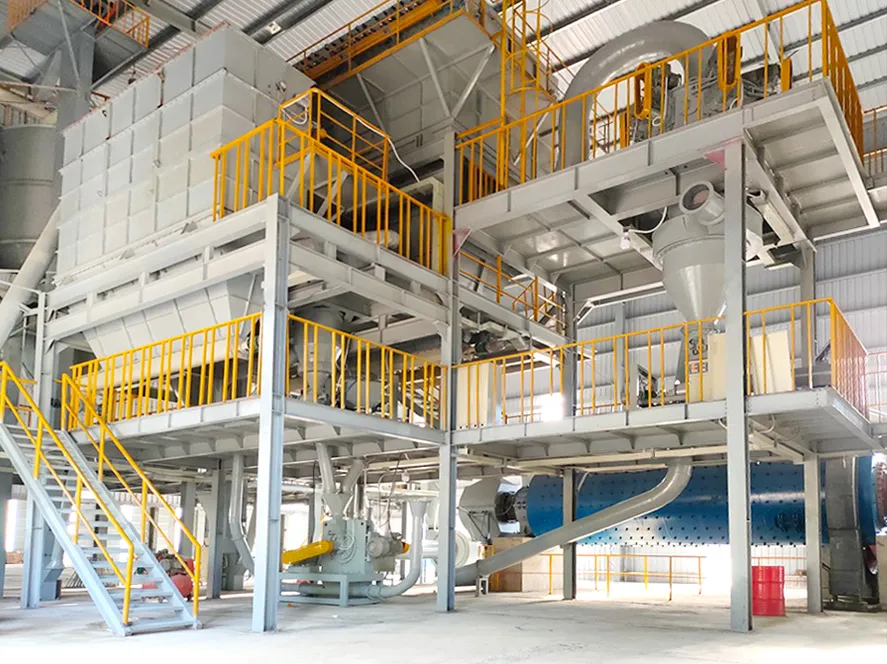
Wheel speed sets the cut. Our note on wheel speed control covers the settings in detail. Air volume trades against it, while feed rate adds a third lever. All three interact, so a stable product needs them recorded together. The table below lists the direction of each change and the cost that comes with it.
| Adjustment | Direction | The cost that follows |
|---|---|---|
| Wheel speed | Higher speed gives a finer cut | Pressure drop rises and throughput falls |
| Air volume | More air gives a coarser cut and higher throughput | Fines that left the wheel return to the circuit and load the filter |
| Feed rate | Lower rate gives a sharper cut | Capacity drops, so the plant pays in tons per hour |
| Dispersion energy | More energy opens agglomerates | Extra air or pins can crush soft or plate-like particles |
Precision has a number, and buyers should ask for it. Classification efficiency describes how much of the coarse fraction the wheel actually rejects. A perfect wheel would sit at 100 percent, and real wheels sit well below that. Our published figures are 60 to 80 percent on the HTS horizontal machine. The ITC vertical machine reaches 60 to 90 percent on its working range. A quotation with a single best-case number promises more than the physics delivers. Ask which material the figure was measured on.
The shape of the cut matters as much as its position. Two products can both report D97 45 µm. One may carry 10 percent oversize while the other carries 1 percent. The oversize comes from particles that slipped through the wheel. It shows up as specks, grit or a failed sieve check. A sharper cut therefore buys quality in the product the customer receives. Classification choice thus sits at the centre of quality control in powder plants.
Which Wheel Type Fits Which Job
One wheel design cannot serve every cut. The family therefore spans five machines, and each one covers a band of D97 with its own rotor arrangement. The table lists the working ranges from the published parameter sheets.
| Machine | Arrangement | D97 range | Natural fit |
|---|---|---|---|
| HTS horizontal classifier | Single wheel or multi-rotor, mounted on a mill or standalone | 3 to 150 µm | Ball mill circuits and mid-range standalone cuts |
| ITC vertical classifier | Vertical wheel with integrated dispersion | 5 to 150 µm | Feeds that agglomerate and need sharp dispersion ahead of the cut |
| MBS air classifier | Standalone with independent fan | 8 to 200 µm | Coarser mineral cuts without a mill in the loop |
| CTC centrifugal classifier | Mechanical impeller, low speed | 32 to 250 µm | Coarse industrial cuts where air power is unnecessary |
| TDC turbo-double classifier | Two wheels in series | 3 to 45 µm | Narrow fine distributions that one wheel cannot hold |
Two entries on the sheet span the widest range. The HTS horizontal classifier reaches from 3 µm up to 150 µm. The ITC vertical classifier adds built-in dispersion on the same band. Both mount on a mill or run standalone, so one machine serves several lines in a plant.
Where the Classifier Sits in a Circuit
Most classifiers do not run alone, since they close the loop around a mill and the pair decides both the capacity and the fineness of the line. A ball mill that dumps into a classifier returns coarse particles to the mill mouth. The mill therefore never wastes energy on already-fine material. The ball mill and classifier system page shows how that loop is built and sized. The classifier holds the top cut while the mill holds the bottom of the distribution. The two machines therefore share one job.

What to Check at Acceptance
Four records protect the buyer, and each one can be written into the order.
- D97 and the oversize share at contract capacity, measured over a four-hour run
- Classification efficiency on the actual material, since a catalogue figure describes another powder
- Pressure drop and wheel speed stability across the run, which shows whether the cut will drift in production
- Wheel and liner wear after the run, which prices the maintenance before the order is signed
We build classifiers and grinding circuits for powder plants, and every project starts with a test on the customer’s material. Write to [email protected] with your target D97, the feed description and the capacity the line must hold.
Epic Powder

“Thanks for reading. I hope my article helps. Please leave a comment down below. You may also contact EPIC Powder online customer representative Molly for any further inquiries.”
— Jason Wang, Engineer