
Glass Powder is a functional filler known for its high strength and transparency. It is quietly becoming a “behind-the-scenes hero” in the world of modern high-performance materials. It possesses excellent chemisch stability, weather resistance, and electrical insulation. Furthermore, it can significantly enhance the hardness and abrasion resistance of base materials.
However, the performance of glass powder is closely related to its deeltjesgrootte distribution. The key to releasing its full potential lies in using advanced ultra-fine grinding equipment. This process refines the glass powder to micron or even nanometer scales. This article will explore the applications of glass powder in architectural coatings and refractory materials. It will also analyze the core role of ultra-fine grinding technology.
Breakthroughs in Architectural Coatings
In the field of architectural coatings, glass powder is more than just a filler. It acts as a performance “reinforcer.”
1. Enhancing Coating Hardness and Scratch Resistance
Glass powder itself is extremely hard. Its Mohs hardness typically ranges between 5.5 and 7.0. When uniformly dispersed in a bekleding matrix, it forms a tough physical barrier. For floor coatings or exterior wall paints frequently subjected to friction, adding ultra-fine glass powder can significantly reduce scratches and wear.
2. Improving Coating Transparency and Gloss
The refractive index of glass powder is very close to that of most synthetic resins. Therefore, it shows high transparency within the coating film. When processed by ultra-fine grinding equipment, the glass powder has a smaller particle size and a narrow distribution. This effectively avoids light scattering. It makes the coating colors appear fuller while providing a delicate surface gloss.
3. Excellent Weathering and Chemical Resistance
Glass powder is chemically inert. In architectural coatings, it resists UV aging and acid rain erosion. It also stands up to chemical attacks from alkaline substrates like concrete. This extends the lifespan of the building’s exterior and reduces maintenance costs.
Performance Optimization in Refractory Materials
In high-temperature industrial sectors, the stability of refractory materials determines production safety and efficiency.
1. Fluxing and Strengthening at High Temperatures
In refractory castables or ceramic binders, fine glass powder generates a trace liquid phase at high temperatures. This liquid phase fills the internal micropores of the material. It promotes sintering, which improves the density and the strength of the material at both room and high temperatures.
2. Improving Thermal Shock Resistance
Glass powder has a low coefficient of thermal expansion. Ultra-fine grinding technology allows for precise control of the particle size. This ensures that the glass powder is distributed uniformly within the refractory matrix. It effectively buffers thermal stress. Consequently, the material is less likely to crack during drastic temperature fluctuations.
3. Enhancing Resistance to Slag Erosion
The dense structure created by glass powder filling effectively blocks the penetration of molten metal slag. For furnace lining materials, this “densification” effect is a core technical method for extending service life.
Core Technology: Ultra-fine Grinding Equipment
To achieve the performance mentioned above, the fineness of glass powder must reach the micron level (D50 = 1-10 μm). Traditional ball mills often struggle to balance efficiency with purity. Therefore, professional ultra-fine grinding equipment has become the industry standard.
1. Jet Molen
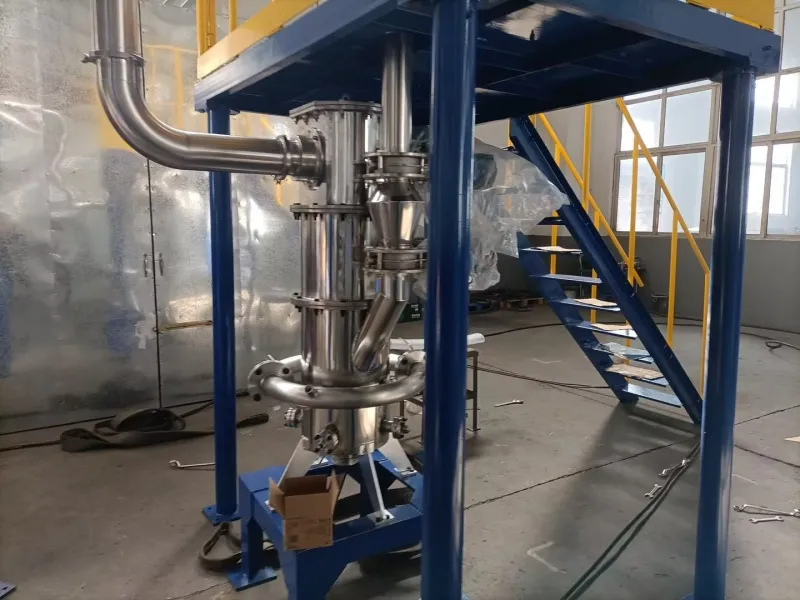
De straal molen is the preferred choice for processing high-performance glass powder. It uses supersonic airflow to make material particles collide and rub against each other in the grinding chamber.
Contamination-free: Since the process relies on collisions between particles, it greatly reduces the mixing of metal impurities.
High Precision: The built-in high-efficiency classification system can accurately control particle size distribution. This ensures there are no oversized particles.
2. Mechanical Impact Ultra-fine Mill
This equipment uses a high-speed rotating rotor to impact and shear the glass.
High Output: Compared to jet mills, mechanical mills have a higher energy efficiency ratio. They are suitable for large-scale industrial production.
High Adjustability: By adjusting the rotor speed and air volume, manufacturers can easily switch between different specifications of powder.
3. Stirred Mills and Sand Mills (Wet Grinding)
Wet grinding is usually used when producing nanometer-scale glass powder. In a liquid medium, small grinding media (such as zirconium beads) perform deep grinding on the glass particles. This process results in an active powder with an extremely high specific surface area.
How Does Ultra-fine Grinding Change Performance?
Why must we emphasize “ultra-fine”? This involves the size effect in physics.
Increased Specific Surface Area: As particle size decreases, the contact area between the glass powder and the resin or refractory base grows geometrically. This enhances the interfacial bonding strength.
Filling Effect: Particles from ultra-fine grinding can fill the gaps between coarser particles. This is known as “grading optimization.” it makes the overall structure more compact.
Enhanced Reactive Activity: In refractory materials, finer powder means a lower starting temperature for sintering. This helps in saving energy and reducing consumption.
Application Suggestions and Industry Trends
1. Selection of Particle Size
Transparent Primers: It is recommended to use glass powder with D50 ≤5μm. This ensures transparency and a smooth feel.
Refractory Castables: A powder with a wider particle size distribution (2-45 μm) can be used to take advantage of its space-filling effect.
2. Oppervlaktemodificatie
To further improve the affinity between glass powder and organic resins, a silane coupling agent is often added. This surface treatment can happen during or after the ultra-fine grinding process. It significantly reduces the viscosity of the coating and allows for higher loading levels.
3. Environmental Protection
Much of the glass powder comes from the deep processing of recycled glass. Ultra-fine grinding technology transforms waste glass into high-value functional fillers. This aligns perfectly with the requirements for a circular economy and low-carbon building materials in the modern construction industry.
Toepassingsgevallen
Architectural Coatings: A paint manufacturer added ultra-fine glass powder (processed by a jet classificatormolen) to outdoor coatings. The results showed a 20% increase in gloss retention after 12 months of outdoor exposure. Additionally, the crack resistance under temperature changes was enhanced.
Refractory Materials: A refractory producer added $5 \mu m$ glass powder to high-alumina castables. The density increased by 15%, and thermal shock resistance improved by 25%. This significantly extended the service life of the furnace lining.
Conclusie
The potential of glass powder is far from being fully exploited. In architectural coatings, it is a “tool” for improving hardness and weather resistance. In refractory materials, it acts as a “binder” for strengthening structures and resisting erosion. All these performance improvements depend on the limits of particle size achieved by ultra-fine grinding equipment.
As processing technology continues to advance, we can foresee a future for ultra-fine glass powder. Finer, purer, and more functional powders will bring more possibilities to the field of high-performance materials.

Bedankt voor het lezen. Ik hoop dat mijn artikel je helpt. Laat hieronder een reactie achter. Je kunt ook contact opnemen met de klantenservice van Zelda Online voor verdere vragen.
— Geplaatst door Emily Chen