Horizontal Fluidized Bed Jet Mill - MQW

Horizontal Fluidized Bed Jet Mill - MQW

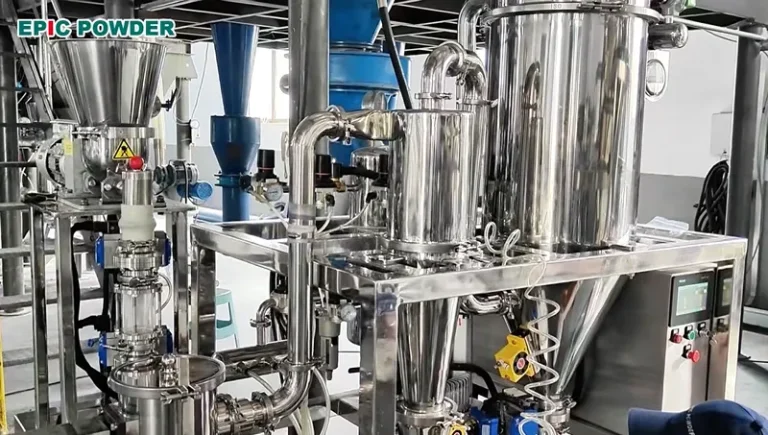
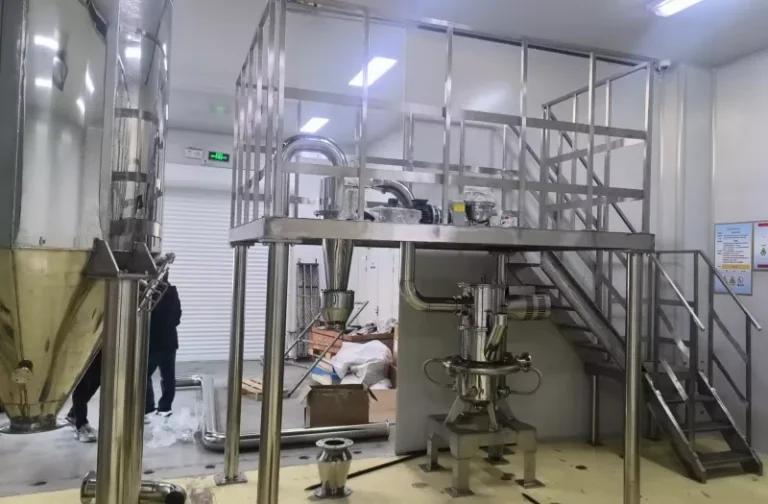
MQW jet mill is a Fluidised Bed Opposed Jet Mill, with built-in horizontal classifying wheels (single wheel or multiple wheels). After the compressed air is filtered and dried, it is sprayed into the grinding chamber through the Laval nozzle at high speed. At the intersection of multiple high-pressure airflows, the materials are repeatedly collided, rubbed, and sheared to be crushed. The ground materials rise with the suction force of the fan. The airflow moves to the classifying area, under the strong centrifugal force generated by the high-speed rotating classifying turbine, the coarse and fine materials are separated, the fine particles that meet the particle size requirements enter the cyclone separator and dust collector through the classifying wheel, and the coarse particles descend to the grinding area to continue grinding.

MQW60
Kes MQW

Ciri-ciri Produk

  • The grinding process is completed by the collision of the material itself, completely self-grinding, with minimal wear on the equipment, suitable forgrinding of various hardness materials.
  • The grinding form of fluidized bed collision can better maintain the shape of particles.
  • Pengisaran suhu rendah dan bebas sederhana, sesuai untuk bahan sensitif haba, cair rendah, mengandungi gula dan meruap.
  • Pengisaran suhu tinggi dan tekanan tinggi untuk mencapai kelajuan suntikan yang lebih tinggi, kelikatan dinamik yang lebih rendah, dan kehalusan dan kecekapan pengisaran yang lebih tinggi.
  • Roda dalam, mengelaskan, muncung dan komponen utama lain boleh dilindungi oleh bahan tahan haus seperti alumina, zirkonia, dan silikon karbida, dan bahan organik untuk mengelakkan sentuhan dengan logam semasa keseluruhan proses pengisaran dan mendapatkan produk ketulenan tinggi.
  • The grading wheel is installed horizontally, which can better control the fineness of products with low density and produce finer products.
  • Reka bentuk kitaran litar tertutup gas lengai/kalis letupan, yang boleh memenuhi pengisaran bahan mudah terbakar, mudah meletup, mudah teroksida dan mudah menyerap bahan lembapan.

Jet Mill Working Principle

Kilang Jet Udara Bertentangan Katil Terbendalir: Selepas udara termampat ditapis dan dikeringkan, ia disembur ke dalam ruang pengisaran pada kelajuan tinggi melalui muncung Laval. Di persimpangan berbilang aliran udara tekanan tinggi, bahan-bahan itu berulang kali berlanggar, digosok, dan digunting untuk dihancurkan. Bahan yang dihancurkan naik dengan sedutan kipas. Aliran udara bergerak ke zon pengelasan. Di bawah tindakan daya emparan kuat yang dihasilkan oleh turbin klasifikasi berputar berkelajuan tinggi, bahan kasar dan halus diasingkan. Zarah halus yang memenuhi keperluan saiz zarah memasuki pemisah siklon dan pengumpul habuk melalui roda klasifikasi untuk pengumpulan, dan zarah kasar turun ke zon penghancuran dan terus dihancurkan.

Jet Mill Product Parameters

Elementor 动态表格 - MQW系列气流粉碎机参数
parameter/ Model MQW03 MQW06 MQW010 MQW20 MQW30 MQW40 MQW60 MQW80 MQW120 MQW160 MQW240
Saiz Suapan(mm) <1 <2 <2 <3 <3 <3 <3 <3 <1 <3 <3
Kapasiti Pengeluaran (kg/j) 0.3~10 10~150 20~300 40~600 100~900 200~1200 500~2000 800~3000 1500~6000 2000~8000 4000~12000
Saiz zarah(D97:μm) 3~45 3~45 3~45 3~45 3~45 3~45 3~45 3~25 15x4 15x6 15x6
Motor pengelas (kw) 2.2 3 5.5/7.5 7.5/11 11/15 15/7.5x3 7.5x3 11x3 15x3 15x4 15x6
Penggunaan udara (m³/min) 3 6 10 20 30 40 60 80 120 160 240
Tekanan udara (Mpa) 0.6~1 0.6~1 0.6~1 0.6~1 0.6~1 0.6~1 0.6~1 0.6~1 0.6~1 0.6~1 0.6~1

Nota: Kapasiti pengeluaran berkait rapat dengan saiz zarah, graviti tentu, kekerasan, kelembapan dan penunjuk lain bahan mentah. Di atas hanya untuk rujukan pemilihan.

Kelebihan dan kekurangan perkhidmatan pengilangan jet

Among particle size reduction technologies, jet milling’s advantages include:

  • It can achieve very fine particles. It also creates tight size distributions. This is better than other milling methods.

  • No knives, blades, or hammers. Also, no milling media or screens. This means minimal risk of contamination from worn mill parts.

  • The simple chamber design is easy to clean, reducing risk of cross contamination

  • Grinding doesn’t cause temperature changes. This is unlike mechanical mills. Such changes are important for heat-sensitive materials.

Different materials act differently on the jet mill. The best materials are: 

  • Abrasive

  • Brittle

  • Dense

  • Hard

  • Very friable (in other words, easy to crumble)

Jet mills also have their disadvantages, though they’re few. For one, they can be expensive to buy — which is why working with a toll processor is a smart business decision. A partnership can be a great way to get the benefits of jet milling technology and still manage costs. The process also needs high energy. It needs specialty gases and other special items to meet the specs.

Materials that may respond poorly to the jet milling process are often: 

  • Elastic

  • Wet

  • Sticky 

  • Light and fluffy

  • Easily deformed

  • Shock absorbent

  • Difficult to accelerate

Of course, a toll processor has years of experience. They have been meeting tough particle specs. They already have the gear and know-how. They can use it well to get the best results.

Jet Mill Product Related

Kilang Jet Katil Terbendalir Menegak - MQL
Kilang Jet Lingkaran - MQP
Kilang Makmal tiga dalam satu
MQP Kilang Jet Lingkaran Makmal - Makmal

Jawapan kepada soalan lazim berkaitan pengilangan jet

By working with a tolling partner’s technical team, you will gain efficiency. They will help choose the best mill type. They will also pick the right speed and feed rate. They will also cover any special project needs.

The team brings focused insights and extensive experience to the table. However, you should also expect to provide safety data sheets and answer a few questions, such as:

A jet mill is a type of ultrafine grinding equipment. It is a machine that uses a lot of energy. Therefore, the feed particle size of the air flow mill should be as fine as possible. It is recommended that the feed particle size be less than 80 mesh. Under normal circumstances, the feed particle size needs to be less than 1 mm.

Jet milling usually makes particles that are 1 to 10 microns in size. This is referred to as micronization.

Some product formulations require particles as small as 200 nanometers. The material's properties determine how small these sizes can be. You can make them smaller by increasing the mill's power. Additionally, by increasing the time the material spends in the milling chamber.

Some products require particles larger than 10 microns. This can be achieved by reducing the power to the mill or increasing the feed rate to the equipment.

In both circular and fluidized bed mills, jets of air or steam are made by gas. The gas is compressed to a gauge pressure of 50 to 120 psig. The most common gas used is commercially compressed air.

Superheated steam (392–980°F) is compressed to 100–220 psig. It can also be used on raw feed materials that are not heat-sensitive. Some of the other gases used include:

  • Nitrogen, which can protect materials from oxidation and/or fire

  • Argon, another inert option, though more expensive than nitrogen

  • Helium, used to achieve higher-velocity impact between particles

A great deal of energy is needed to create enough momentum to cause particles to break on impact. The compressor and nozzles turn high air pressure into energy. They do this within the mill. Large particles recirculate, and multiple high-velocity collisions progressively reduce their mass.

HUBUNGI TEAM KAMI

Sila isi borang di bawah.
Pakar kami akan menghubungi anda dalam masa 6 jam untuk membincangkan keperluan anda untuk mesin dan proses.

Ralat: Borang hubungan tidak ditemui.