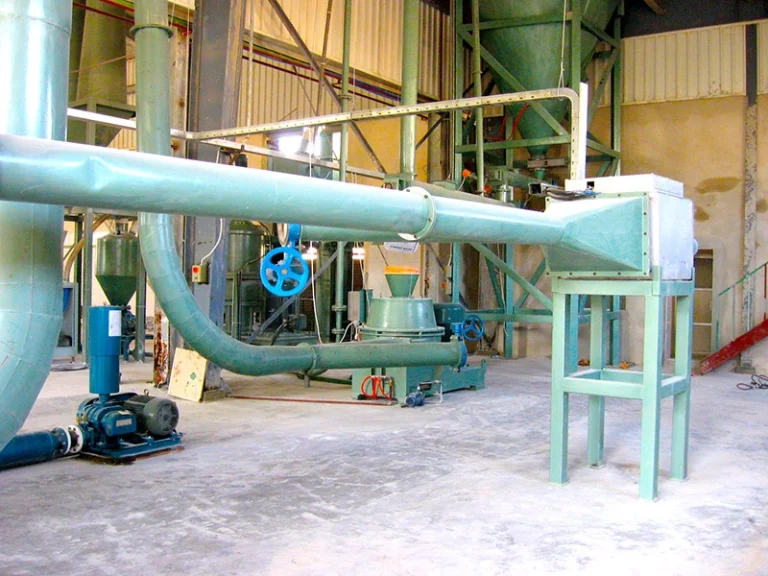
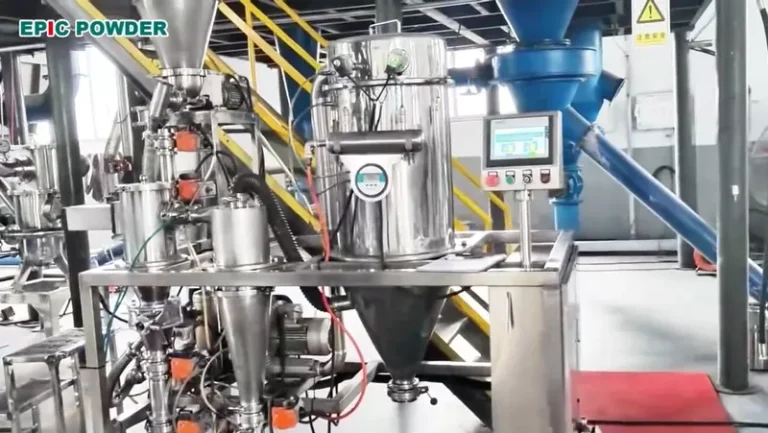
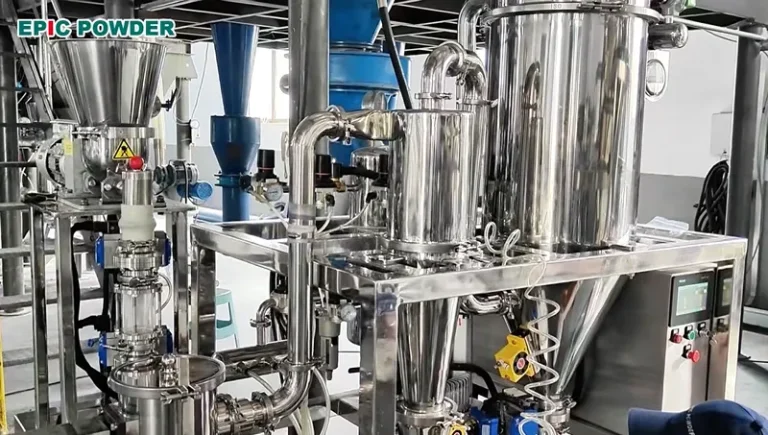
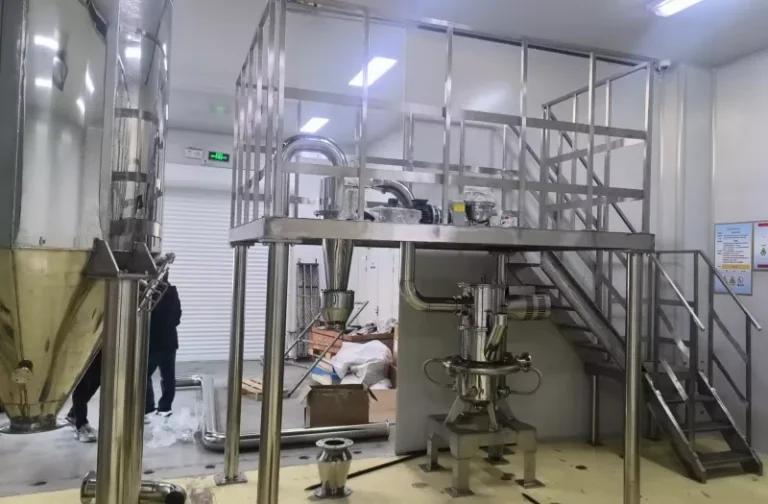
Máy nghiền phản lực MQW là Máy nghiền phản lực tầng sôi, có tích hợp bánh xe phân loại ngang (bánh đơn hoặc nhiều bánh). Khí nén sau khi được lọc và sấy khô sẽ được phun vào buồng nghiền thông qua vòi Laval với tốc độ cao. Tại nơi giao nhau của nhiều luồng không khí áp suất cao, các vật liệu liên tục va chạm, cọ xát và cắt để nghiền nát. Vật liệu nền nổi lên nhờ lực hút của quạt. Luồng khí di chuyển đến khu vực phân loại, dưới lực ly tâm mạnh do tuabin phân loại quay tốc độ cao tạo ra, các vật liệu thô và mịn được tách ra, các hạt mịn đáp ứng yêu cầu về kích thước hạt đi vào máy tách lốc xoáy và máy hút bụi thông qua quá trình phân loại. bánh xe và các hạt thô rơi xuống khu vực nghiền để tiếp tục nghiền.
Máy nghiền phản lực không khí tầng sôi: Sau khi khí nén được lọc và sấy khô sẽ được phun vào buồng nghiền với tốc độ cao thông qua vòi phun Laval. Tại nơi giao nhau của nhiều luồng không khí áp suất cao, các vật liệu liên tục va chạm, cọ xát và cắt để nghiền nát. Các vật liệu bị nghiền nát nổi lên nhờ lực hút của quạt. Luồng không khí di chuyển đến vùng phân loại. Dưới tác dụng của lực ly tâm mạnh do tuabin phân loại quay tốc độ cao tạo ra, các vật liệu thô và mịn được tách ra. Các hạt mịn đáp ứng các yêu cầu về kích thước hạt đi vào máy phân tách lốc xoáy và máy hút bụi thông qua bánh xe phân loại để thu gom, các hạt thô đi xuống vùng nghiền và tiếp tục bị nghiền nát.
| tham số/Mô hình | MQW03 | MQW06 | MQW010 | MQW20 | MQW30 | MQW40 | MQW60 | MQW80 | MQW120 | MQW160 | MQW240 |
|---|---|---|---|---|---|---|---|---|---|---|---|
| Kích thước cho ăn (mm) | <1 | <2 | <2 | <3 | <3 | <3 | <3 | <3 | <1 | <3 | <3 |
| Năng lực sản xuất (kg/giờ) | 0.3~10 | 10~150 | 20~300 | 40~600 | 100~900 | 200~1200 | 500~2000 | 800~3000 | 1500~6000 | 2000~8000 | 4000~12000 |
| Kích thước hạt(D97:μm) | 3~45 | 3~45 | 3~45 | 3~45 | 3~45 | 3~45 | 3~45 | 3~25 | 15x4 | 15x6 | 15x6 |
| Động cơ máy phân loại (kW) | 2.2 | 3 | 5.5/7.5 | 7.5/11 | 11/15 | 15/7.5x3 | 7,5x3 | 11x3 | 15x3 | 15x4 | 15x6 |
| Lượng khí tiêu thụ (m³/phút) | 3 | 6 | 10 | 20 | 30 | 40 | 60 | 80 | 120 | 160 | 240 |
| Áp suất không khí (Mpa) | 0.6~1 | 0.6~1 | 0.6~1 | 0.6~1 | 0.6~1 | 0.6~1 | 0.6~1 | 0.6~1 | 0.6~1 | 0.6~1 | 0.6~1 |
Lưu ý: Năng lực sản xuất có liên quan chặt chẽ đến kích thước hạt, trọng lượng riêng, độ cứng, độ ẩm và các chỉ số khác của nguyên liệu thô. Trên đây chỉ là để tham khảo lựa chọn.
Among particle size reduction technologies, jet milling’s advantages include:
It can achieve very fine particles. It also creates tight size distributions. This is better than other milling methods.
No knives, blades, or hammers. Also, no milling media or screens. This means minimal risk of contamination from worn mill parts.
The simple chamber design is easy to clean, reducing risk of cross contamination
Grinding doesn’t cause temperature changes. This is unlike mechanical mills. Such changes are important for heat-sensitive materials.
Different materials act differently on the jet mill. The best materials are:
Abrasive
Brittle
Dense
Hard
Very friable (in other words, easy to crumble)
Jet mills also have their disadvantages, though they’re few. For one, they can be expensive to buy — which is why working with a toll processor is a smart business decision. A partnership can be a great way to get the benefits of jet milling technology and still manage costs. The process also needs high energy. It needs specialty gases and other special items to meet the specs.
Materials that may respond poorly to the jet milling process are often:
Elastic
Wet
Sticky
Light and fluffy
Easily deformed
Shock absorbent
Difficult to accelerate
Of course, a toll processor has years of experience. They have been meeting tough particle specs. They already have the gear and know-how. They can use it well to get the best results.
By working with a tolling partner’s technical team, you will gain efficiency. They will help choose the best mill type. They will also pick the right speed and feed rate. They will also cover any special project needs.
The team brings focused insights and extensive experience to the table. However, you should also expect to provide safety data sheets and answer a few questions, such as:
A jet mill is a type of ultrafine grinding equipment. It is a machine that uses a lot of energy. Therefore, the feed particle size of the air flow mill should be as fine as possible. It is recommended that the feed particle size be less than 80 mesh. Under normal circumstances, the feed particle size needs to be less than 1 mm.
Jet milling usually makes particles that are 1 to 10 microns in size. This is referred to as micronization.
Some product formulations require particles as small as 200 nanometers. The material's properties determine how small these sizes can be. You can make them smaller by increasing the mill's power. Additionally, by increasing the time the material spends in the milling chamber.
Some products require particles larger than 10 microns. This can be achieved by reducing the power to the mill or increasing the feed rate to the equipment.
In both circular and fluidized bed mills, jets of air or steam are made by gas. The gas is compressed to a gauge pressure of 50 to 120 psig. The most common gas used is commercially compressed air.
Superheated steam (392–980°F) is compressed to 100–220 psig. It can also be used on raw feed materials that are not heat-sensitive. Some of the other gases used include:
Nitrogen, which can protect materials from oxidation and/or fire
Argon, another inert option, though more expensive than nitrogen
Helium, used to achieve higher-velocity impact between particles
A great deal of energy is needed to create enough momentum to cause particles to break on impact. The compressor and nozzles turn high air pressure into energy. They do this within the mill. Large particles recirculate, and multiple high-velocity collisions progressively reduce their mass.
WhatsApp us
Hãy điền form bên dưới.
Các chuyên gia của chúng tôi sẽ liên hệ với bạn trong vòng 6 giờ để thảo luận về nhu cầu của bạn về máy móc và quy trình.
Lỗi: Không tìm thấy biểu mẫu liên hệ.