
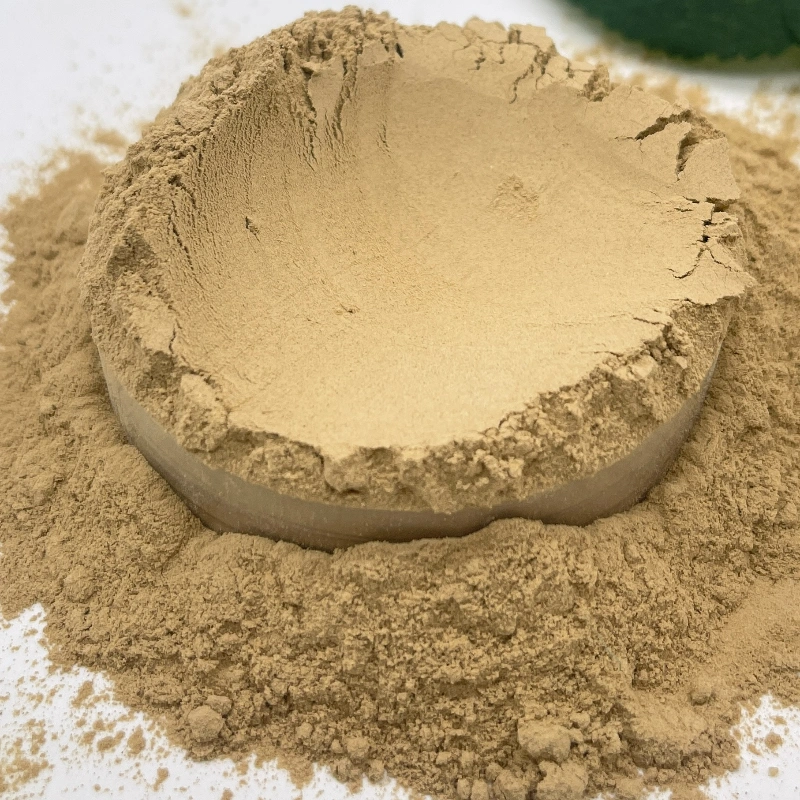
Bentonite is a natural clay 광물 primarily composed of montmorillonite. In the industrial world, it is widely known as the “universal clay.” Montmorillonite has a typical 2:1 layered silicate crystal structure. In this structure, one aluminum-oxygen octahedron layer is sandwiched between two silicon-oxygen tetrahedron layers. Its unique interlayer regions are rich in water molecules and exchangeable cations, such as Na⁺、Ca²⁺、Mg²⁺. This micro-structure gives bentonite remarkable hydrophilicity, high cation exchange capacity (CEC), and high swelling capacity when exposed to water.
Natural bentonite inherently possesses a high specific surface area (usually between 60-800 m²/g) and a well-developed pore structure. With the growth of modern precision agriculture and green pesticide formulation technologies, utilizing ultrafine grinding bentonite as a sustained-release carrier for herbicides has demonstrated massive advantages that traditional carriers simply cannot match. Below is a deep analysis across five dimensions: micro-mechanisms, processing modification, environmental effects, and economic benefits.
Superior Adsorption Performance, Structural Foundation, and the Multiplication Effect of 초미세 분쇄
The primary advantage of bentonite as a herbicide carrier lies in its powerful adsorption capacity. The sheet surfaces and channels of montmorillonite provide a massive number of active sites. These sites lock herbicide molecules onto the particle surfaces and within the layers through physical adsorption (van der Waals forces).
The Quantum Leap Brought by Ultrafine Grinding:
When natural bentonite undergoes ultrafine grinding—typically reducing its 입자 크기 to the micrometer or even nanometer level—its performance experiences a massive leap:
- Exponential Growth in Specific Surface Area: The extreme refinement of the particles exposes a vast amount of previously hidden layers and pores. This provides several times more effective adsorption sites than ordinary powders.
- Mechanochemical Activation: The intense mechanical shearing and impact do more than just reduce particle size. They also destroy parts of the montmorillonite crystal lattice, causing lattice distortion. This “activated” state increases unsaturated bonds on the surface and drastically boosts surface energy. Consequently, it greatly enhances both the physical and 화학적인 adsorption of herbicide molecules.
- Improved Dispersion and Suspendability: Ultrafine bentonite boasts excellent suspension stability in both water and organic phases. It does not settle easily. This is absolutely critical for formulating high-quality herbicide dosage forms, such as suspension concentrates (SC) or wettable powders (WP).
The Synergistic Effect of Organic Modification:
Furthermore, combining the bentonite ultrafine grinding process with organic modification (such as using long-chain quaternary ammonium cation surfactants) can effectively regulate the micro-environment of the interlayer regions. This process transforms the originally hydrophilic bentonite into organobentonite with lipophilic (hydrophobic) properties. This modification significantly boosts its affinity and loading capacity for the vast majority of hydrophobic organic herbicides, such as amide and sulfonylurea herbicides.
Excellent Cation Exchange Capacity (CEC) and Chemical Bonding
Bentonite contains a large number of exchangeable low-valence cations between its layers. This grants it an extremely high Cation Exchange Capacity (CEC), which is one of its core competitive advantages as an active carrier.
Stable Binding Mechanism:
When positively charged herbicide molecules (or herbicides with polar functional groups) come into contact with bentonite, an ion exchange reaction occurs with the interlayer cations. This exchange is not just surface adsorption. Instead, it pulls the herbicide molecules directly into the interlayer regions of the montmorillonite. This forms ion-dipole interactions or strong electrostatic attractions. This chemical bonding mechanism greatly enhances the loading stability of the herbicide on the carrier. As a result, the active ingredients are not easily washed away by rain.
Regulation of Release Kinetics:
Based on this ion exchange and electrostatic bonding, the release of the herbicide into the soil medium is no longer a simple matter of concentration diffusion. Instead, the herbicide molecules must overcome electrostatic attraction. In some cases, other ions in the soil are even required to trigger a “secondary exchange” to desorb the molecules. This mechanism provides an additional pathway to regulate release kinetics. It achieves a smoother and more durable release of the drug. Ultimately, it effectively avoids the classic flaws of traditional herbicides, where concentrations are too high early on (causing crop damage) and too low later on (rendering them ineffective).
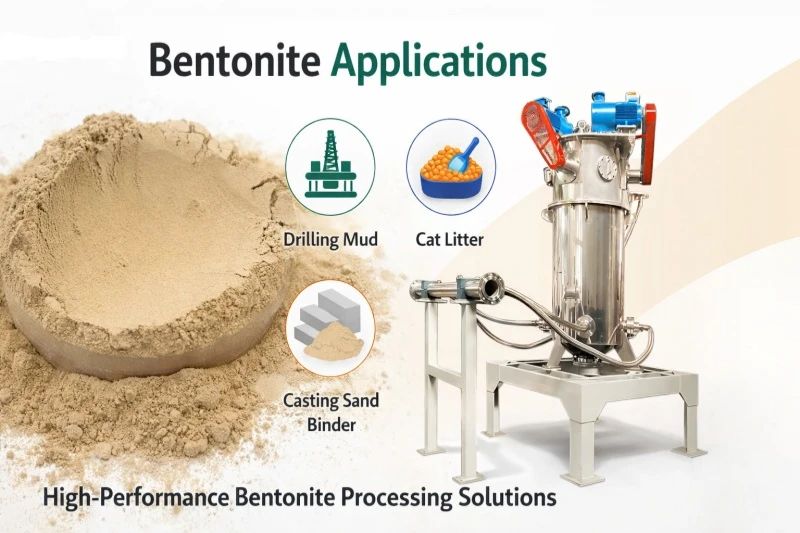
High Modifiability and Potential for Customized Performance Regulation
Bentonite is not a rigid or inert filler. It is a smart base material with a very high degree of design freedom. Its structural parameters—such as interlayer spacing (d001), layer charge density, and surface acidity or alkalinity—can be flexibly and precisely regulated through various physical and chemical methods.
Diversified Modification Methods:
- Acid and Thermal Activation: These can clear out pore channels and adjust the specific surface area and pore volume.
- Inorganic Pillaring: This involves introducing inorganic polymers (such as polymerized aluminum or iron) between the layers. This forces the interlayer spacing to expand, forming a microporous material with a fixed pore size. This structure is perfect for embedding large-molecule herbicides.
- Organic Modification and Ultrafine Compounding: As mentioned earlier, this adjusts the surface hydrophilicity and hydrophobicity.
A Case of “Customized” Drug Loading:
This powerful modifiability allows bentonite to be “customized” to meet the loading and release needs of herbicides with different physical and chemical properties. Agricultural pharmaceutical research shows that bentonite treated with ultrafine grinding and organic modification has a significantly enhanced adsorption capacity for pretilachlor, a common paddy field herbicide. This capacity increases as both the modifier load and grinding fineness increase. Even more excitingly, the effective field release time of pretilachlor loaded on modified ultrafine bentonite was extended by 16 to 23 times compared to the untreated technical material. This means a single application can protect the crop throughout its sensitive period, drastically reducing the required frequency of pesticide applications.
Good Environmental Stability and Ecological Safety
Any carrier used for agricultural chemicals must account for its performance in complex natural environments. Bentonite demonstrates extremely high ecological adaptability in this regard.
Physical and Chemical Stability:
Bentonite is essentially a natural aluminosilicate mineral. It has undergone hundreds of millions of years of weathering and geological evolution in nature. Therefore, its 2:1 layered crystal structure exhibits excellent chemical and physical stability within common soil pH ranges (both slightly acidic and alkaline) and under severe weather conditions (such as high temperatures and UV radiation). This stability ensures that the sustained-release behavior of the loaded herbicide remains highly consistent and predictable, even in complex and changing field environments.
Soil Improvement and Eco-Friendliness:
Many synthetic polymer sustained-release carriers use non-degradable plastic microspheres or synthetic resins. Unlike them, bentonite is naturally one of the components of soil. Its introduction does not cause secondary pollution, such as microplastic pollution. Instead, it actually helps to improve soil structure. Bentonite can enhance the water-holding and fertilizer-retaining capacity of sandy soils. It also increases the soil’s cation exchange buffering capacity. This “dual-benefit” feature of carrying medicine while improving soil perfectly fits the current global strategies advocating for “green pesticides” and sustainable agriculture.
Significant Cost-Effectiveness and Resource Availability
The practical implementation of any high-tech solution cannot ignore cost considerations. On this front, bentonite holds an absolute industrial advantage over other high-end nano-carriers, such as carbon nanotubes or mesoporous silica.
Abundant Reserves and Low Cost:
Bentonite deposits are widely distributed across the globe, and the proven reserves are extremely rich. Its mining and primary processing technologies are already highly mature, keeping raw material costs relatively low.
Industrial Feasibility of Ultrafine Grinding:
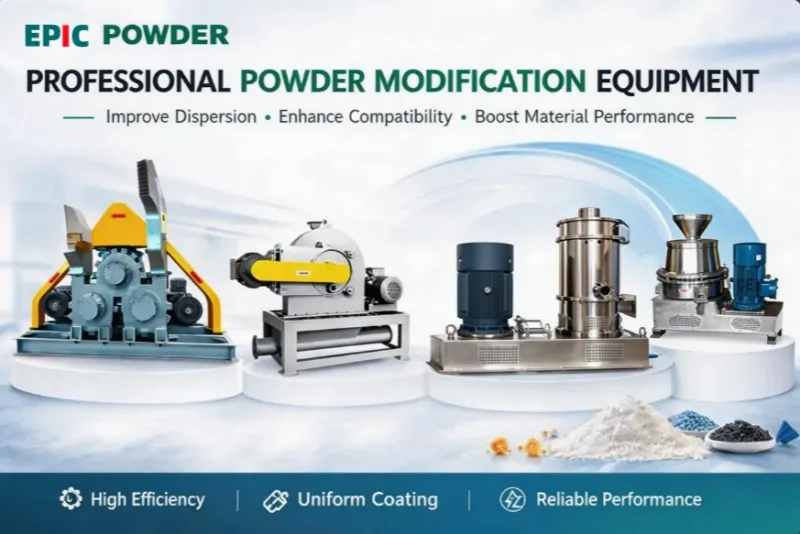
While ultrafine grinding does consume mechanical energy, modern industrial equipment—such as 제트밀, stirred mills, and Raymond mills—can already achieve large-scale, low-cost continuous production. The cost-effectiveness of bentonite ultrafine grinding combined with 표면개질 remains far lower than that of synthetic polymer carriers. This natural price advantage gives it overwhelming economic competitiveness and massive promotion value in the large-scale industrial production of herbicide controlled-release agents and granules.
결론
To sum up, bentonite’s unique layered silicate structure, massive specific surface area, and excellent cation exchange capacity make it an ideal choice for a herbicide carrier. The introduction of ultrafine grinding technology shatters the performance ceiling of this natural mineral. By reducing particle sizes to the micro-nano scale and triggering mechanochemical activation, it multiplies both adsorption capacity and suspension stability. Combined with flexible chemical modification, outstanding environmental stability, and an unmatched cost advantage, modified ultrafine bentonite holds brilliant application prospects. It will help achieve the goal of “reducing pesticide usage while increasing efficiency,” making it a crucial cornerstone for the future development of green pesticide formulations.
읽어주셔서 감사합니다. 제 글이 도움이 되셨으면 좋겠습니다. 아래에 댓글을 남겨주세요. 추가 문의 사항은 젤다 온라인 고객 담당자에게 연락하실 수도 있습니다.
— 게시자 에밀리 첸