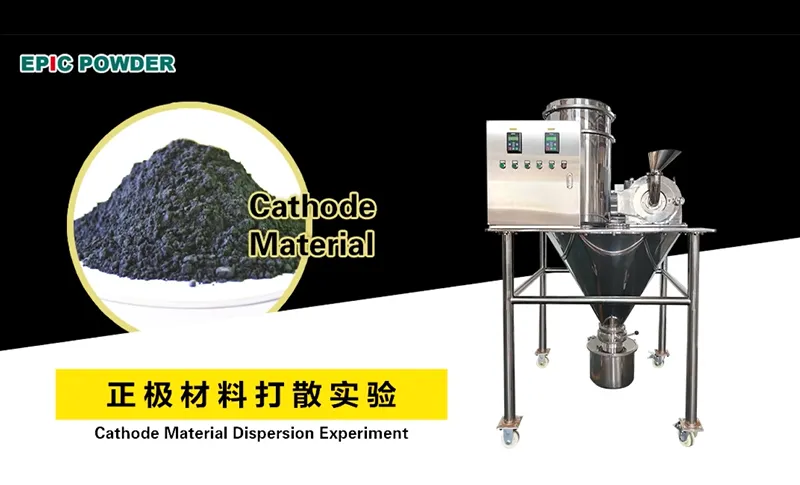
In the production of 리튬 이온 배터리, the performance of cathode materials—such as lithium cobalt oxide (LCO), nickel–cobalt–manganese oxides (NCM), and 리튬 철 인산 (LFP)—directly affects energy density, cycle life, and safety. Among the common challenges in cathode material processing, agglomeration is one of the most critical. These agglomerates are often formed due to van der Waals forces or electrostatic interactions, making particles difficult to disperse uniformly. This, in turn, affects slurry rheology and the final microstructure of the electrode. Agglomerates not only lead to a broad 입자 크기 distribution but may also reduce ion transport efficiency and overall battery performance.
This article explores why agglomerates are difficult to break apart. It focuses on using a 핀밀 to optimize the particle size distribution of cathode materials, ultimately improving efficiency and quality.

Causes and Impacts of Agglomeration
During processing, cathode material particles tend to form both soft aggregates and hard agglomerates. Soft aggregates can usually be dispersed easily through mechanical stirring or the use of dispersants. Hard agglomerates, however, are held together by strong intermolecular forces—such as van der Waals forces—and are much more difficult to separate.
This phenomenon is especially common in conductive additives like 카본 블랙. Strong interparticle attractions create large, persistent clusters in the slurry. Research indicates that van der Waals forces cause these hard agglomerates, which ultimately disrupt electrode uniformity and the conductive network.
Agglomeration leads to several adverse effects. First, it causes a non-uniform particle size distribution. Ideally, cathode materials should exhibit a narrow particle size distribution to ensure slurry stability and optimized electrochemical performance. If the distribution is too wide, fine particles may fill voids, while large agglomerates create uneven porosity, reducing lithium-ion diffusion rates.
Second, during electrode 코팅, agglomerates may cause defects such as uneven coatings or adhesion problems, which can ultimately compromise battery capacity and cycling stability. In addition, agglomeration becomes more severe in high–solid-content slurries, further increasing processing difficulty.
Working Principle and Advantages of Pin Mills
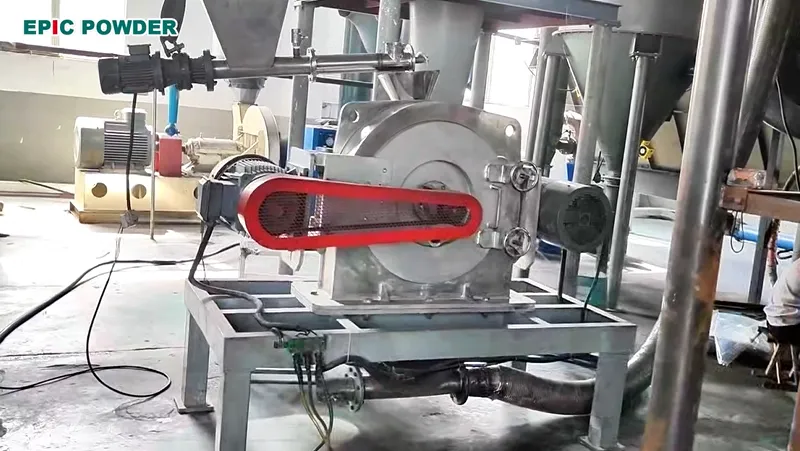
그만큼 핀밀 is a high-efficiency mechanical grinding device. It is widely used in powder processing, particularly for the size reduction and dispersion of battery materials. Its operation relies on centrifugal impact. As material enters the chamber, high-speed rotating pins subject it to intense impact and shear. Additionally, auxiliary airflow or rotor motion promotes interparticle collisions to achieve fine grinding.
Unlike traditional ball mills or hammer mills, pin mills do not rely on screens, hammers, or cutting blades. Instead, particle size distribution is controlled by the precise arrangement and configuration of the pins.
In cathode material processing, pin mills are particularly suitable for lithium-based compounds such as lithium iron phosphate and lithium titanate. Their key advantages include:
- 정확한 입자 크기 제어: By adjusting rotational speed, pin clearance, and feed rate, a narrow particle size distribution—typically in the micron range (5–10 μm)—can be achieved.
- Efficient deagglomeration: High-speed impact effectively breaks hard agglomerates without excessive heat generation, avoiding material degradation.
- Continuous operation: Pin mills support continuous processing and coating lines, making them suitable for large-scale battery manufacturing.
- Integration with air classification: They are often combined with 공기 분류기 systems to further optimize particle size distribution.

Practical Methods for Optimizing Cathode Particle Size Distribution with a Pin Mill
To optimize the particle size distribution of cathode materials using a pin mill, the following steps can be applied:
- Pre-treatment stage:
First, the raw material (such as Ni-rich layered oxides) should be pre-crushed to ensure an appropriate initial particle size range (e.g., 5–10 mm). Adding dispersants (such as sodium polyacrylate) can reduce viscosity and promote uniform feeding. - Optimization of grinding parameters:
Key parameters include rotor speed (typically 1,000–3,000 rpm), pin configuration, and airflow intensity. Higher rotational speeds help break agglomerates but should be carefully controlled to avoid excessive grinding and the generation of too many nanoscale particles.
For lithium battery cathodes, the target particle size distribution is often D50 = 5–15 μm with D90 < 30 μm, which helps improve compaction density and ion transport. Experimental results show that an optimized distribution can achieve a D30/D70 ratio greater than 0.45, thereby enhancing packing density. - Combination with other processes:
Pin mills can be integrated into ball-mill–classifier production lines. Multi-stage classifiers can be used to fine-tune the distribution curve, ensuring minimal energy consumption and reduced overgrinding. During slurry preparation, in-situ deagglomeration—adding solvent during grinding—can further enhance dispersion uniformity. - Performance evaluation:
Laser particle size analyzers are used to monitor distribution curves. An ideal distribution is uniform, enabling higher slurry solid content and fewer coating defects. Studies indicate that a uniform particle size distribution can significantly improve lithium-ion mobility and battery capacity.
결론
The difficulty of breaking agglomerates remains a key bottleneck in cathode material processing. Through precise impact grinding and parameter optimization, pin mills provide an effective solution for achieving narrow particle size distributions and stable deagglomeration. This directly contributes to improved slurry homogeneity, higher compaction density, and enhanced electrochemical performance of lithium-ion batteries.
에픽 파우더 brings over 20 years of experience to ultrafine powder processing. We offer customized pin mill and air classification solutions specifically for lithium battery cathode and conductive materials. Our system integrates grinding, deagglomeration, and classification into a single optimized process. This helps manufacturers achieve consistent particle size control and scalable production. As battery specifications tighten, our advanced milling technologies will remain essential for next-generation energy storage.

읽어주셔서 감사합니다. 제 글이 도움이 되셨으면 좋겠습니다. 아래에 댓글을 남겨주세요. 추가 문의 사항은 젤다 온라인 고객 담당자에게 연락하실 수도 있습니다.
— 게시자 에밀리 첸