
Jet mill pricing, operating costs, and total cost of ownership compared, from lab-scale units to full industrial production systems.
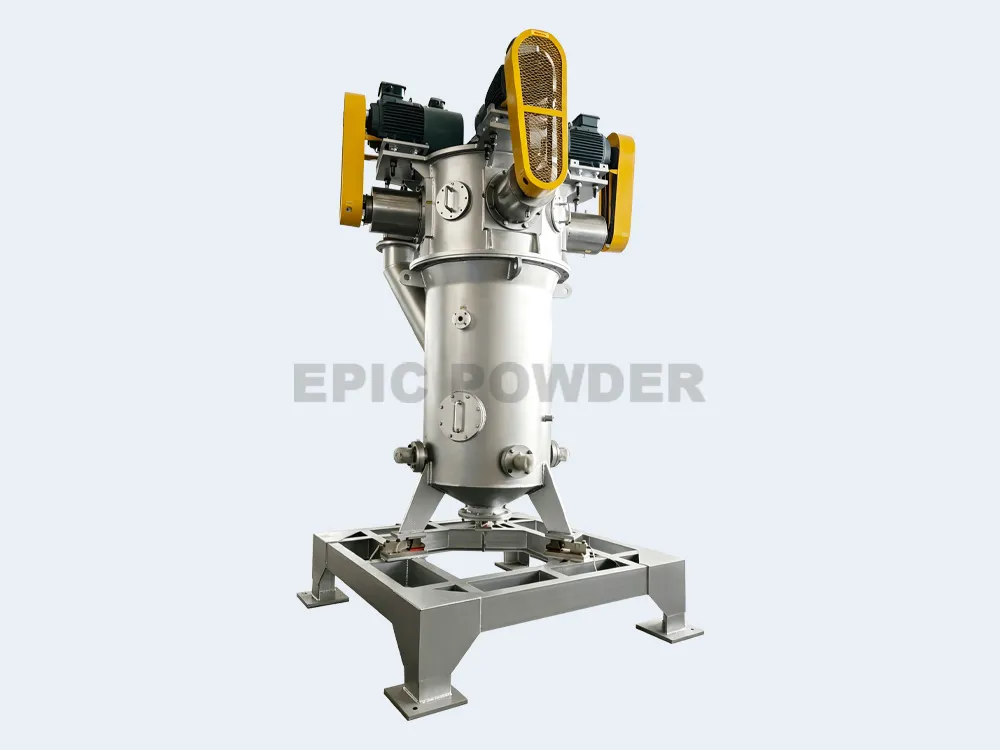
When evaluating a jet mill purchase, the first question is usually: "How much does it cost?" Jet mill pricing is not one-size-fits-all. Unlike commodity equipment, jet mills are configured for specific materials, throughput targets, and particle size requirements. The price of a system that grinds battery-grade graphite to D50 = 3 µm is very different from one that processes industrial minerals to D97 = 45 µm.
Below we break down real price ranges across different scales, the six key factors that drive cost, operating expenses, and how jet mill total cost of ownership compares to ball mills.
1. Jet Mill Price Ranges by Scale
Jet mill pricing spans several orders of magnitude depending on capacity, configuration, and application. The table below provides indicative market ranges based on current supplier data and industry benchmarks.[1][2]
2. Six Key Factors That Determine Jet Mill Cost
Here are the six factors that have the biggest impact on your final quote.
2.1 Throughput Capacity
This is the single biggest cost driver. A 10 kg/h lab unit and a 10 t/h industrial system are fundamentally different machines, not just scaled-up versions of each other. Larger throughput requires bigger grinding chambers, more nozzles, larger classifiers, and more powerful compressors. According to industry cost models, a 10–50 tph industrial jet mill system ranges from $300,000 to over $2 million, with the compressor system alone accounting for 40–60% of the total startup cost.[3]
2.2 Target Particle Size / Fineness
Finer targets demand more sophisticated equipment. Achieving D97 = 5 µm requires a high-performance classifier, precise airflow control, and often a fluidized bed jet mill design. If your target is D97 = 3 µm or below, expect a meaningful price premium for the additional classification stages and tighter manufacturing tolerances. Coarser targets (D97 = 20–45 µm) can often be achieved with simpler, less expensive configurations.
2.3 Compressed Air / Gas Infrastructure
Jet mills rely on high-pressure compressed air (or steam, or nitrogen) to accelerate particles to supersonic speeds. The compressor is often the most expensive single component in the system. For a 10 t/h calcium carbonate line at D97 = 5 µm, the compressed air system alone can cost $200,000–$500,000.[3] If your facility already has sufficient compressed air capacity, this cost can be partially offset.
2.4 Material of Construction and Linings
Standard carbon steel construction is the baseline. However, many applications require specialized linings:
- Ceramic-lined (alumina or zirconia): For high-purity applications where metal contamination must be avoided. Adds 15–30% to equipment cost.
- Polyurethane (PU) lined: More economical than ceramic, suitable for moderate abrasion and non-extreme purity requirements.
- Stainless steel (304/316L): Required for food, pharmaceutical, and certain chemical applications. Adds 20–40% to equipment cost.
2.5 Automation and Control Systems
A basic manual system costs less than a fully automated one with PLC, HMI touchscreen, real-time particle size monitoring, and remote diagnostics. Automation adds $15,000–$80,000+ depending on complexity, but reduces labor costs and improves consistency in production environments.
2.6 Enclosure and Safety Requirements
Explosion-proof designs (ATEX/NFPA compliance), pharmaceutical-grade enclosures, or cleanroom-compatible construction add significant cost, typically 20–50% above standard configurations. These requirements are non-negotiable for certain industries, so factor them in early.
3. Jet Mill Operating Costs Breakdown
Jet mills are energy-intensive to operate, and ongoing costs can exceed the initial capital investment within a few years.
3.1 Energy Consumption
Jet mills use high-pressure compressed air to accelerate particles, and generating that compressed air requires significant electrical power. Typical specific energy consumption ranges from 35–60 kWh per ton for compressed air jet mills at D50 ≈ 3 µm.[4] For harder materials or finer targets, energy consumption can reach 300–800 kWh/t.[3]
A 10 t/h jet mill grinding CaCO₃ to D97 = 5 µm can consume $960,000–$1,800,000 per year in electricity alone, depending on local rates.[3] Energy is the dominant operating expense for jet mills.
3.2 Compressed Air / Gas Consumption
A compressed air jet mill processing CaCO₃ to D97 = 3–10 µm consumes approximately 800–1,500 m³ of air per ton of product.[3] If nitrogen inerting is required for flammable or oxygen-sensitive materials, gas costs add another layer of expense.
3.3 Maintenance Costs
One advantage of jet mills: no grinding media means lower wear-part costs. Typical wear-part expenses are $0.50–$1.00 per ton, compared to $2–$4 per ton for ball mills.[4] Annual maintenance for a 10 t/h industrial system runs approximately $40,000–$70,000, covering nozzle replacement, classifier inspection, and general servicing.[3]
3.4 Nozzle Replacement
Jet mill nozzles are subject to abrasive wear from high-velocity particles. Replacement intervals depend on material hardness, but typically fall in the 6–12 month range. A full set of replacement nozzles for a mid-size industrial jet mill costs $2,000–$8,000.
4. Jet Mill vs Ball Mill: Total Cost of Ownership
A common question is: "Should I buy a jet mill or a ball mill?" The table below compares the total cost of ownership for both technologies at industrial scale.
| Cost Factor | Ball Mill | Jet Mill (Compressed Air) |
|---|---|---|
| Capital Cost (10–50 tph) | $200,000 – $1,500,000 | $300,000 – $2,000,000 |
| Installed Power per tph | ~20 kW | ~120 kW (compressor + mill) |
| Specific Energy | ~15 kWh/t | ~40 kWh/t |
| Wear Parts per Ton | $2 – $4 | $0.50 – $1 |
| All-in Operating Cost per Ton | $6 – $12 | $18 – $30 |
| Minimum Practical Particle Size | D97 ≈ 10–20 µm | D97 ≈ 3–5 µm |
| Metal Contamination Risk | Moderate (media wear) | Very low (no grinding media) |
Sources: Habtoor Resources, JACAN Powder Equipment.[3][4]
Ball mills are cheaper upfront and cheaper to operate. Jet mills justify their premium when any of the following apply:
- Target particle size is ≤ 10 µm, especially below 5 µm, where ball mills struggle to achieve narrow distributions.
- Purity is critical. Applications in pharmaceuticals, battery materials, and advanced ceramics cannot tolerate metal contamination from grinding media.
- Material is heat-sensitive. Jet milling's adiabatic expansion cooling helps control temperature without external cooling systems.
- Material is very hard (Mohs > 7). Jet mills excel at grinding hard, abrasive materials that would rapidly wear ball mill media.
- Particle shape must be preserved. Jet milling maintains the original particle morphology better than ball milling for plate-like or needle-shaped materials.
5. Hidden Costs Buyers Often Overlook
Several expenses catch first-time buyers off guard. Budget for these from the start.
- Installation and commissioning: Typically 5–15% of the equipment cost. Includes mechanical and electrical installation, system integration, and on-site calibration.
- Civil works and facility modifications: Foundations, reinforced flooring, ventilation, and utility connections can add tens of thousands of dollars.
- Initial spare parts inventory: Nozzles, gaskets, filter elements, and classifier components. Budget 2–8% of equipment cost.
- Operator training: Jet mills require skilled operators. At Epic Powder Machinery, we include on-site training during commissioning, but you should budget for ongoing training as staff turnover occurs.
- Auxiliary equipment: Air dryers, filters, feeding systems, and product collection equipment are often quoted separately. Confirm what is included.
- Shipping and logistics: For international buyers, freight, customs duties, and local handling can add 5–15% to the total cost.
6. How to Get an Accurate Jet Mill Quote
Before contacting a supplier, prepare the following information:
- Material details: Type, hardness (Mohs), feed particle size (D50/D97), moisture content, and any special characteristics (flammable, heat-sensitive, abrasive).
- Target specifications: Desired D50, D97, throughput in kg/h or t/h, and acceptable particle size distribution width.
- Purity requirements: Maximum allowable metal contamination (ppm), need for ceramic or PU lining, and cleanroom compatibility.
- Special requirements: Explosion-proof design, nitrogen inerting, pharmaceutical GMP compliance, or FDA-compliant materials of construction.
- Site conditions: Available power supply, compressed air capacity (if any), floor space, and ceiling height.
7. Is a Jet Mill Worth the Investment?
The answer depends on your product and market:
Jet mills are worth the premium when: your product commands a high market price (battery materials, pharmaceutical APIs, specialty pigments, advanced ceramics), and the finer particle size or higher purity directly translates to better performance or higher selling price. In these cases, the $18–$30/ton operating cost is easily absorbed by product margins.
Ball mills or mechanical mills make more sense when: you are producing standard fillers, industrial minerals, or bulk commodities where particle size requirements are moderate (D97 > 15 µm) and cost per ton is the primary driver. At $6–$12/ton all-in operating cost, ball mills are the economical choice for these applications.
At Epic Powder Machinery, we have spent over 20 years helping clients across 160+ countries evaluate the total cost of ownership for powder processing equipment. We do not push one technology over another. We help you find the right solution for your material, your budget, and your business goals.
Get a Customized Jet Mill Quote
Contact Epic Powder Machinery today for a free consultation, material testing, and a detailed quote tailored to your application. Our engineering team will help you select the right configuration for your material and budget.
Request a Quote