Polymer materials are one of the three major material systems alongside metals and ceramics in modern industry. They are widely used in daily necessities, electronics, electrical components, cable manufacturing, automotive parts, construction materials, and many other fields. However, since most polymers have carbon-chain backbones, they readily decompose when heated and generate flammable gases. As a result, they ignite easily in the presence of an open flame, posing significant threats to human safety and property. Therefore, incorporating aluminum hydroxide, one of the most widely used halogen-free flame retardants, has become an important approach to enhancing the flame-retardant performance of polymers and an important research topic in material science.

Combustion Mechanism of Polymers and Flame-Retardant Strategies
Essentially, the combustion of polymers is a thermal decomposition process. Once heated to a certain temperature, polymer chains break, generating volatile flammable species that participate in free-radical chain reactions in the flame zone, further intensifying combustion. This process releases a large amount of heat, which feeds back into the material, causing continuous thermal degradation and forming a vicious cycle.
Based on this mechanism, current flame-retardant strategies mainly focus on two approaches:
Gas-Phase Flame Retardancy
Interrupting free-radical chain reactions in the combustion zone to reduce combustion efficiency.
Condensed-Phase Flame Retardancy
Blocking heat transfer or forming a protective char layer to prevent heat and flammable decomposition products from migrating to the flame zone.
To achieve these effects, various flame retardants have been developed. They work by absorbing heat, releasing inert gases, capturing free radicals, or promoting carbonization. Depending on their 化学薬品 structure, flame retardants can be broadly divided into organic and inorganic types.
Why Many Industries Are Shifting Toward Inorganic Flame Retardants
Although some organic flame retardants—such as halogenated systems—are highly effective, their thermal decomposition products may pose toxicity or environmental risks. With increasingly stringent environmental regulations, industries are turning toward safer, environmentally friendly inorganic flame retardants.
Advantages of Inorganic Flame Retardants:
- Non-toxic and low smoke generation
- High thermal stability and low chemical reactivity
- Relatively low cost and high permissible loading levels
Among all inorganic flame retardants, aluminum hydroxide (Al(OH)₃, ATH) is the most widely used and is regarded as a “perennial favorite” in the flame-retardant industry.
Why Is Aluminum Hydroxide So Popular?

As the largest-volume and most widely applied inorganic flame retardant, ATH can be found in almost all polymer flame-retardant systems, including wire and cable compounds, rubber products, thermosets, thermoplastics, and building materials. Its advantages mainly include:
1. Strong Endothermic Decomposition (Physical Heat Absorption & Cooling)
ATH undergoes an endothermic decomposition at around 200–300°C:
Al(OH)₃ → Al₂O₃ + 3H₂O↑
This reaction absorbs significant heat and releases water vapor, which dilutes flammable gases and slows down combustion.
2.Formation of Protective Alumina Layer (Condensed-Phase Protection)
The generated Al₂O₃ forms a dense, stable ceramic-like layer on the material surface, blocking oxygen and preventing further thermal decomposition of the polymer.
3.Safe, Environmentally Friendly, and Cost-Effective
ATH is chemically stable and does not produce toxic gases. It aligns with global environmental regulations. Its abundant resources and low cost also make it ideal as both a flame retardant and functional filler, improving mechanical and insulation properties while reducing smoke.
4.Extremely Wide Application Range
Due to its moderate decomposition temperature, ATH is particularly suitable for low-processing-temperature polymers such as polyolefins, PVC, and rubber.
Common applications include:
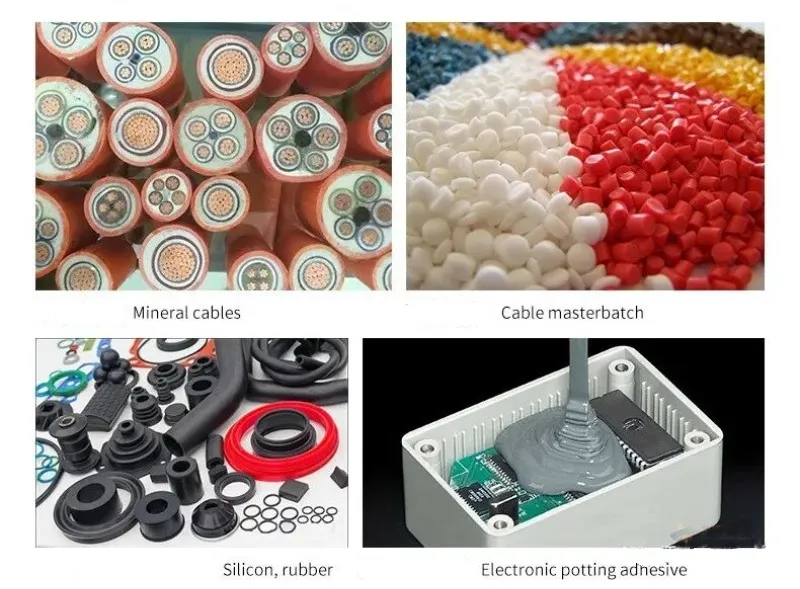
- Wires & Cables: low-smoke halogen-free cable compounds with 50%–65% ATH loading
- 建材: thermal insulation boards, flame-retardant aluminum composite panels, subway/tunnel composites
- Automotive & Transportation: EV battery pack materials, interior parts, rail transit components
- Electronics & Appliances: PCB laminates, appliance housings, plugs & sockets
- Rubber Conveyor Belts: flame-retardant antistatic belts for mining
Aluminum hydroxide also has disadvantages.
Main drawbacks include:
- High loading levels (typically 40%–65% for UL94 V-0), which may reduce mechanical strength and melt flow
- High hydrophilicity and poor compatibility with hydrophobic polymers, requiring surface treatment (silane, titanate, stearic acid, etc.)
However, with advances in ultrafine grinding (D50 < 2 μm), surface modification, nano-ATH, and synergistic use with magnesium hydroxide, these issues have been greatly alleviated.
Preparation and Grinding Technology of Aluminum Hydroxide:

The performance of ATH in flame-retardant systems is closely related to its 粒子サイズ, particle-size distribution, specific surface area, and surface properties. Therefore, high-quality ATH must rely on stable and precise grinding and classification processes.
1. Raw Material Source and Pre-Treatment
Industrial-grade ATH is typically produced through the Bayer process. The raw ATH particles often exhibit agglomeration and relatively large particle size. Further grinding is required to meet performance requirements in polymer systems.
2. Grinding Equipment Selection: The Key to Particle Size Control
Different applications demand different particle sizes:
- Cable compounds: D50 = 1–10 μm
- Coatings / Adhesives: finer grades
- High-end masterbatches: D97 < 10 μm with narrow size distribution
Common grinding solutions include:
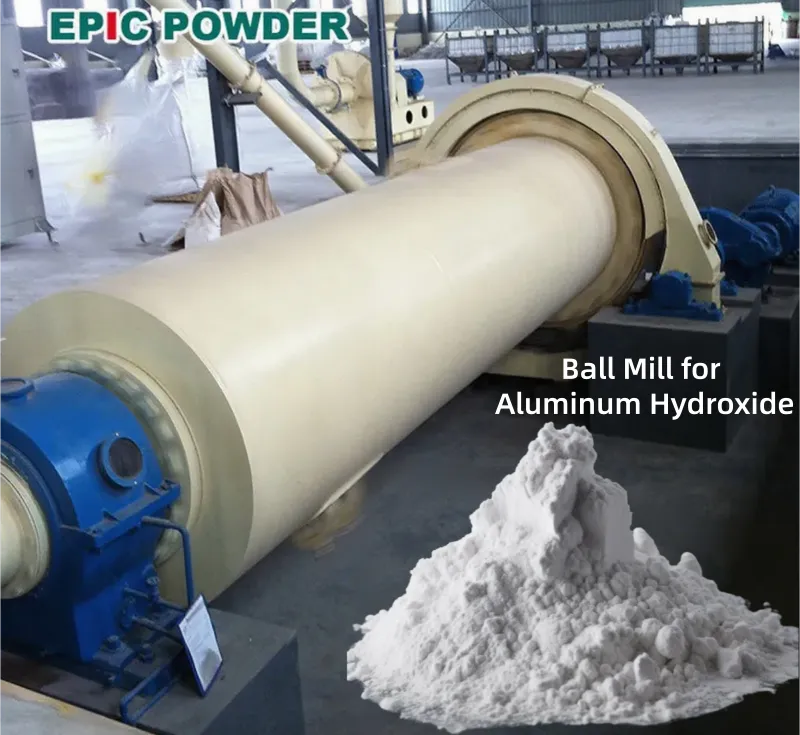
ボールミル+空気分級システム
- Ideal for large-scale, stable production of D50 1–8 μm ATH
- Precise particle-size control, achieving D97 10–15 μm
- Widely used in PVC, PP, cable compounds
- Improved particle shape and dispersibility
Jet Mill (Air Jet Mill)
- Uses high-velocity airflow for ultrafine impact grinding
- Produces D97 3–5 μm or finer supermicron powder
- Suitable for engineering plastics, transparent materials, optical-grade formulations
- No media contamination, ensuring high purity

Vertical Roller Mill, ピンミル, Impact Mill
- Suitable for medium-fineness grades (D50 5–30 μm)
- Used in construction materials and rubber products
- Higher output, lower operating cost
3. Classification Technology: Ensuring Narrow PSD and High Stability
High-precision turbine or multi-wheel classifiers separate fine and coarse particles, providing ATH with:
- 狭い粒度分布
- Lower system viscosity in polymer melts
- Uniform dispersion
- More stable and efficient flame-retardant performance
Especially in high-loading cable compounds, particle-size stability directly influences mechanical properties and extrusion performance.
4. 表面改質: Improving Compatibility with Polymer Matrices
Non-polar polymers such as PP and PE exhibit poor compatibility with inorganic fillers, making surface treatment essential.
Common Coupling Agents
- Titanates
- Silanes
- Aluminates
Modification Process
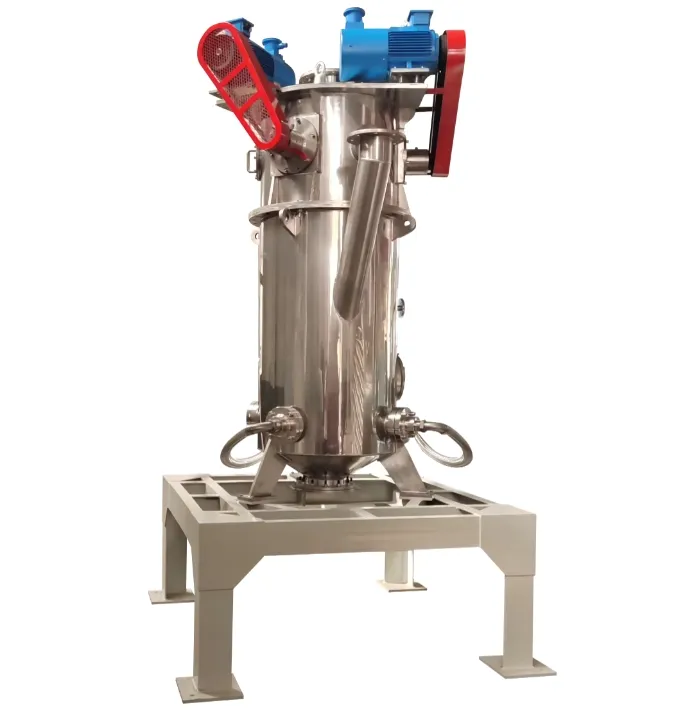
Continuous modifier + high-shear mixing
Benefits
- Lower melt viscosity
- Better dispersion
- Higher allowable filler loading
- Improved mechanical properties
In wire and cable compounds, high-quality ATH must undergo surface コーティング to achieve excellent processing stability and electrical insulation performance.
結論
Improving the flame-retardant performance of polymers is a long-term and critical task. Among numerous flame retardants, aluminum hydroxide stands out due to its heat absorption, water release, protective layer formation, safety, and environmental friendliness. It enhances flame-retardant levels while meeting increasingly strict regulations, making it widely used in cables, construction, automotive, and electronics.
As flame-retardant technology evolves, ATH will continue to play a key role—especially in high-efficiency formulations, synergistic systems, and precision applications.
エピックパウダー provides complete processing solutions for ATH production, including:
- ボールミル + multi-stage 空気分級機 systems
- Jet mill ultrafine powder production lines
- Continuous powder surface modification systems
Through precise particle-size control, low-contamination grinding, and efficient modification, EPIC Powder enables stable, high-performance ATH for cable compounds, rubber, construction materials, and engineering plastics.

読んでいただきありがとうございます。この記事がお役に立てれば幸いです。ぜひ下のコメント欄にご意見をお寄せください。また、ご質問等ございましたら、Zeldaのオンラインカスタマーサポートまでお問い合わせください。
— 投稿者 エミリー・チェン