
In the field of materiais em pó, negro de carbono branco (precipitated silica) e negro de carbono are two important inorganic functional fillers. Although their names are similar, they differ significantly in structure, properties, preparation methods, and applications. In many industries, they not only demonstrate unique advantages but also complement each other.
Basic Concepts and Properties
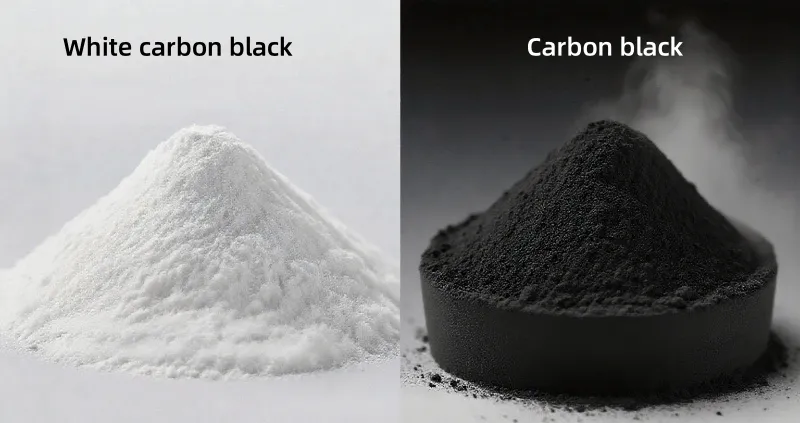
Preto de carbono branco (SiO₂·nH₂O)
- Nature: Amorphous silicon dioxide synthesized mainly by precipitation or fumed methods.
- Aparência: White powder with high specific surface area and porous structure.
- Key Properties: Large surface area, strong adsorption capacity, chemical stability, hydrophilic nature (or hydrophobic after surface modification).
Negro de carbono (C)
- Nature: Amorphous carbon obtained by the incomplete combustion or thermal decomposition of hydrocarbons.
- Aparência: Black fine powder, usually in an aggregated state.
- Key Properties: Extremely small particle size, high structure, strong blackness, good electrical conductivity, excellent reinforcing performance.
Métodos de preparação
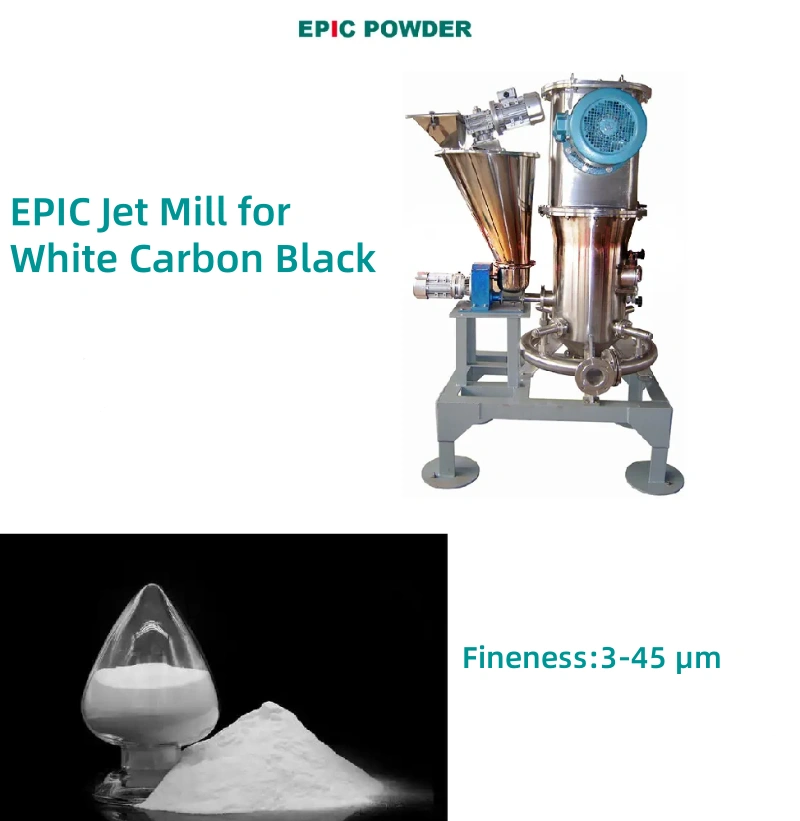
White Carbon Black: Produced mainly by the precipitation method (reaction of sodium silicate with sulfuric or hydrochloric acid) and the fumed method (hydrolysis of silicon tetrachloride in a hydrogen–oxygen flame). The precipitation method has lower cost and higher output, while the fumed method produces purer and higher-performance products.
Negro de carbono: Produced by furnace method (partial combustion of natural gas or heavy oil), channel method, and thermal decomposition. Among them, the furnace process dominates in production and applications.
Aplicativo Fields
Applications of White Carbon Black
- Rubber industry: As a reinforcing filler, especially in green tires, it reduces rolling resistance, improves wet grip, and lowers fuel consumption.
- Coatings and inks: Used as a matting agent and rheology controller, improving wear resistance and anti-settling performance.
- Plastics and adhesives: Enhances mechanical strength, barrier properties, and anti-aging performance.
- Pesticides, feed, toothpaste: Serves as a carrier, diluent, or abrasive.
Applications of Negro de carbono
- Rubber industry: The most important reinforcing filler for tires, seals, hoses, etc., improving wear resistance and mechanical strength.
- Pigments: Widely used in inks, coatings, and plastics as a black pigment with excellent tinting strength and lightfastness.
- Conductive materials: Conductive carbon black is used in cables, lithium batteries, and electrode materials.
- Others: Applied as a catalyst carrier, UV stabilizer, and more.
Comparison Between White Carbon Black and Carbon Black
| Item | Preto de carbono branco | Negro de carbono |
| Aparência | White powder | Black powder |
| Main Component | SiO₂·nH₂O | C |
| Tamanho da partícula | Nano-scale, aggregated | Nano-scale, aggregated |
| Features | High surface area, hydrophilic, reinforcing but non-conductive | Strong blackness, conductive, excellent reinforcing ability |
| Rubber Application | Improves rolling resistance and wet grip (green tires) | Enhances wear resistance, tear resistance, and strength |
| Typical Uses | Green tires, toothpaste, pesticide carrier | Traditional tires, conductive plastics, pigments |
Relationship and Development Trends
With the rise of green and low-carbon concepts, white carbon black has increasingly formed a complementary relationship with carbon black in the tire industry:
- Traditional tires rely heavily on carbon black for reinforcement but suffer from higher rolling resistance and energy consumption.
- New-generation “green tires” use large amounts of silica in combination with silane coupling agents, significantly improving low rolling resistance and wet grip performance.
- In conductive materials and deep-colored plastics, carbon black remains irreplaceable. However, in transparent materials, eco-friendly tires, and functional carriers, silica shows clear advantages.
Looking ahead, in industries such as rubber, plastics, coatings, energy, and environmental protection, white carbon black and carbon black will continue to develop in a differentiated, functionalized, and synergistic manner.
Pó Épico
Epic Powder, com mais de 20 anos de experiência na indústria de pós ultrafinos. Promovemos ativamente o desenvolvimento futuro de pós ultrafinos, com foco nos processos de britagem, moagem, classificação e modificação desses pós. Entre em contato conosco para uma consulta gratuita e soluções personalizadas! Nossa equipe de especialistas se dedica a fornecer produtos e serviços de alta qualidade para maximizar o valor do seu processamento de pós. Epic Powder — Seu especialista em processamento de pós de confiança!