
If you’re working with boehmite ultrafine grinding, you know achieving the perfect Partikelgröße and purity is non-negotiable—especially for high-stakes applications like lithium battery separator coatings. Grinding boehmite down to submicron scales presents unique challenges: avoiding contamination, controlling particle size distribution (PSD), and preserving thermal stability. That’s why Strahlmühle technology stands out—it delivers contamination-free, ultrafine boehmite powders with tight PSD control and consistent quality. In this guide, we’ll cut through the noise and show you how to optimize Strahlmahlen for boehmite, unlocking superior material performance without compromising purity or scalability. Let’s get into what makes ultrafine grinding of boehmite essential and how you can master the process.
What Is Boehmite and Why Ultrafine Grinding Is Essential ?
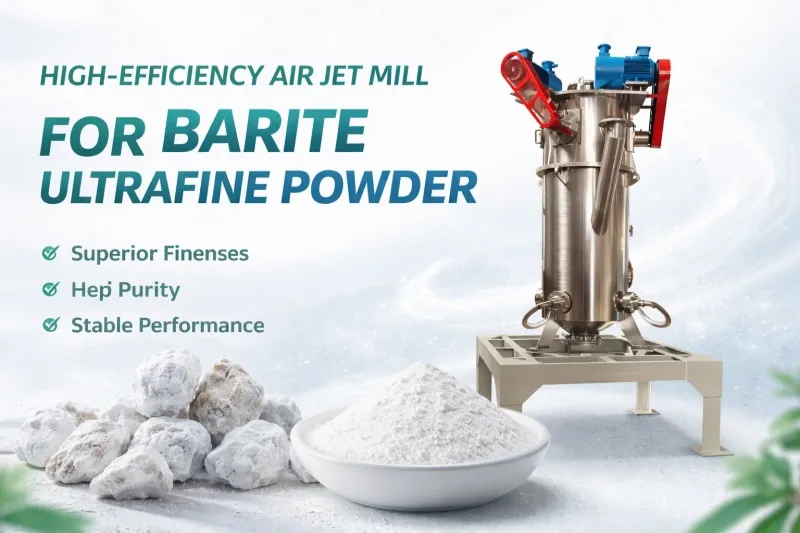
Boehmite (γ-AlOOH) is a key alumina hydroxide Mineral widely used in advanced industrial applications. Compared to related materials like gibbsite or pseudo-boehmite, boehmite has distinct chemisch and physical properties that make it valuable: it offers excellent thermal stability, a crystalline structure that enhances reactivity, and a unique morphology ideal for specialty uses.
Particle Size and Performance Impact
Ultrafine grinding of boehmite drastically influences its end-use performance by controlling:
- Surface area: Smaller particles provide a larger surface area, improving reactivity and interaction with binders or electrolytes.
- Dispergierbarkeit: Fine, uniform particles disperse more evenly, critical in coatings and composites.
- Reactivity: Ultrafine boehmite enhances catalytic and thermal properties.
- Thermal stability: Maintaining phase integrity requires controlled particle size to avoid unwanted transformations during processing.
Target Specifications for Ultrafine Boehmite
For high-performance applications, ultrafine boehmite powders typically meet strict standards, including:
- Particle size (D50): Most target ranges fall between 0.3 and 2 μm or finer to ensure optimal packing and functionality.
- Narrow particle size distribution (PSD): A tight PSD prevents process issues and ensures consistency.
- Low impurities: Battery-grade boehmite demands metal contaminants below 100 ppm to preserve electrochemical stability and safety.
Market Drivers
The demand for ultrafine boehmite powder is fueled by several key growth sectors:
- EV batteries: High-purity boehmite enhances lithium-ion battery separator coatings, improving thermal shutdown and cycle life.
- High-end ceramics and abrasives: Ultrafine powder improves sintering, mechanical strength, and surface finish.
- Flame retardants: Its high surface area boosts effectiveness in polymer systems.
Understanding these fundamentals highlights why boehmite jet mill processing and precise ultrafine grinding are essential for delivering premium quality powders tailored to evolving market needs.
Challenges in Boehmite Ultrafine Grinding
Grinding boehmite ultrafine powder comes with several hurdles. Its crystal structure makes it naturally hard to grind and prone to agglomeration, causing particles to clump together and resist size reduction. Traditional ball or media mills often introduce contamination risks since metal grinding media can wear off, affecting the purity crucial for battery-grade boehmite.
Heat buildup during grinding is another issue—it can alter boehmite’s phase stability and damage the material’s integrity. Keeping a consistent, narrow particle size distribution (PSD) while also controlling moisture and surface chemistry is tough, but essential for performance.
On top of these, energy efficiency and scalability pose challenges when moving from lab to industrial production. Efficient ultrafine grinding methods must balance these factors to deliver high-purity, well-controlled boehmite powder without excessive energy use or contamination.
Preferred Methods for Boehmite Ultrafine Grinding
When it comes to ultrafine grinding of boehmite, both dry and wet methods have their place depending on the application. Wet grinding is often chosen when controlling morphology or when the product needs to be processed further in slurry form. Hydrothermal synthesis or precursor routes combined with wet grinding can produce boehmite powders with a controlled particle shape and size distribution.
Dry grinding, on the other hand, offers advantages in terms of ease of drying and handling. Traditional dry milling techniques like ball milling have limitations: they tend to generate contamination from metal media and produce broader particle size distributions. Attritor mills improve on this by providing more uniform energy input but still face challenges with boehmite’s strong agglomeration and hardness.
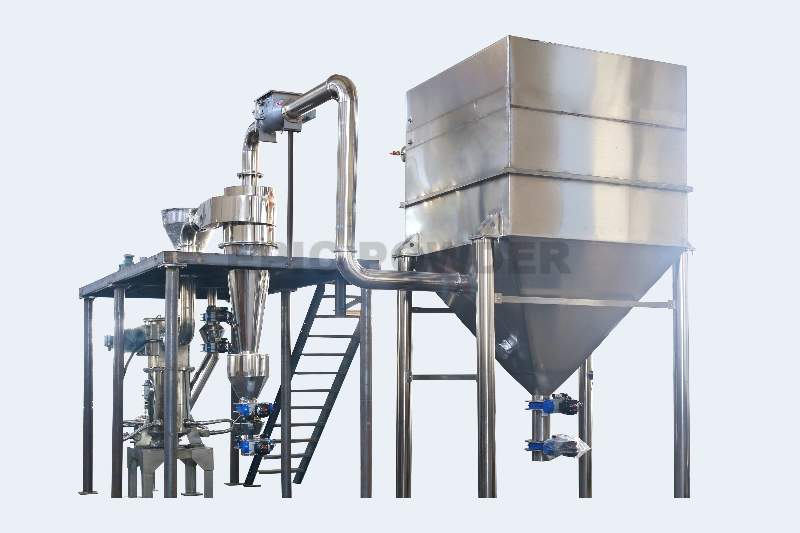
This is where fluid energy methods—especially jet milling—really shine. Jet mills use particle-on-particle collisions without any moving grinding parts in the grinding zone, eliminating contamination risks that come from metal wear. Plus, they can operate under inert gas or steam atmospheres to protect boehmite’s thermal stability and surface chemistry during grinding.
In , jet milling stands out as the preferred method for boehmite ultrafine grinding because of its ability to deliver contamination-free ultrafine boehmite powder with precise particle size control and excellent purity, making it ideal for sensitive applications such as battery-grade materials. For a detailed look at optimized jet mill setups that achieve submicron boehmite particle sizes, check out these ultrafine grinding solutions.
Jet Mill Technology for Boehmite Ultrafine Grinding
Jet milling is a top choice for producing ultrafine boehmite powder thanks to its fluidized bed or Spiralstrahlmühle designs. These mills use compressed air or steam to accelerate particles at high speeds, causing particle-on-particle collisions that break down boehmite without any metal contact. This means the output is ultra-pure — a critical advantage for battery-grade ultrafine boehmite where contamination must be minimal.
Key benefits of jet mill technology for boehmite include precise control over particle size distribution (PSD), very low heat buildup during grinding, and compatibility with heat-sensitive or abrasive materials. The integrated air classification system sharpens PSD cut points and allows recycling of oversized particles, ensuring consistent submicron boehmite grinding.
To get optimal results, several process parameters need close attention:
- Schleifdruck
- Classifier rotor speed
- Vorschubgeschwindigkeit
- Nozzle configuration
- Choice of gas (air, nitrogen, or steam)
For example, boehmite jet mill production lines have demonstrated the ability to consistently deliver powders with D50 well below 1 µm and impurities under 100 ppm. This advanced milling method supports the growing demand for high purity, finely controlled boehmite powders in applications like lithium battery separator coatings and advanced ceramics.
For a detailed look at milling and classification technology options tailored to ultrafine powders like boehmite, exploring high-performance air classifier mill systems can offer valuable insights.
Equipment Selection and System Design for Boehmite Ultrafine Grinding
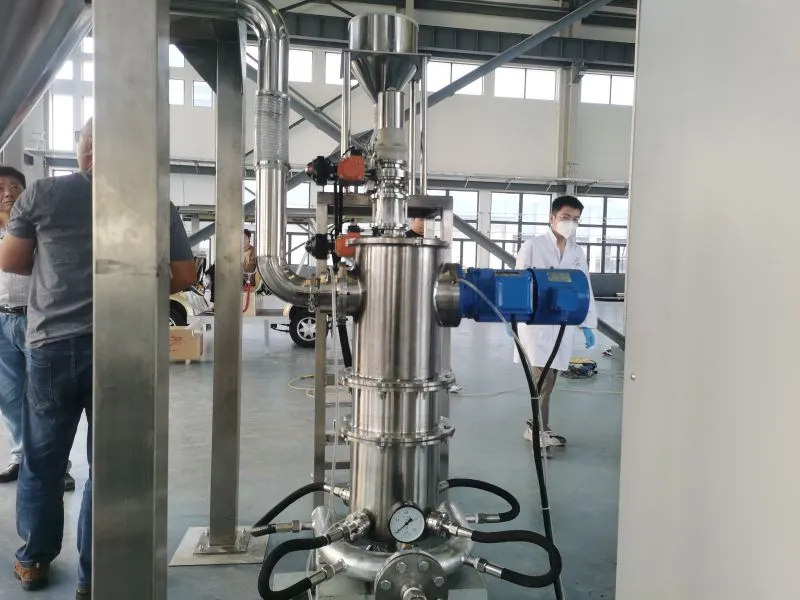
Choosing the right grinding system is crucial for producing high-quality ultrafine boehmite powder. Here’s a quick comparison of popular options:
| Grinding System | Pros | Cons |
|---|---|---|
| Strahlmühlen | Ultra-pure output, low heat, no metal contact, fine PSD control | Higher initial investment |
| Mechanical Mills | Simple, cost-effective | Risk of contamination, heat buildup |
| Stirred Media Mills | Good for wet grinding, fine particles | Media wear, contamination risk |
| Wet Ultrafine Grinders | Effective dispersion | Complex drying steps, moisture control |
Key Features in a Boehmite Jet Mill System
To meet demanding specs for battery-grade ultrafine boehmite, look for:
- Wear-resistant linings (ceramic or polymer) to avoid contamination
- Automated controls for stable and repeatable operation
- Inline particle size monitoring for real-time PSD adjustments
Complete Production Line Essentials
Optimizing your flow from raw material to finished powder requires:
- Controlled feeding system for consistent throughput
- Precise grinding combined with an integrated Windsichter
- Effective collection methods to minimize product loss
- Clean and safe packaging environment to preserve purity
Epic Powder offers customized jet mill systems engineered specifically for high-purity boehmite. Their solutions deliver consistent ultrafine powders with excellent batch-to-batch uniformity, addressing contamination control and process scalability. For insights on optimizing ultrafine grinding systems, their approach shares parallels with advanced solutions found in the customized ultra-fine sulfur grinding solutions designed for similar high-purity and particle size challenges.
Applications of Ultrafine Boehmite Powder
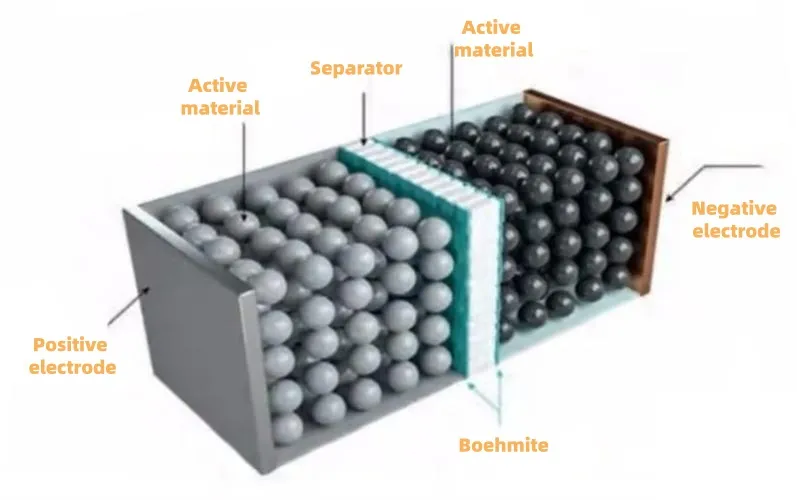
Ultrafine boehmite powder plays a key role across several high-tech industries due to its unique properties and finely controlled particle size. For lithium-ion battery separator coatings, ultrafine boehmite around 0.5 μm enhances thermal shutdown capabilities, improves electrolyte wettability, and extends cycle life—critical benefits for advanced batteries in the EV market.
In advanced ceramics and abrasives, ultrafine boehmite contributes to better sintering behavior, leading to stronger mechanical properties and superior polishing performance. Its small particle size and high purity also make it an excellent catalyst support, flame retardant additive, and filler in polymers, where the increased surface area boosts chemical reactivity and dispersion.
Beyond these well-established uses, ultrafine boehmite powder is gaining traction in specialty coatings, pigments, and other niche chemical applications where precise particle size distribution (PSD) and purity greatly affect performance.
For tailored powder systems optimized for battery materials, you can explore innovative processing solutions similar to those found in battery-specific milling and classification technologies, such as those detailed in our battery negative electrode material processes.
Quality Control and Characterization of Ultrafine Boehmite Powder
Ensuring top quality in ultrafine boehmite powder starts with precise characterization. Common analytical methods include:
- Laser diffraction to measure particle size distribution (PSD), crucial for controlling particle fineness and uniformity.
- BET surface area analysis to assess the specific surface area, impacting reactivity and dispersion.
- SEM/TEM imaging for detailed morphology and particle shape examination.
- XRD (X-ray diffraction) to confirm phase purity and crystallite size, preserving the boehmite’s essential properties.
- ICP (Inductively Coupled Plasma) for detecting trace impurities, particularly metals, to ensure battery-grade purity levels (<100 ppm).
For battery-grade ultrafine boehmite, maintaining a narrow PSD around 0.3–0.5 μm and low impurities is critical to optimize separator coatings and electrolyte interactions. The grinding process directly influences these specs by controlling particle breakage and avoiding contaminant introduction.
Troubleshooting common issues involves adjusting jet mill process parameters to reduce agglomeration, enhance flowability, and minimize excessive fines that can affect packing density and functional performance. Fine-tuning feed rate, grinding pressure, and classifier speed can help maintain consistent quality and meet tight specifications.
Optimized quality control combined with advanced grinding systems ensures ultrafine boehmite powder matches high-performance demands, especially for lithium battery and specialty material applications. For integrated solutions, exploring Epic Powder’s range of customized grinding and classification equipment can provide reliable control of boehmite PSD and purity, supporting scalable production needs. See their detailed ultrafine air jet mill grinding solutions for reference.
Benefits and Best Practices for Industrial Implementation
Ultrafine grinding of boehmite using advanced methods like the boehmite jet mill delivers clear performance gains:
- Better dispersibility: Smaller, uniform particles mix more evenly in coatings, ceramics, and battery materials.
- Higher packing density: Ultrafine powders fill voids efficiently, improving mechanical strength and thermal properties.
- Enhanced material properties: Improved reactivity, thermal stability, and surface area boost end-use performance.
Operational Advantages
Industrial jet milling systems offer key operational perks over traditional grinders:
| Vorteil | Beschreibung |
|---|---|
| Lower contamination risk | No metal contact zone prevents impurities |
| Energy savings | Optimized jet mill setups use compressed air/steam efficiently |
| Reduced maintenance | No moving grinding parts means less wear and downtime |
Best Practices for Smooth Operations
To maximize ultrafine boehmite powder quality and milling efficiency, follow these guidelines:
- Raw material preconditioning: Control feed moisture and particle size for steady grinding.
- Process validation: Regularly monitor particle size distribution (PSD) and adjust jet mill parameters accordingly.
- Safety considerations: Implement strict dust handling and explosion prevention protocols due to fine powder hazards.
Sustainability and Efficiency
Modern boehmite ultrafine grinding prioritizes environmental responsibility:
- Efficient energy use: Closed-loop jet milling systems recycle grinding gases and minimize waste heat.
- Minimal powder loss: Recycling oversize particles via integrated air classifiers ensures near-zero material loss, enhancing sustainability.
By adopting these practices with state-of-the-art jet mill systems, industries can produce high purity ultrafine boehmite powder consistently while saving energy and lowering operational risks.
For insights on complete systems engineered for ultrafine powders, see Epic Powder’s customized solutions in their air classifier mill portfolio and success stories on battery electrode material jet milling.

Vielen Dank fürs Lesen. Ich hoffe, mein Artikel war hilfreich. Hinterlassen Sie gerne einen Kommentar. Bei weiteren Fragen können Sie sich auch an den Online-Kundendienst von Zelda wenden.
— Gepostet von Jason Wang