
Bei der Pulverherstellung – insbesondere bei der Herstellung ultrafeiner Pulver – stellen Übermahlung und Agglomeration zwei häufige Herausforderungen dar. Übermahlung bezeichnet den Zustand, in dem bereits geeignete Feinpartikel weiter vermahlen werden. Dies führt zu Energieverschwendung und einer umfassenderen Agglomeration. Partikelgröße Die Verteilung und in manchen Fällen die Produktleistung können beeinträchtigt werden. Agglomeration tritt auf, wenn sich ultrafeine Partikel durch Van-der-Waals-Kräfte, elektrostatische Kräfte oder Flüssigkeitsbrücken anziehen. Dadurch bilden sich Sekundärpartikel, die die Pulverdispersion, die Fließfähigkeit und die Endprodukteigenschaften negativ beeinflussen. Diese Probleme reduzieren nicht nur die Produktionseffizienz, sondern erhöhen auch den Energieverbrauch und die Betriebskosten. Als hocheffizientes Trockenklassiergerät, der Luftklassierer Diese Probleme lassen sich effektiv lösen, indem man Partikel präzise trennt.
Ursachen für “Übermahlung” und “Agglomeration” bei der Pulverproduktion
Bei mechanischen Mahlprozessen (wie z. B. Kugelmühlen oder StrahlmahlenDie Partikel werden mit zunehmender Mahldauer immer feiner. Sobald jedoch eine bestimmte Feinheit erreicht ist, tritt ein Mahlgleichgewicht ein: Während die Anzahl feiner Partikel zunimmt, beginnen ultrafeine Partikel zu agglomerieren. Die Geschwindigkeit der Partikelgrößenreduktion gleicht sich allmählich der Geschwindigkeit der Agglomeration aus. Wird über diesen Punkt hinaus gemahlen, kann die Partikelgröße nicht weiter abnehmen, sondern aufgrund von Agglomeration sogar wieder zunehmen.
Wird das qualifizierte Feinpulver nicht rechtzeitig abgetrennt, gelangt es immer wieder in die Mahlzone zurück, was zu einer Übermahlung führt.
Diese Phänomene treten besonders deutlich bei der Herstellung von ultrafeinen Pulvern auf, wie zum Beispiel Kalziumkarbonat, Quarz und Siliziumkarbid, was die Produktqualität und den Durchsatz erheblich beeinflusst.
Funktionsprinzip eines Luftklassierers
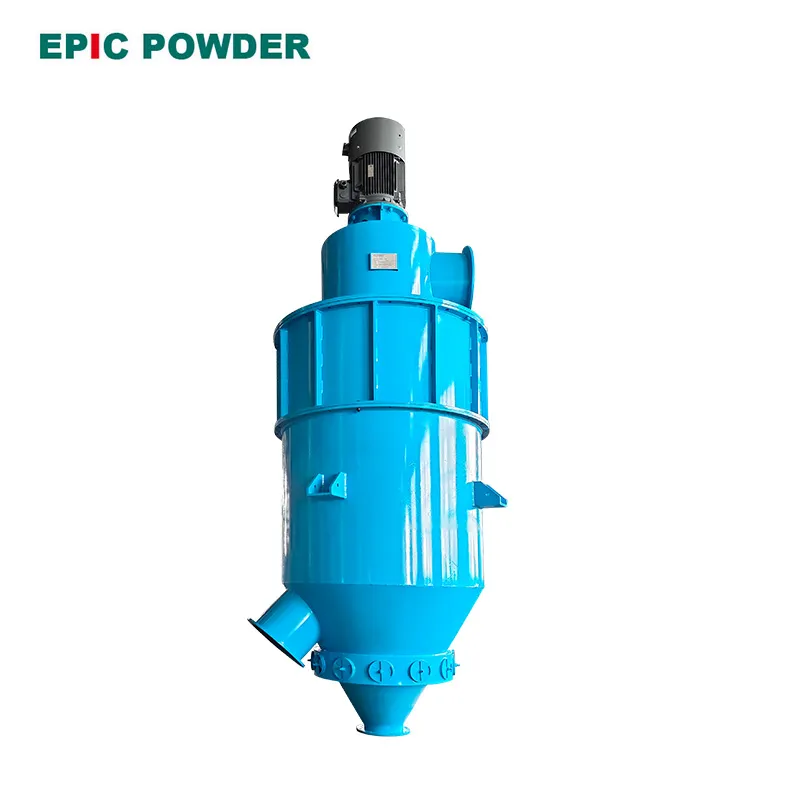
Ein Windsichter Trennt Partikel durch die kombinierte Wirkung von Luftstrom und Zentrifugalkraft. Gängige Typen sind Turbo- (dynamische) Sichter und Zyklonabscheider. Ein typischer Turbo-Sichter besteht aus einer Zufuhrverteilungsplatte, einem Sichtrad (Rotor), Leitschaufeln und einem Sekundärlufteinlass.
Funktionsprinzip:
Das Material gelangt mit dem Luftstrom in die Klassierzone. Durch die Zentrifugalkraft des schnell rotierenden Klassierrades und den Luftwiderstand passieren feine Partikel die Spalten des Klassierrades und werden aufgefangen, während grobe Partikel gegen die Gehäusewand geschleudert werden und zurück in die Mahlzone fallen. Der Sekundärluftstrom wäscht die grobe Fraktion weiter aus, dispergiert mitgerissene Feinanteile und reduziert den Materialverlust.
Durch die Anpassung von Parametern wie Rotordrehzahl und Luftdurchsatz kann die Schnittgröße präzise gesteuert werden (typischerweise D97 ≈ 3–150 μm), wodurch eine enge Partikelgrößenverteilung erreicht wird.
Wie Luftklassierer “Übermahlung” und “Agglomeration” beheben”

Vermeidung von Überschleifen
- Ein Windsichter ist in Reihe mit Mahlanlagen (z. B. Kugel- oder Strahlmühlen) geschaltet und bildet so ein geschlossenes System. Nach dem Mahlen gelangt das Material in den Sichter; qualifiziertes Feinpulver wird sofort abgetrennt und aufgefangen, während grobe Partikel zur weiteren Zerkleinerung in die Mahlzone zurückgeführt werden. Dadurch wird ein wiederholtes Mahlen von Feinpartikeln verhindert, Übermahlen vermieden, die Mahleffizienz gesteigert und der Energieverbrauch gesenkt.
- Im Vergleich zu Systemen mit offenem Kreislauf reduzieren Systeme mit geschlossenem Kreislauf das übermäßige Mahlen deutlich und erzeugen eine engere Partikelgrößenverteilung.
Minderung der Agglomeration
- Die Zerstäubung durch den Luftstrom und die Sekundärluftwäsche während der Klassierung tragen dazu bei, schwache Agglomerate aufzubrechen und die Pulverdispersion zu verbessern.
- Durch die rechtzeitige Abtrennung feiner Partikel wird ein längeres Verweilen in der Mahlzone verhindert und somit die Wahrscheinlichkeit einer Verklumpung verringert.
- Moderne Luftklassierer verfügen über optimierte Konstruktionen (wie verbesserte Zufuhrverteiler und Turbulenzkegel), um die Dispersion weiter zu verbessern und den “Fischhakeneffekt” (Fehlklassifizierung von Feinstpartikeln als Grobpartikel) zu reduzieren.
Darüber hinaus gewährleisten der Unterdruckbetrieb und die staubfreie Systemkonstruktion eine saubere und umweltfreundliche Produktion.
Anwendungsvorteile und wichtige Überlegungen
Luftklassierer werden in großem Umfang eingesetzt in nichtmetallische Mineralien, Chemikalien, Pharmazeutika und Batteriematerialien. Zu ihren Hauptvorteilen zählen:
- Hohe Klassifizierungsgenauigkeit mit Effizienzen von 60%–90%
- Fähigkeit zur mehrstufigen Klassifizierung zur Erzeugung mehrerer Partikelgrößenfraktionen
- Energiesparender, geräuscharmer Betrieb und einfache Steuerung
In der Praxis sollten die Betriebsparameter (wie Rotordrehzahl und Luftdurchsatz) entsprechend den Materialeigenschaften (z. B. Feuchtigkeitsgehalt und Fließfähigkeit) optimiert werden. Gegebenenfalls können Additive eingesetzt werden, um die Agglomeration weiter zu verhindern.
Der Aufbau eines geschlossenen Mahlkreislaufs mit Windsichter ist eine der effektivsten Methoden, um Übermahlung und Agglomeration bei der Pulverherstellung zu verhindern. Er verbessert Produktqualität und Ausbeute, ermöglicht eine umweltfreundliche und effiziente Fertigung und treibt die Pulverindustrie in Richtung höherer Präzision und Reinheit voran.
Abschluss
Im Bereich der Pulververarbeitung, Qingdao Epic Powder Machinery (EPIC Powder) ist ein professioneller Anbieter von Anlagen zur Aufbereitung ultrafeiner Pulver. Zu seinen fortschrittlichen Windsichtern gehören die Turbosichter der HTS-Serie, die Vertikalsichter der ITC-Serie und Luftklassierer der CTC-Serie. Diese Systeme sind bekannt für ihre hohe Klassifizierungsgenauigkeit, enge Partikelgrößenverteilung und hervorragende Dispersionsleistung.
Durch die Integration von Windsichtern in geschlossene Mahlprozesse verhindert EPIC Powder effektiv Übermahlung und Verklumpung. Gleichzeitig erzielt das System einen geringeren Energieverbrauch, eine verbesserte Produktqualität und eine umweltfreundliche Produktion.
Die Wahl der Klassieranlagen von EPIC Powder hilft Herstellern, in eine effizientere und präzisere Ära der Pulververarbeitung einzusteigen.

Vielen Dank fürs Lesen. Ich hoffe, mein Artikel war hilfreich. Hinterlassen Sie gerne einen Kommentar. Bei weiteren Fragen können Sie sich auch an den Online-Kundendienst von Zelda wenden.
— Gepostet von Emily Chen