
A project focused on air jet milling of positive electrode materials for lithium batteries involves several key components, including material selection, process design, equipment setup, and performance evaluation. Here’s a structured outline for such a project:
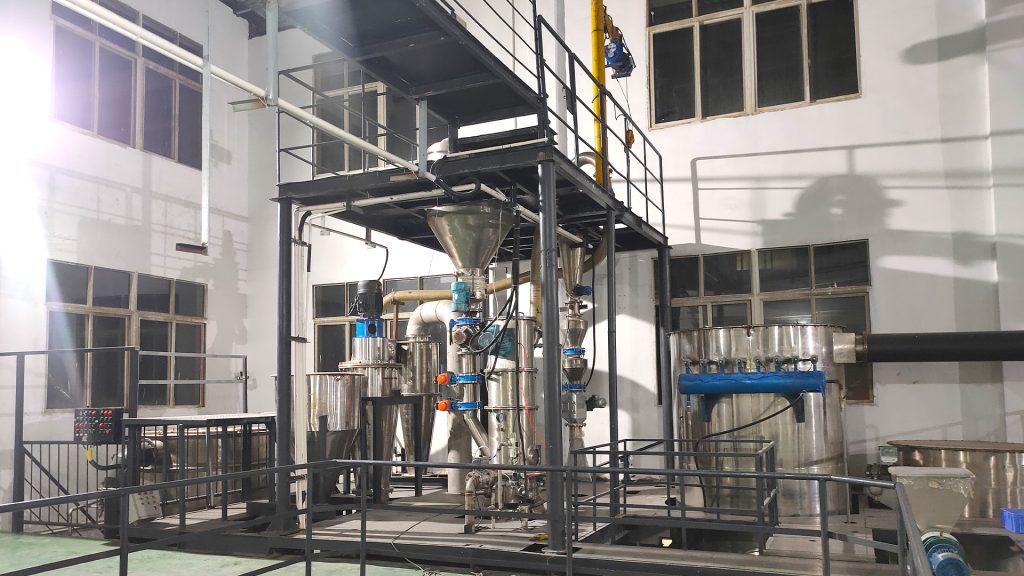
Air Jet Milling of Positive Electrode Materials for Lithium-Ion Batteries
– Background on Lithium-Ion Batteries:
– Importance of lithium-ion batteries in energy storage and electric vehicles.
– Role of positive electrode materials (cathodes) such as lithium cobalt oxide (LiCoO₂), lithium iron phosphate (LiFePO₄), and lithium nickel manganese cobalt oxide (NMC).
– Need for Particle Size Reduction:
– Influence of particle size on electrochemical performance, surface area, and reaction kinetics.
– Advantages of air jet milling in achieving fine particle sizes without contamination.
Objectives
– To optimize the air jet milling process for the selected positive electrode material.
– To assess how milling parameters impact particle size, shape, and electrochemical performance.
– To compare the performance of milled materials with conventionally processed materials.
Materials and Methods**
– Materials Selection:
– Choose a suitable positive electrode material (e.g., LiCoO₂, LiFePO₄, NMC).
– Air Jet Milling Process:
– Description of the air jet milling equipment (e.g., fluidized bed jet mill).
– Milling parameters (e.g., air pressure, feed rate, milling time).
– Characterization Techniques:
– Particle size analysis (e.g., laser diffraction, scanning electron microscopy).
– Surface area measurement (e.g., BET analysis).
– Electrochemical testing (e.g., cyclic voltammetry, galvanostatic charge/discharge tests).
– Experimental Design:
– Design of experiments (DOE) to systematically vary milling parameters and analyze their effects.
Resultados
– Milling Performance:
– Data on particle size distribution and morphology before and after milling.
– Analysis of the impact of different milling parameters.
– Electrochemical Performance:
- Compare the charge and discharge capacities of milled and unmilled materials.
- Look at their cycle stability.
- Assess their rate capability.
– Optimization:
– Identification of optimal milling conditions for enhanced performance.
Etapas de implementação
- Projeto: Planejar o layout da instalação de moagem, incluindo a localização dos equipamentos e o fluxo de trabalho.
- Aquisição: Obter os equipamentos de moagem e máquinas auxiliares necessários.
- Instalação: Supervisionar a instalação do equipamento, garantindo a configuração e calibração adequadas.
- Testes e Otimização: Teste o processo de fresagem e altere os parâmetros conforme necessário.
- Produção: Iniciar a produção em larga escala após otimizar o processo e atender aos padrões de qualidade.
Project Management Considerations:
- – Timeline: Establish a timeline for each phase of the project.
- – Budget: Estimate costs for materials, equipment, and testing.
- – Safety: Address safety protocols related to handling chemicals and operating milling equipment.
This outline offers a solid guide for a project on air jet milling of positive electrode materials for lithium batteries. It covers scientific and practical aspects.