
Ultrafine powder is not only the basic material for the preparation of structural materials, but also has unique functional properties. It is widely used in fine ceramics, electronic components, bioengineering, and new printing materials. It can also be used in many fields such as high-performance refractory materials and fine chemicals. As these industries continue to increase their requirements for powder performance, the position of ultrafine powder classification technology in the entire powder processing technology has become increasingly prominent. It has become a key link in improving product quality and energy efficiency.
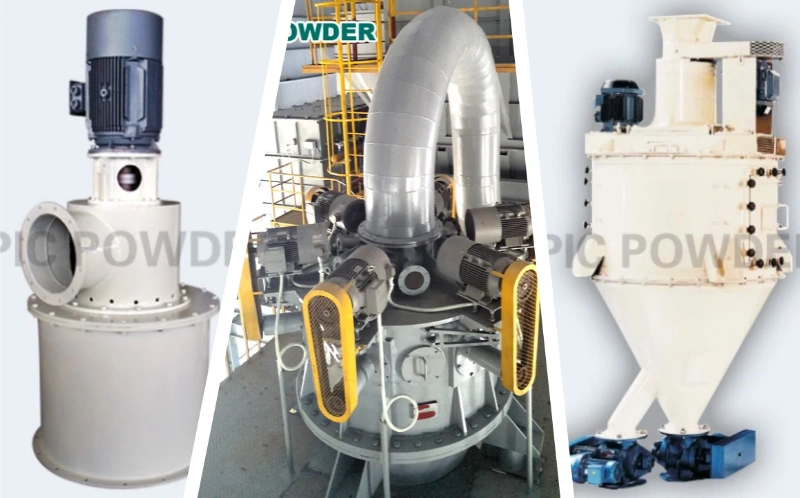
The Importance of Ultrafine Powder Classification
During the crushing process, only some particles can reach the target particle size. If this part of qualified powder is not separated in time, it will continue to be crushed together with the unqualified particles. This will not only waste energy, but also may cause excessive crushing of some materials and reduce product quality.
At the same time, as the particle size decreases, the agglomeration tendency between particles increases, and the phenomenon of “crushing and re-aggregation” is prone to occur. It may even lead to deterioration of the crushing effect. Therefore, efficient classification must be carried out in the preparation process of ultrafine powders. On the one hand, the product particle size distribution is controlled within the ideal range. On the other hand, fine powder is separated in time to improve crushing efficiency and reduce energy consumption.
With the increase of powder fineness and the expansion of production capacity, the difficulty of classification is also increasing. The efficient classification of ultrafine powders has become a bottleneck restricting the progress of powder technology. Therefore, classification technology is also regarded as one of the basic core technologies of powder engineering.
Basic Principles of Ultrafine Powder Classification
In a broad sense, powder classification is based on the physical and chemical properties of particles, such as particle size, density, color, shape, chemical composition, magnetism, radioactivity, etc.
In a narrow sense, classification usually refers to the use of particles in a specific medium (such as air or water) to produce different movement behaviors due to different particle sizes under the action of gravity, inertia or centrifugal force.
Thereby achieving effective separation.
Key Technical Issues of Classification
For any classification method, the key to achieve a better classification effect is how to improve the dispersion of the classified materials and choose a suitable classification force field.
After ultrafine processing, the material presents different properties from the original material. First, the specific surface area increases and the surface energy increases. Secondly, the proportion of the number of atoms or ions on the surface is greatly increased, which increases its surface activity. The attraction between particles increases or it is easy to aggregate due to the effect of foreign impurities such as water.
Ultrafine particles are also easy to gather on large particles due to collision absorption during the crushing process or due to static electricity and other forces after crushing. Whether in the air or in the liquid phase, it is easy to generate secondary particles with larger particle sizes. This makes the classification of ultrafine products more difficult than that of ordinary products.
Therefore, the first task of classification is to disperse the particles. Make them in a monodisperse state, thereby improving the dispersibility of the powder. That is, the basis of ultrafine powder lies in the dispersion of powder particles. It can be said that sufficient dispersion can make the classification process more efficient.
Classificateur d'air EPIC
Horizontal Air Classifier -HTS
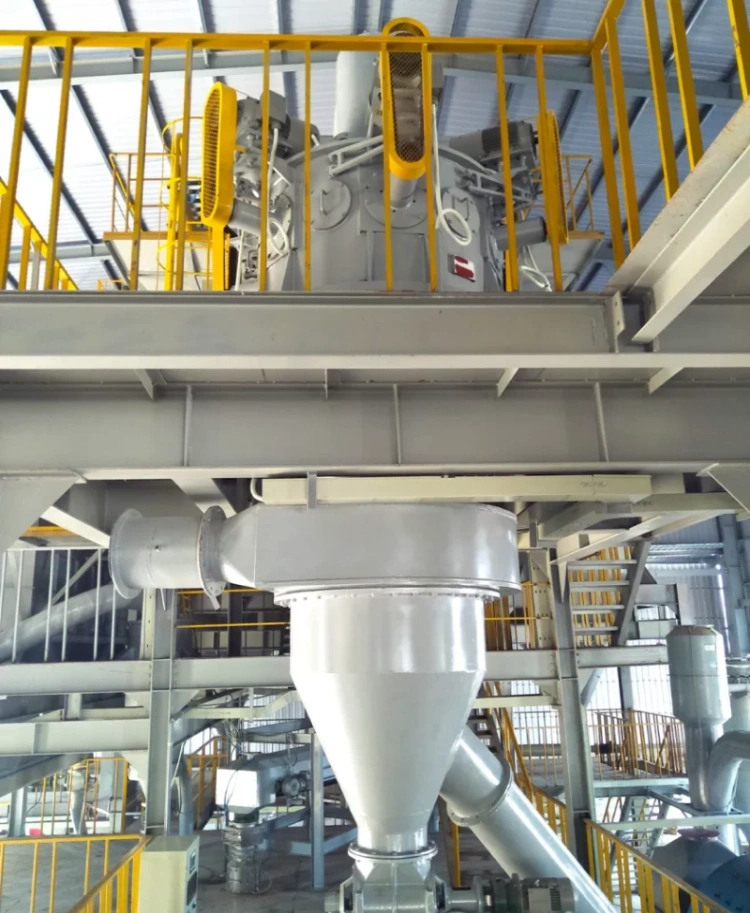
Roue de classification simple:
- Un rotor étagé monté horizontalement, la vitesse linéaire peut atteindre 100 m/s ;
- La vitesse du rotor peut être ajustée par conversion de fréquence, et la répartition de la force peut être ajustée de manière flexible ;
- Convient au classement précis de matériaux secs de taille micrométrique ;
- D50 disponible : 1,5-25 μm.
Roue de classification multiple:
- Le diamètre du rotor est de 315 mm à 630 mm, et il existe de 2 à 6 rotors, ce qui est utilisé pour la classification des poudres ultrafines ;
- La roue de classification augmente l'espace de classification au sommet du silo ;
- Commande par variateur de fréquence, vitesse réglable ;
- Rendement supérieur à celui d'un rotor unique.
Classificateur d'air vertical – ITC
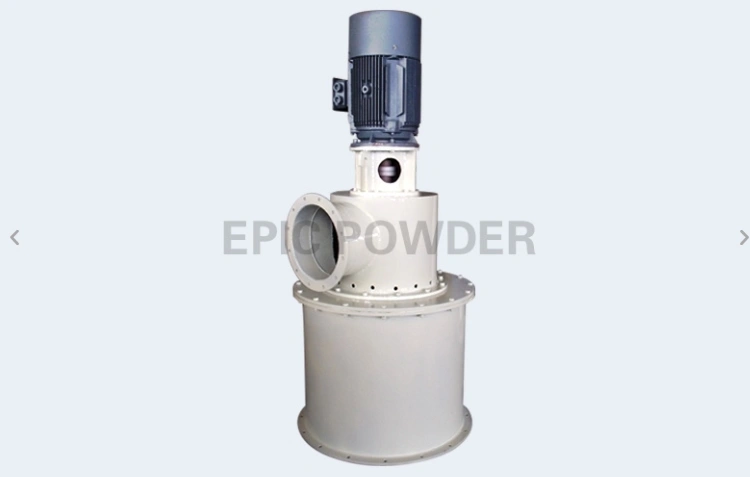
- Il est très performant pour la découpe de pointe des produits ultrafins et des produits moyennement fins.
- Applicable à une large gamme de tailles de particules, les plus grossières pouvant atteindre 200 microns.
- Il existe différents modèles pour répondre à différents besoins de production, et la capacité d'alimentation du plus grand modèle peut atteindre 800 t/h.
- Conception résistante à l'usure, capable de traiter des produits en poudre d'une dureté extrêmement élevée.
- La conception de la circulation d'air interne peut réduire les investissements et économiser de l'espace au sol.
- It can be combined with a broyeur à boulets to form a closed-circuit production system for grinding various materials.
Classificateur centrifuge – CTC
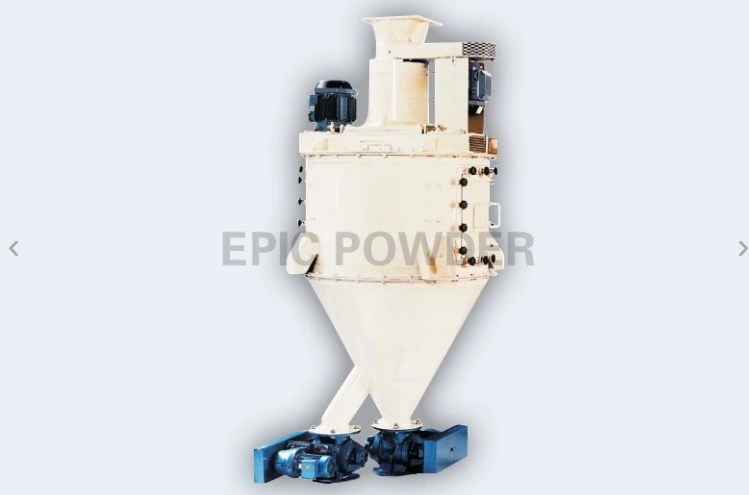
- Classification de la coupe supérieure de l'apex : d97 < 32 μm.
- Wide range of particle size: 32-250μm.
- Plage de capacité de traitement : 1-50 t/h.
- La technologie provient d'Allemagne, et sa conception est éprouvée et fiable.
- Cet équipement présente une faible consommation d'énergie, un faible coût d'investissement et un faible coût d'entretien.
- Aucun équipement périphérique nécessaire, faible encombrement.
- Convient aux abrasifs, au sable de quartz, au marbre et autres matériaux durs.
Poudre EPIC
Epic Powder, plus de 20 ans d'expérience dans l'industrie des poudres ultrafines. Nous contribuons activement au développement futur des poudres ultrafines, en nous concentrant sur les procédés de concassage, de broyage, de classification et de modification. Contactez-nous pour une consultation gratuite et des solutions personnalisées ! Notre équipe d'experts s'engage à vous fournir des produits et services de haute qualité afin d'optimiser la valeur de votre traitement des poudres. Epic Powder : votre expert de confiance en traitement des poudres !