Correo electrónico: [email protected]
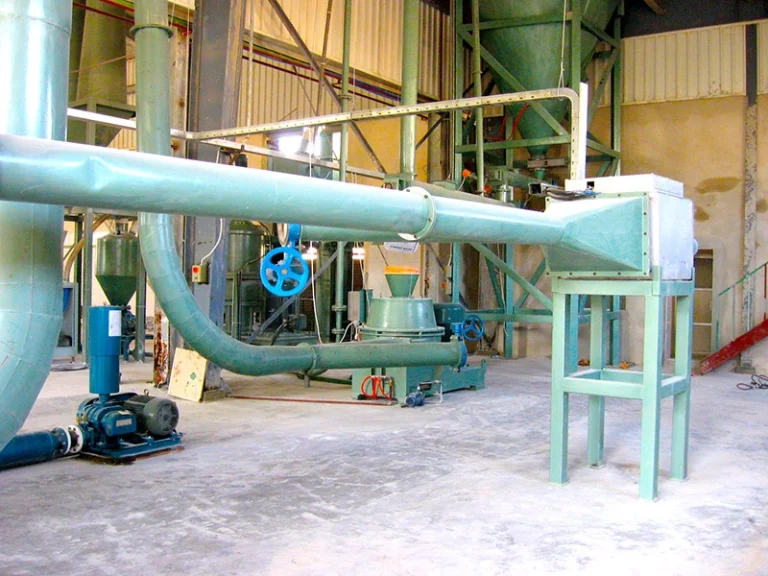
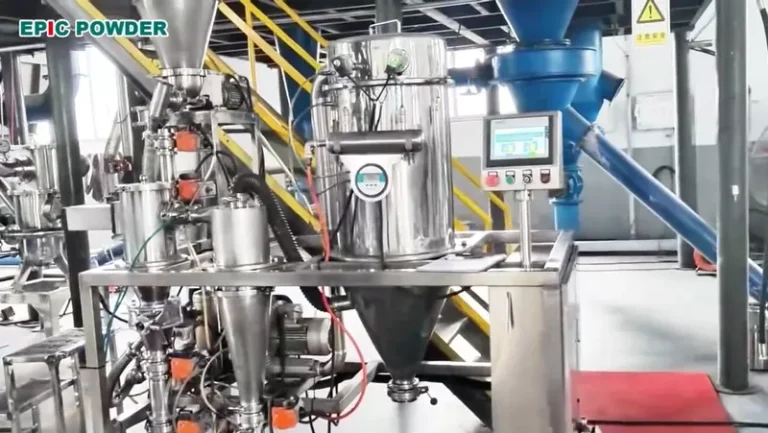
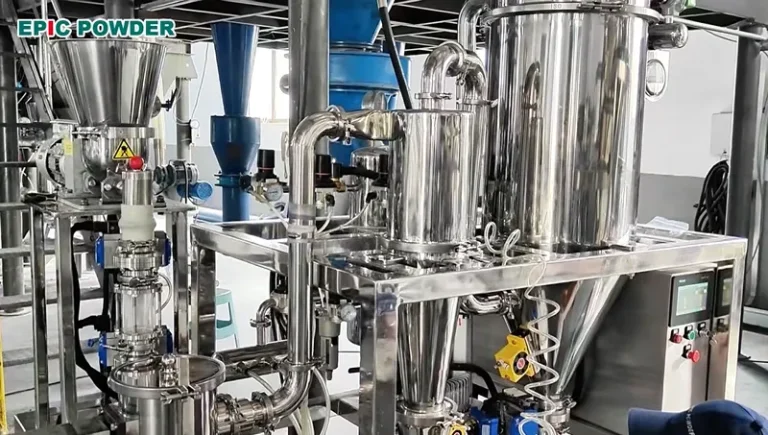
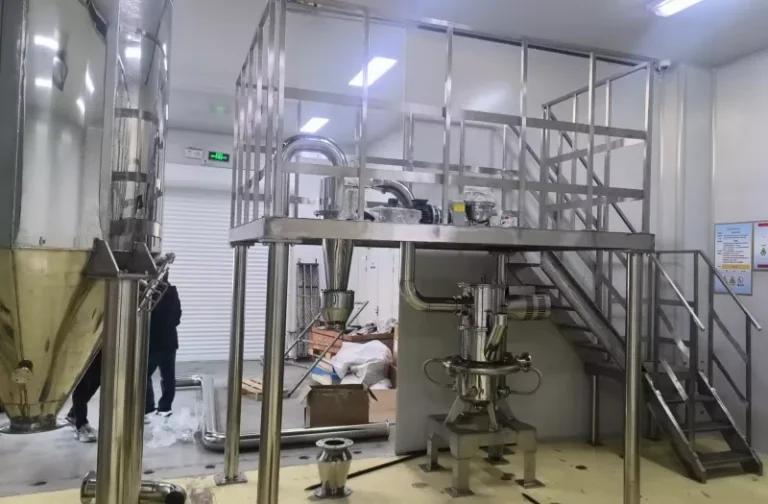
El molino de chorro MQW es un molino de chorro opuesto de lecho fluidizado, con ruedas clasificadoras horizontales incorporadas (una o varias ruedas). Después de filtrar y secar el aire comprimido, se pulveriza a alta velocidad en la cámara de molienda a través de la boquilla Laval. En la intersección de múltiples flujos de aire a alta presión, los materiales chocan, se frotan y se cortan repetidamente para ser triturados. Los materiales molidos se elevan con la fuerza de succión del ventilador. El flujo de aire se mueve hacia el área de clasificación, bajo la fuerte fuerza centrífuga generada por la turbina clasificadora giratoria de alta velocidad, los materiales gruesos y finos se separan, las partículas finas que cumplen con los requisitos de tamaño de partícula ingresan al separador ciclónico y al colector de polvo a través del área de clasificación. rueda, y las partículas gruesas descienden al área de molienda para continuar moliendo.
Molino de chorro de aire opuesto de lecho fluidizado: después de filtrar y secar el aire comprimido, se rocía en la cámara de molienda a alta velocidad a través de la boquilla Laval. En la intersección de múltiples flujos de aire a alta presión, los materiales chocan, se frotan y se cortan repetidamente para ser triturados. Los materiales triturados se elevan con la succión del ventilador. El flujo de aire se desplaza a la zona de clasificación. Bajo la acción de la fuerte fuerza centrífuga generada por la turbina de clasificación giratoria de alta velocidad, se separan los materiales gruesos y finos. Las partículas finas que cumplen con los requisitos de tamaño de partícula ingresan al separador ciclónico y al colector de polvo a través de la rueda de clasificación para su recolección, y las partículas gruesas descienden a la zona de trituración y continúan siendo trituradas.
| parámetro/modelo | MQW03 | MQW06 | MQW010 | MQW20 | MQW30 | MQW40 | MQW60 | MQW80 | MQW120 | MQW160 | MQW240 |
|---|---|---|---|---|---|---|---|---|---|---|---|
| Tamaño de alimentación (mm) | <1 | <2 | <2 | <3 | <3 | <3 | <3 | <3 | <1 | <3 | <3 |
| Capacidad de producción (kg/h) | 0.3~10 | 10~150 | 20~300 | 40~600 | 100~900 | 200~1200 | 500~2000 | 800~3000 | 1500~6000 | 2000~8000 | 4000~12000 |
| Tamaño de partícula (D97:μm) | 3~45 | 3~45 | 3~45 | 3~45 | 3~45 | 3~45 | 3~45 | 3~25 | 15x4 | 15x6 | 15x6 |
| Motor del clasificador (kW) | 2.2 | 3 | 5.5/7.5 | 7.5/11 | 11/15 | 15/7.5x3 | 7.5x3 | 11x3 | 15x3 | 15x4 | 15x6 |
| Consumo de aire (m³/min) | 3 | 6 | 10 | 20 | 30 | 40 | 60 | 80 | 120 | 160 | 240 |
| Presión atmosférica (MPa) | 0.6~1 | 0.6~1 | 0.6~1 | 0.6~1 | 0.6~1 | 0.6~1 | 0.6~1 | 0.6~1 | 0.6~1 | 0.6~1 | 0.6~1 |
Nota: La capacidad de producción está estrechamente relacionada con el tamaño de las partículas, la gravedad específica, la dureza, la humedad y otros indicadores de las materias primas. Lo anterior es sólo para referencia de selección.
Among particle size reduction technologies, jet milling’s advantages include:
It can achieve very fine particles. It also creates tight size distributions. This is better than other milling methods.
No knives, blades, or hammers. Also, no milling media or screens. This means minimal risk of contamination from worn mill parts.
The simple chamber design is easy to clean, reducing risk of cross contamination
Grinding doesn’t cause temperature changes. This is unlike mechanical mills. Such changes are important for heat-sensitive materials.
Different materials act differently on the jet mill. The best materials are:
Abrasive
Brittle
Dense
Hard
Very friable (in other words, easy to crumble)
Jet mills also have their disadvantages, though they’re few. For one, they can be expensive to buy — which is why working with a toll processor is a smart business decision. A partnership can be a great way to get the benefits of jet milling technology and still manage costs. The process also needs high energy. It needs specialty gases and other special items to meet the specs.
Materials that may respond poorly to the jet milling process are often:
Elastic
Wet
Sticky
Light and fluffy
Easily deformed
Shock absorbent
Difficult to accelerate
Of course, a toll processor has years of experience. They have been meeting tough particle specs. They already have the gear and know-how. They can use it well to get the best results.
By working with a tolling partner’s technical team, you will gain efficiency. They will help choose the best mill type. They will also pick the right speed and feed rate. They will also cover any special project needs.
The team brings focused insights and extensive experience to the table. However, you should also expect to provide safety data sheets and answer a few questions, such as:
A jet mill is a type of ultrafine grinding equipment. It is a machine that uses a lot of energy. Therefore, the feed particle size of the air flow mill should be as fine as possible. It is recommended that the feed particle size be less than 80 mesh. Under normal circumstances, the feed particle size needs to be less than 1 mm.
Jet milling usually makes particles that are 1 to 10 microns in size. This is referred to as micronization.
Some product formulations require particles as small as 200 nanometers. The material's properties determine how small these sizes can be. You can make them smaller by increasing the mill's power. Additionally, by increasing the time the material spends in the milling chamber.
Some products require particles larger than 10 microns. This can be achieved by reducing the power to the mill or increasing the feed rate to the equipment.
In both circular and fluidized bed mills, jets of air or steam are made by gas. The gas is compressed to a gauge pressure of 50 to 120 psig. The most common gas used is commercially compressed air.
Superheated steam (392–980°F) is compressed to 100–220 psig. It can also be used on raw feed materials that are not heat-sensitive. Some of the other gases used include:
El nitrógeno, que puede proteger los materiales de la oxidación y/o el fuego.
El argón es otra opción inerte, aunque más cara que el nitrógeno.
Helio, utilizado para lograr un impacto a mayor velocidad entre partículas.
A great deal of energy is needed to create enough momentum to cause particles to break on impact. The compressor and nozzles turn high air pressure into energy. They do this within the mill. Large particles recirculate, and multiple high-velocity collisions progressively reduce their mass.
Contáctanos por WhatsApp
Por favor, rellene el siguiente formulario.
Nuestros expertos se comunicarán con usted dentro de las 6 horas para analizar sus necesidades de máquinas y procesos.
Error: No se encontró ningún formulario de contacto.