
Calcite is calcium carbonate, CaCO3, and it reaches the market from three sources: limestone deposits, marble waste, and calcite veins. Chemically they are the same compound. Commercially they are not the same product, and the difference sits in whiteness, acid-insoluble residue, particle size distribution, and oil absorption.
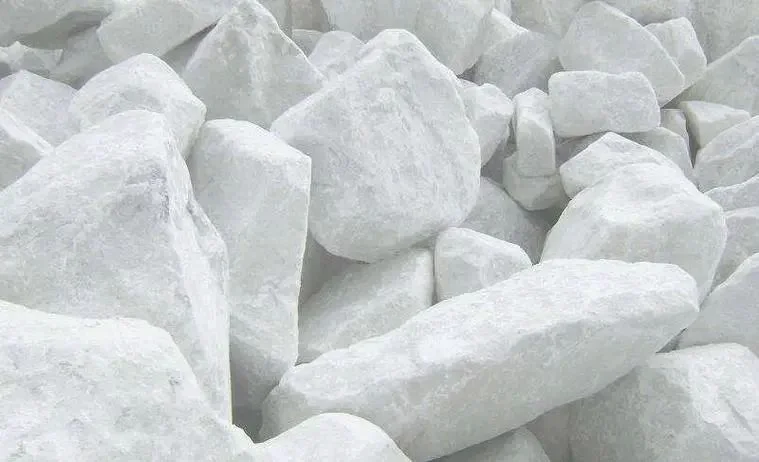
This page covers what buyers actually compare: how the three sources differ, what each industry demands, why a 2500 mesh powder costs several times a 325 mesh powder of the same whiteness, and which processing route delivers each grade.
Calcite, Limestone and Marble: One Mineral, Three Products
All three are calcium carbonate. What separates them is how the deposit formed, which sets crystal size, impurity level, and how the material behaves when ground.
| Source | How it formed | Typical character | Where it goes | Price position |
|---|---|---|---|---|
| Calcite vein | Hydrothermal precipitation in fractures, often coarse and clean | Large crystals, low color bodies, easy to whiten | High whiteness filler, plastics, coatings, paper | Highest of the three |
| Calcaire | Marine biological and chemical deposition, compacted over time | Fine grained, variable impurities, wide color range | Coarse filler, feed, FGD, soil pH correction, cement | Lowest, volume product |
| Marble | Limestone recrystallized under heat and pressure | Larger crystals than limestone, whiteness depends on the quarry | Filler, construction, some paper grades | Middle |
The purchase decision follows the application, not the geology. A plastics compounder needs whiteness and low oil absorption, so a clean calcite vein or a white marble wins. An FGD plant needs reactivity and low cost, so crushed limestone wins. Paying for calcite whiteness in an application that never sees the color is waste.
Properties That Matter on the Processing Line
Calcite has a Mohs hardness of 3 and a density of about 2.71 g/cm³. Both numbers are low for a mineral filler, which is why calcite grinds cheaply and why mill wear stays manageable compared with quartz or alumina.
The crystal carries three cleavages, so it breaks into blocky fragments rather than needles or plates. Blocky particles pack well and present less surface per gram, which keeps oil absorption and binder demand down. Particle shape is a quality attribute in calcite, not a byproduct of grinding.
Calcite reacts with acid to release carbon dioxide, and it decomposes on heating into calcium oxide and carbon dioxide. The acid reaction is the basis of flue gas desulfurization and water treatment use. The thermal decomposition sets the upper limit for any process that dries or compounds the powder at temperature.
Specs by Industry
Each industry buys calcite on a small set of numbers. Sending a datasheet that misses the one number a buyer checks first ends the conversation.
| Industrie | Typical fineness | The number they check first | What fails a trial |
|---|---|---|---|
| Plastics (PVC, PE, PP) | 800 to 2500 mesh | Whiteness plus oil absorption | High oil absorption raises binder demand and drops impact strength |
| Revêtements | 1250 to 2500 mesh | Whiteness and top size | Coarse tails show as specks; yellow tint ruins the tint strength |
| Paper | 600 to 1500 mesh | Brightness and d97 | Oversize scratches the wire; iron stains print |
| Caoutchouc | 325 to 1250 mesh | Fineness and oil absorption | Moisture causes blisters; coarse particles cut tensile strength |
| Feed and soil | Coarse, 60 to 200 mesh | Calcium content and heavy metals | Impurity profile fails feed additive limits |
| FGD and water treatment | Crushed, 200 to 325 mesh | Reactivity and price per ton | Over-grinding adds cost with no gain in reactivity |
How Fineness Sets the Price
Mesh is the trade unit, micron is the engineering unit. The conversion is not linear, and neither is the cost.
| Grade | Approximate top size | Typical use | Why the price steps up |
|---|---|---|---|
| 325 mailles | about 45 µm | Feed, soil, coarse filler, FGD | Single pass grinding, high yield |
| maille de 600 | about 23 µm | Rubber, paper filler, putty | Classification starts to reject material |
| maille de 800 | about 18 µm | Plastics, PVC profiles | Energy per ton rises, output per hour falls |
| maille 1250 | about 10 µm | Coatings, masterbatch, paper coating | Multi-stage circuit, wear parts wear faster |
| 2500 mesh | about 5 µm | High-end plastics, optical and functional filler | Low yield per pass, classifier load, contamination control |
Two costs drive the ladder. Grinding energy per ton rises steeply as the target size falls, because the mill keeps doing work on material that has already reached spec. Classification cost rises with it, since the cut gets finer, the circulating load grows, and the fraction rejected back to the mill can exceed the finished product.
Yield explains most of the price gap between 1250 and 2500 mesh. A mill producing 5 µm powder returns a large share of its throughput to the grinding zone, so the same motor hours produce far fewer saleable tons. Add wear part consumption and the ultrafine grade can cost several times the 800 mesh price from the same ore.
When a specification arrives in mesh, convert it before sizing equipment. The Calculateur de mailles en microns gives the top size for each grade so the mill and classifier selection starts from the right number.
Four Complaints and Their Process Causes
Most rejections in calcite trace to one of four causes, and each one has a known origin upstream.
Yellow or Grey Tint
Iron and titanium in the deposit set the base color, and the grinding circuit can make it worse. Steel wear from mill internals adds iron, and hot air that is too hot oxidizes it. Check the ore and the wear parts before blaming the mill setting. Whitening a dark ore by grinding finer does not work.
Oil Absorption Higher Than the Datasheet
Oil absorption follows surface area and particle shape. Over-grinding past the target size creates fines that raise surface area without adding value. Aggregated or porous particles hold binder in their internal voids. A blocky, tightly cut distribution keeps the value low, and that comes from the classifier setting, not from the mill alone.
Moisture Above Spec
Calcite is usually ground in an air-swept circuit, and the product leaves at the mill outlet temperature. If the system cools before the bag filter, moisture condenses back onto the powder. Storage in a humid silo does the same thing. Feed moisture and outlet temperature need to be controlled together.
Top Size Drifting Between Batches
The classifier wheel speed, the feed rate, and the air volume all shift the cut point. A circuit run at fixed speed with a varying feed rate delivers a varying d97. Log the three values together, or the drift cannot be traced.
Which Route Produces Which Grade
Coarse grades from 325 to 600 mesh run on a pendulum or roller mill with an integrated classifier, or on a ball mill with an external air classifier at higher capacity. The choice between them comes down to capacity and to how tight the top size must be.
From 800 to 1250 mesh the circuit needs a dynamic classifier, because a static separator cannot hold a 10 µm cut. Impact mills with an integrated classifying wheel handle this range and keep the oversize in the circuit until it reaches spec.
For 2500 mesh and finer, dry processing moves to a stirred or vibration mill paired with a fine classifier, and wet processing becomes an option when the downstream user accepts a slurry. Where iron contamination is a hard limit, the last stage moves to a jet mill, which grinds without media contact.
A chemical plant in Taiwan runs calcite to ultrafine grade with a pin mill and a multi-stage classifier on the same line; the calcium carbonate ultrafine grinding line write-up shows the equipment layout and the fineness it holds.
Surface treatment is a separate step. Plastics and coatings buyers often want stearic acid coated powder to cut binder demand and improve dispersion, and the coating changes the oil absorption number the buyer sees. The stearic acid surface modification process covers dosage and the dry coating route.
What to Put in an RFQ
A calcite inquiry gets a firm price when it carries six values: whiteness with the test method, d97 in microns, oil absorption, moisture, acid-insoluble residue, and coated or uncoated. Add the monthly tonnage and the destination port.
Whiteness without a method is not a specification. R457 and ISO brightness read differently on the same sample, and a supplier and buyer using different scales will argue over a batch that meets both. State the method, and the comparison becomes a number instead of an opinion.
If you are setting up a calcite line or replacing a circuit that cannot hold its top size, send the target spec and tonnage. We size the mill and classifier combination against the fineness and the whiteness limit you actually sell on.
Poudre épique
Epic Powder conçoit des systèmes de broyage et de classification pour les minéraux, les produits chimiques, l'agroalimentaire et la pharmacie. Forts de plus de 20 ans d'expérience dans le traitement des poudres, nous sélectionnons le broyeur adapté à la granulométrie et à la capacité souhaitées. Décrivez-nous votre matériau et nous vous recommanderons une solution éprouvée.

“Merci de votre lecture. J'espère que cet article vous sera utile. N'hésitez pas à laisser un commentaire ci-dessous. Vous pouvez également contacter le service client en ligne d'EPIC Powder. Molly pour toute autre question.”
— Emily Chen, Ingénieur