
As a procurement manager or process engineer, you know that white carbon black (precipitated or fumed silica) is a high‑value functional filler. Its immense surface area and reinforcing ability can transform ordinary polymers into advanced materials. Yet the same properties that make silica valuable also create two stubborn challenges: agglomeration y poor compatibility with organic matrices.
Unmodified silica particles are hydrophilic and tend to form hard hydrogen‑bonded agglomerates. In a silicone rubber compound, these agglomerates become “fish eyes” that weaken the product. In a coating formulation, they cause settling and poor rheology. The solution is modificacion superficial – coating each silica particle with a coupling agent or stearic acid to make it hydrophobic and easy to disperse.
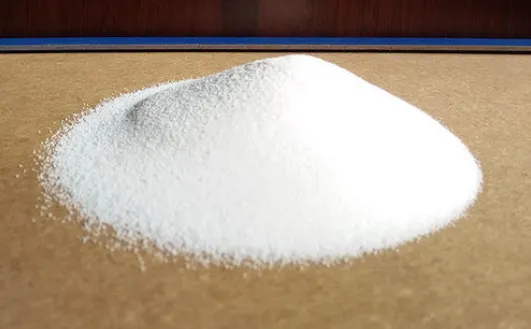
But the method of modification matters. Ordinary mixers or simple high‑speed agitators often fail to provide the intense, uniform shear needed to break agglomerates and fully coat nano‑ or micron‑sized silica. That is where a three‑roller coating machine excels.
In this article, we will explain why white carbon black needs modification, how a three‑roller coating machine works, and which industries benefit the most. We will also provide technical data in a fineness‑related table and share a real‑world validation: a Chinese national science institute recently chose EPIC Powder’s CRM‑6 three‑roller coating machine for their critical silica modification project.
1. Why Modify White Carbon Black? A Quick Technical Refresher
White carbon black (SiO₂·nH₂O) has a high density of silanol groups (–Si–OH) on its surface. These groups make the particle surface hydrophilic and acidic. When added to non‑polar polymers (silicone rubber, polyolefins, etc.), the untreated silica does not wet or disperse well. Worse, the silanol groups form hydrogen bonds between particles, creating agglomerates that are difficult to break by ordinary mixing.
Modificación de la superficie chemically converts the silanol groups into hydrophobic groups (e.g., –Si–O–Si–R) using coupling agents (silane, titanate, aluminate) or physical coatings (stearic acid). The results:
- Improved dispersion (fewer agglomerates)
- Higher filler loading without loss of mechanical properties
- Better compatibility with the polymer matrix
- Enhanced hydrophobicity for moisture resistance
However, the efficiency of modification depends heavily on the mixing intensity and temperature control. A three‑roller coating machine provides precisely that – high shear, self‑generated heat, and continuous operation.
2. Industry Applications: Where Modified White Carbon Black Is Essential
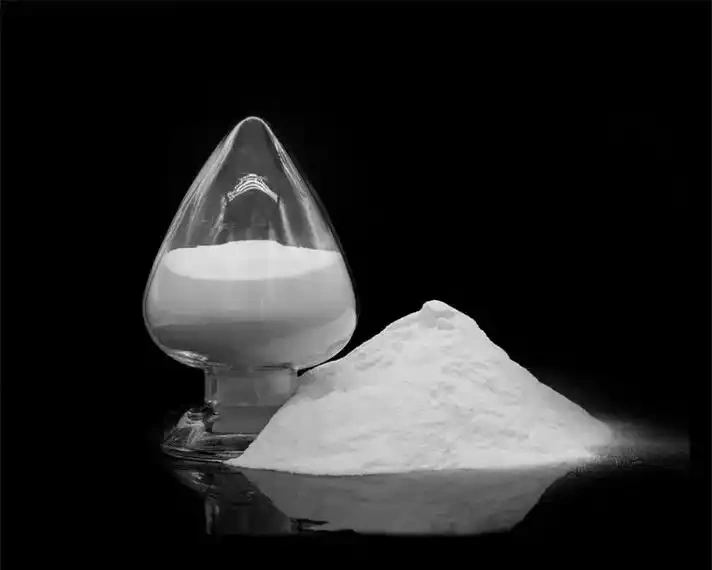
Different industries require different modification outcomes. Below we detail the four major sectors where a three‑roller coating machine adds the most value.
2.1 Silicone Rubber Industry (Most Critical Application)
Silicone rubber is the largest consumer of modified white carbon black. Unmodified silica will not reinforce silicone rubber because the two are incompatible. After surface modification (usually with a silane coupling agent or silicone oil), the silica becomes hydrophobic and organophilic.
Why the three‑roller coating machine is preferred:
Silicone rubber compounds are highly viscous. Ordinary mixers cannot fully break silica agglomerates in such a paste. A three‑roller coating machine (or a three‑roll mill in downstream compounding) applies extreme shear that delaminates agglomerates and distributes the modified silica uniformly. For liquid silicone rubber (LSR) , the same principle applies – the three‑roller coating machine ensures that every silica particle is coated before incorporation.
Benefits for procurement managers:
- Reduced consumption of expensive coupling agents (higher coating efficiency)
- Fewer rejected batches due to poor dispersion
- Ability to use lower‑cost untreated silica and modify it in‑house
Benefits for engineers:
- Consistent tensile strength and tear resistance across batches
- Transparent or translucent products without haze from agglomerates
- Better processability (lower viscosity, easier molding)
2.2 Rubber Industry (Tires & Mechanical Goods)
In tire tread compounds, silica is used to replace carbon black for lower rolling resistance (fuel efficiency) while maintaining wet grip. However, untreated silica slows down vulcanization and disperses poorly.
How three‑roller coating helps:
By pre‑coating the silica with a bifunctional silane (e.g., Si69) using the high‑shear environment of a three‑roller coating machine, the silica surface becomes reactive with the rubber matrix. The machine’s self‑friction heating (80–120°C) precisely activates the silane without external heat.
For engineers:
- Better dispersion means fewer “blow holes” in extruded profiles
- Improved abrasion resistance and fatigue life
For procurement:
- Lower scorch risk and faster mixing cycles reduce energy cost
2.3 Coatings & Inks (Thickeners, Matting Agents, Anti‑Settling)
In coatings, white carbon black is often used as a rheology modifier – it provides thixotropy (shear‑thinning) and prevents pigment settling. But untreated silica can cause severe agglomeration in solvent‑borne or water‑borne systems.
Role of the three‑roller coating machine:
The machine coats each silica particle with a low‑molecular‑weight wax, stearic acid, or a coupling agent. The coated silica no longer absorbs the resin or solvent; instead, it forms a loose network that gives the desired thixotropy without hard settling.
Industry examples:
- Automotive paints: Modified silica improves anti‑sag properties on vertical surfaces.
- Printing inks: It controls flow and dot gain.
- Wood coatings: It provides a smooth matte finish.
For procurement:
- Less modifier waste (the machine’s high coating rate exceeds 95%)
- Ability to use a wider range of raw silica grades
2.4 Plastics & Composites (High Filler Loading & Light Weight)
In plastics (PP, PE, PVC, nylon) and thermoset composites, modified white carbon black acts as a reinforcing filler and a flame retardant synergist. The challenge is achieving high filler loading without embrittlement.
Three‑roller coating machine advantage:
Because the machine thoroughly de‑agglomerates and coats each particle, the modified silica flows more easily into the polymer melt. Engineers can increase the filler loading from 10% to over 25% while maintaining impact strength. The negative pressure operation of the CRM series also ensures a dust‑free process – a major plus when handling nano‑silica.
For engineers:
- Better thermal stability and reduced moisture absorption
- Improved dielectric properties for wire & cable compounds
For procurement:
- Lower compound cost per kilogram (more filler, less polymer)
- Faster throughput in twin‑screw extrusion
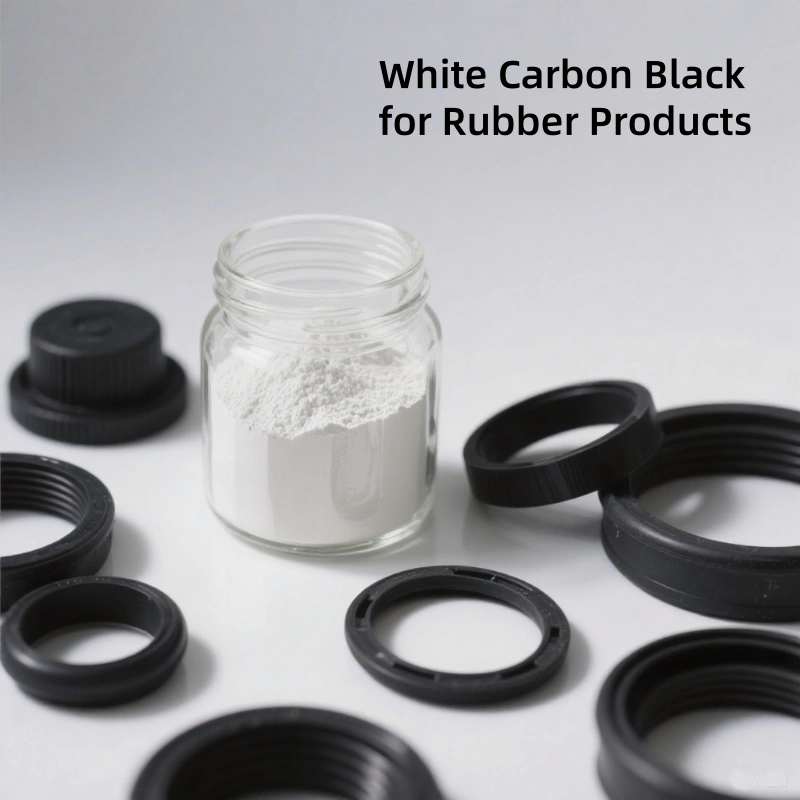
3. Technical Deep Dive: How a Three‑Roller Coating Machine Works
The EPIC Powder Three‑Roller Coating Machine (also called a continuous coating system) is designed specifically for powder surface modification. Unlike batch mixers, it operates continuously and uses mechanical shear and self‑generated heat.
Principio de funcionamiento
The machine consists of three independently driven mixing chambers, each with a high‑speed rotor. As the rotor spins (up to 4500 RPM on the CRM‑3 model), it creates a strong vortex flow inside the specially shaped chamber. Powder (e.g., white carbon black) and liquid modifier (silane, stearic acid, etc.) are fed simultaneously into the first chamber.
Within milliseconds, three effects occur:
- Impaction: Particles collide with the rotor blades and chamber walls, breaking agglomerates.
- Shear: The turbulent gas‑solid vortex produces intense shear forces that spread the liquid modifier over each particle’s surface.
- Self‑friction heating: High‑speed rotation causes particle‑to‑particle and particle‑to‑wall friction, raising the temperature to 80–120°C. This heat is precisely what the modifier needs to melt (for stearic acid) or chemically react (for silanes). No external heater is required.
After passing through all three chambers, the coated powder exits into a cyclone or bag filter. The entire system runs under negative pressure, meaning no dust escapes – essential for nano‑silica handling.
Key Technical Parameters – Including a Fineness Table
The machine is suitable for powders from 325 mesh up to 3000 mesh (as fine as 5 µm). For white carbon black (which often has low bulk density), the machine’s unique vortex design ensures that even very fine, “fluffy” powders are effectively coated.
Below is a fineness‑related performance table to help engineers and procurement managers select the right model. This table shows the recommended feed fineness range and approximate capacity for each CRM model when processing white carbon black.
| Modelo | Feed Fineness (Mesh) | Particle Size D90 (µm) | Typical Capacity for Silica (kg/h) | Self‑Generated Temp (°C) | Best‑Suited Modifier Type |
|---|---|---|---|---|---|
| CRM‑3 | 325 – 3000 | 5 – 45 | 300 – 900* | 80 – 120 | Stearic acid, silane |
| CRM‑6 | 325 – 3000 | 5 – 45 | 800 – 2000* | 80 – 120 | Silane, titanate, aluminate |
| CRM‑9 | 325 – 3000 | 5 – 45 | 1500 – 4000* | 80 – 120 | Silane (high throughput) |
*Note: Capacity for white carbon black is lower than for denser minerals (like calcium carbonate) because of its low apparent density. The figures above are based on actual silica modification projects. Contact EPIC engineers for a precise calculation using your specific silica grade.
Why fineness matters:
The finer the silica (higher mesh number), the larger the surface area to be coated. A three‑roller coating machine maintains a high coating rate even at 3000 mesh because the vortex flow continuously presents fresh particle surfaces to the modifier. The three chambers in series ensure that no particle escapes uncoated.
Additional Engineering Advantages
- No dead zone: The three‑chamber design eliminates low‑shear zones that plague single‑rotor mixers.
- Low auxiliary equipment: Self‑friction heating means no hot oil boiler or external heater is needed.
- Flexibilidad: Works with all common coupling agents and stearic acid.
- Easy cleaning: Quick‑opening doors on each chamber allow rapid product changeover.
4. Case Study: National Science Institute Chooses EPIC’s CRM‑6 for Silica Modification
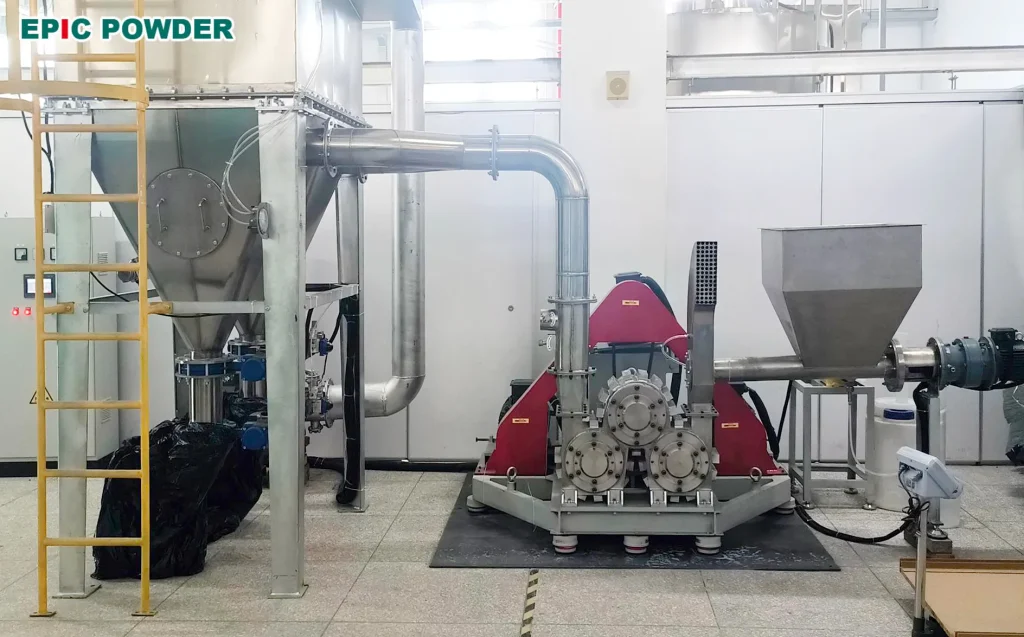
The most credible validation for any industrial equipment is a successful installation at a rigorous research institution. EPIC Powder recently completed a project with a top‑tier Chinese national physical sciences institute (comparable to a Max Planck Institute in Germany or a national laboratory in the US).
Background
The institute was developing a series of advanced composite materials that required hydrophobic white carbon black with extremely uniform surface coverage. They had been using a laboratory‑scale high‑speed mixer, but the results were inconsistent:
- Some batches showed high agglomeration.
- The modifier consumption varied by ±20%.
- Scaling up to pilot production (100–200 kg/h) was impossible with their existing equipment.
El desafío
After reviewing several technologies, the institute’s lead engineer identified three non‑negotiable requirements:
- High shear to break sub‑micron agglomerates of fumed silica.
- Precise temperature control between 90°C and 110°C for a proprietary silane coupling agent.
- Continuous, dust‑free operation because the silica grade was extremely fine and posed a respiratory hazard.
The EPIC Solution
EPIC Powder proposed the CRM‑6 Three‑Roller Coating Machine with the following configuration:
- Feed fineness: 1250 mesh (D90 ≈ 10 µm) white carbon black.
- Modifier: Vinyltrimethoxysilane at 1.5% by weight.
- Target throughput: 150 kg/h for R&D, but scalable to 1000 kg/h later.
The CRM‑6 was installed in the institute’s pilot plant. The three‑rotor design was tuned to generate a stable temperature of 105°C ± 5°C without any external heating – exactly within the silane activation range.
Resultados
After three months of operation, the institute issued a formal acceptance report. Key outcomes included:
| Parámetro | Before (High‑Speed Mixer) | After (EPIC CRM‑6) |
|---|---|---|
| Activation index (hydrophobicity) | 78 – 85% | 96 – 98% |
| Modifier consumption variation | ±20% | ±3% |
| Agglomerates >50 µm per gram | ~1200 | <50 |
| Emisión de polvo | Moderado | Zero (negative pressure) |
| Production continuity | Batch (30 min/batch) | Continuous, 24/7 |
Direct quote from the institute’s senior process engineer (paraphrased from the acceptance report):
“We tested three different modification methods. Only the EPIC three‑roller coating machine delivered the combination of uniform coating and complete de‑agglomeration that our advanced composite project required. The self‑friction heating eliminated the need for a complex external heating unit, and the dust‑free design made it safe for our researchers to operate daily.”
What This Means for You
If a rigorous national science institute trusts EPIC’s three‑roller coating machine for their most demanding silica modification work, you can be confident that it will perform in your production environment. The same machine is now being scaled up for their commercial partner.
5. Why Procurement Managers & Engineers Should Choose EPIC Powder’s CRM Series
For Procurement Managers:
- Lower total cost of ownership: No external heater, fewer auxiliary machines, and high modifier utilization (≥95%).
- Scalable investment: Start with a CRM‑3 for pilot lines, then add CRM‑6 or CRM‑9 as production grows.
- Proven ROI: The case study above shows reduced modifier waste and fewer rejected batches.
- Compliance: Operates under negative pressure – meets strict dust emission standards (OSHA, EU, etc.).
For Engineers:
- Broad material compatibility: Works with all coupling agents and stearic acid; suitable for 300+ powders (calcium carbonate, kaolin, talc, mica, graphite, barium sulfate, magnesium hydrate, zinc oxide, aluminum oxide, etc.).
- Predictable temperature control: Automatic system maintains 80–120°C even with variable feed rates.
- Fácil mantenimiento: Three independent rotors can be serviced without dismantling the whole line.
- Detailed documentation: Full CAD drawings, electrical schematics, and process P&ID provided.
6. Next Steps: Get a Custom Recommendation for Your Silica Modification Project
Every white carbon black grade is different – surface area, moisture content, particle shape, and target application all influence the optimal modification parameters. EPIC Powder’s engineering team offers a free process consultation to help you select the right model and operating conditions.
To request a quote or technical discussion:
👉 Contact EPIC Powder Engineers
Our experts will respond within 6 hours with a preliminary recommendation based on your powder specs and target capacity.
Polvo épico

“Thanks for reading. I hope my article helps. Please leave a comment down below. You may also contact EPIC Powder online customer representative zelda for any further inquiries.”
— Jason Wang, Ingeniero