
En la producción de polvos, especialmente en la preparación de polvos ultrafinos, la sobremolienda y la aglomeración son dos problemas comunes. La sobremolienda se refiere a una situación en la que las partículas finas cualificadas continúan moliéndose. Esto genera un desperdicio de energía, un problema más amplio. tamaño de partícula Distribución y, en algunos casos, rendimiento reducido del producto. La aglomeración se produce cuando las partículas ultrafinas se atraen entre sí mediante fuerzas de van der Waals, fuerzas electrostáticas o fuerzas de puente líquido. Como resultado, se forman partículas secundarias que afectan negativamente la dispersión del polvo, la fluidez y el rendimiento del producto final. Estos problemas no solo reducen la eficiencia de la producción, sino que también aumentan el consumo de energía y los costos operativos. Como dispositivo de clasificación en seco de alta eficiencia, el clasificador de aire Puede abordar eficazmente estos problemas separando con precisión las partículas.
Causas de la “sobremolienda” y la “aglomeración” en la producción de polvos
Durante los procesos de molienda mecánica (como la molienda de bolas o fresado por chorro), las partículas se vuelven progresivamente más finas a medida que aumenta el tiempo de molienda. Sin embargo, una vez alcanzada cierta finura, se produce un fenómeno de equilibrio de molienda: mientras las partículas finas aumentan, las ultrafinas comienzan a aglomerarse. La velocidad de reducción del tamaño de partícula se equilibra gradualmente con la velocidad de aglomeración. Si la molienda continúa más allá de este punto, el tamaño de partícula puede dejar de disminuir e incluso aumentar debido a la aglomeración.
Mientras tanto, si el polvo fino calificado no se separa a tiempo, vuelve a ingresar repetidamente a la zona de molienda, lo que genera una molienda excesiva.
Estos fenómenos son particularmente prominentes en la producción de polvos ultrafinos como carbonato de calcio, cuarzo y carburo de silicio, lo que afecta significativamente la calidad y el rendimiento del producto.
Principio de funcionamiento de un clasificador de aire
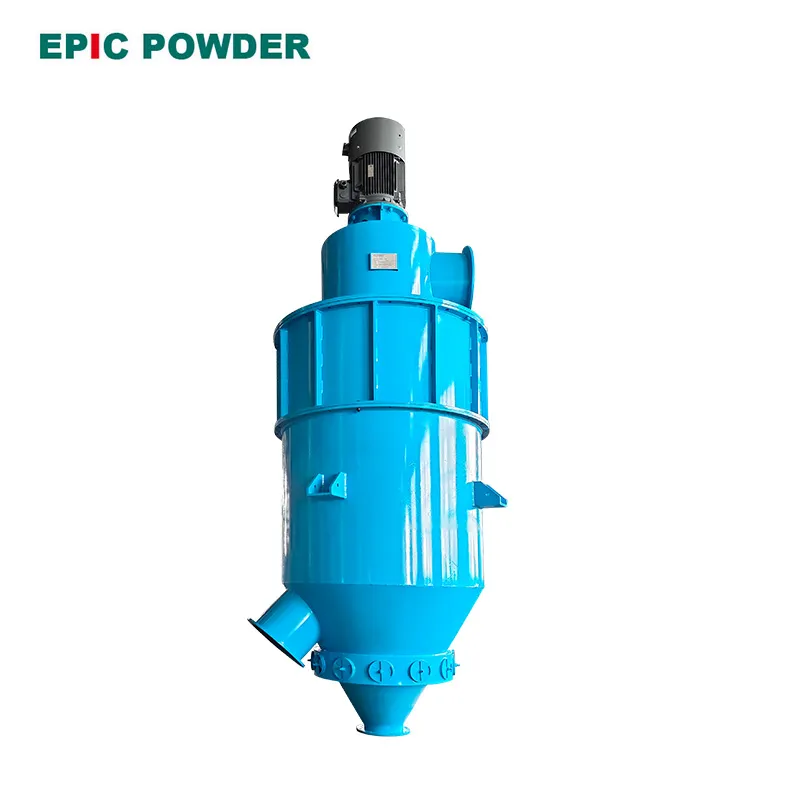
Un clasificador de aire Separa partículas mediante la combinación de los efectos del flujo de aire y la fuerza centrífuga. Los tipos más comunes incluyen los clasificadores de aire turbo (dinámicos) y los sistemas ciclónicos. Un clasificador de aire turbo típico consta de una placa de dispersión de alimentación, una rueda de clasificación (jaula del rotor), álabes guía y una entrada de aire secundario.
Principio de funcionamiento:
El material entra en la zona de clasificación mediante el flujo de aire. Gracias a la fuerza centrífuga generada por la rueda de clasificación giratoria de alta velocidad y a la fuerza de arrastre del flujo de aire, las partículas finas pasan a través de los huecos de la rueda y se recogen, mientras que las partículas gruesas son expulsadas hacia la pared de la carcasa y caen de nuevo a la zona de molienda. El flujo de aire secundario lava aún más la fracción gruesa, dispersando las partículas finas arrastradas y reduciendo el arrastre.
Ajustando parámetros como la velocidad del rotor y el caudal de aire, se puede controlar con precisión el tamaño de corte (normalmente D97 ≈ 3–150 μm), logrando una distribución estrecha del tamaño de partícula.
Cómo Clasificadores de aire Solucionar el problema de “Sobremolienda” y “Aglomeración”

Cómo prevenir el sobremoldeo
- Un clasificador de aire se conecta en serie con equipos de molienda (p. ej., molinos de bolas o molinos de chorro) para formar un sistema de circuito cerrado. Tras la molienda, el material entra al clasificador; el polvo fino cualificado se separa y recoge inmediatamente, mientras que las partículas gruesas regresan a la zona de molienda para una mayor reducción de tamaño. Esto evita la molienda repetida de las partículas finas, evita la molienda excesiva, mejora la eficiencia de la molienda y reduce el consumo de energía.
- En comparación con los sistemas de circuito abierto, los sistemas de circuito cerrado reducen significativamente la molienda excesiva y producen una distribución de tamaño de partícula más estrecha.
Mitigación de la aglomeración
- La dispersión del flujo de aire y el lavado con aire secundario durante la clasificación ayudan a romper los aglomerados débiles y mejorar la dispersión del polvo.
- La separación oportuna de las partículas finas evita la permanencia prolongada en la zona de molienda, reduciendo la probabilidad de aglomeración.
- Los clasificadores de aire modernos cuentan con diseños optimizados (como dispersores de alimentación mejorados y conos de turbulencia) para mejorar aún más la dispersión y reducir el “efecto anzuelo” (clasificación errónea de partículas finas como gruesas).
Además, el funcionamiento a presión negativa y el diseño del sistema libre de polvo garantizan una producción limpia y respetuosa con el medio ambiente.
Ventajas de la aplicación y consideraciones clave
Los clasificadores de aire se utilizan ampliamente en minerales no metálicos, Productos químicos, farmacéuticos y materiales para baterías. Sus principales ventajas incluyen:
- Alta precisión de clasificación con eficiencias de 60%–90%
- Capacidad de clasificación en múltiples etapas para producir fracciones de múltiples tamaños de partículas
- Ahorro de energía, funcionamiento silencioso y fácil control.
En la práctica, los parámetros operativos (como la velocidad del rotor y el flujo de aire) deben optimizarse en función de las propiedades del material (p. ej., contenido de humedad y fluidez). Si es necesario, se pueden utilizar aditivos para prevenir aún más la aglomeración.
La construcción de un sistema de molienda de circuito cerrado con clasificador de aire es una de las maneras más eficaces de solucionar los problemas de sobremolienda y aglomeración en la producción de polvos. Mejora la calidad y el rendimiento del producto, a la vez que permite una fabricación ecológica y eficiente, impulsando la industria de los polvos hacia una mayor precisión y refinamiento.
Conclusión
En el campo del procesamiento de polvos, Maquinaria de polvo épico de Qingdao (EPIC Powder) es un proveedor profesional de equipos para el procesamiento de polvo ultrafino. Sus clasificadores de aire avanzados incluyen los turboclasificadores de la serie HTS, los clasificadores verticales de la serie ITC y... Clasificadores de aire de la serie CTC. Estos sistemas son reconocidos por su alta precisión de clasificación, estrecha distribución del tamaño de partículas y excelente rendimiento de dispersión.
Al integrar clasificadores de aire en los procesos de molienda de circuito cerrado, EPIC Powder elimina eficazmente la sobremolienda y la aglomeración. Al mismo tiempo, el sistema logra un menor consumo de energía, una mejor calidad del producto y una producción respetuosa con el medio ambiente.
La elección del equipo de clasificación de EPIC Powder ayuda a los fabricantes a avanzar hacia una era más eficiente y refinada en el procesamiento de polvos.

Gracias por leer. Espero que mi artículo te haya sido útil. Deja un comentario a continuación. También puedes contactar con el servicio de atención al cliente online de Zelda para cualquier otra consulta.
— Publicado por Emily Chen