
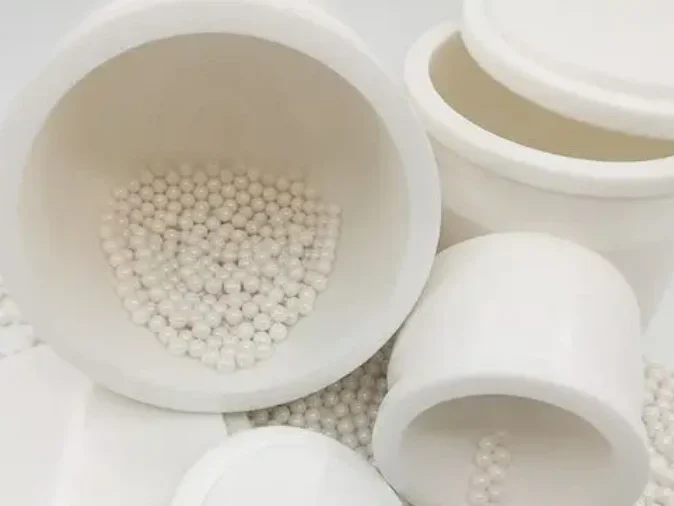
Dans l'industrie du traitement des poudres, comme celle des pâtes électroniques, le broyeur à billes agité est un équipement essentiel. Lors du choix des billes de broyage et des revêtements, beaucoup optent pour la zircone. Résistante à l'usure, chimiquement stable et dotée d'une densité équilibrée, cette approche est très répandue en production, mais elle est aussi à l'origine de nombreux problèmes. La zircone offre certes d'excellentes performances globales, mais elle n'est en aucun cas une solution universelle. Se fier aveuglément à la zircone conduit souvent à la contamination du produit, à une faible efficacité de broyage, voire à la mise au rebut d'un lot entier. Cet article explique pourquoi la zircone n'est pas une solution miracle et comment choisir correctement son revêtement et ses billes de broyage.
1. Pourquoi la zircone n'est pas une solution universelle
Les limitations de la zircone se manifestent principalement dans trois domaines : la stabilité chimique, la compatibilité physique et le contrôle des impuretés à l’état de traces. De nombreux procédés qui semblent fonctionner normalement peuvent en réalité receler des risques importants et cachés.
1.1 Dissolution en milieux fortement alcalins
La zircone présente de bonnes performances en milieu acide, mais dans les suspensions dont le pH est supérieur à 10, elle subit une hydrolyse et forme des zirconates solubles. Ce phénomène consomme non seulement les billes de broyage, mais surtout, les ions zirconium libérés dans la suspension modifient le potentiel zêta du système. Une poudre bien dispersée peut alors se réagglomérer, floculer, voire transformer la suspension entière en gel. Ce type de problème est fréquent lors du traitement en milieu aqueux des matériaux de cathode pour batteries au lithium et dans certains procédés de dispersion alcaline pour les poudres céramiques. Souvent, les ingénieurs passent des heures à rechercher la cause du problème en testant différents dispersants et en ajustant le pH sans succès, pour finalement découvrir que le broyeur lui-même est en cause.
1.2 Contamination inverse causée par une différence de dureté
La zircone possède une dureté Vickers d'environ 1200 à 1300 HV. Si le matériau à rectifier a une dureté proche ou supérieure à cette valeur (comme le carbure de silicium, la micropoudre de diamant ou le corindon), ce sont les billes de zircone qui s'usent. Dans ce cas, non seulement l'efficacité de la rectification est extrêmement faible, mais le taux d'usure de la zircone augmente de façon exponentielle. La contamination du produit par le zirconium peut atteindre plusieurs milliers de ppm, un niveau tout simplement inacceptable pour les applications haut de gamme.
1.3 Réactions à l'état solide sous haute température et haute énergie
Lors du broyage à billes sous agitation, les températures instantanées localisées à l'intérieur de la chambre peuvent être très élevées. Dans ces conditions de haute énergie, le stabilisant contenu dans la zircone (tel que l'oxyde d'yttrium) peut réagir à l'état solide avec le matériau broyé. Par exemple, lors du broyage de matériaux contenant du silicium, la surface des billes de zircone peut réagir avec la silice pour former une coquille de zircon (ZrSiO₄). Bien que dure, cette coquille est également fragile et s'écaille, devenant ainsi une source d'impuretés rigides difficiles à éliminer et facilement imperceptibles pour les méthodes d'inspection classiques.
1.4 L’impact fatal des impuretés à l’état de traces dans les applications haut de gamme
Dans de nombreux domaines de précision, le critère de “ compatibilité ” ne se limite pas à l'absence d'usure visible ; il implique également que les niveaux d'impuretés sont inférieurs au seuil de détection ou n'affectent pas les performances finales.
- Semiconducteurs et pâtes électroniques : Les résidus de zirconium ou d'yttrium au niveau du ppb peuvent agir comme des impuretés profondes qui dégradent la durée de vie des porteurs ou former des noyaux cristallins hétérogènes pendant le frittage qui conduisent à une rupture diélectrique.
- Produits biomédicaux : Les particules de taille nanométrique générées par l'usure de la zircone, si elles sont introduites dans des formulations injectables, peuvent déclencher des réactions immunitaires.
- Matériaux optiques : Les impuretés de zirconium à l'état de traces, ayant un indice de réfraction différent de celui du matériau de la matrice, provoquent une diffusion excessive de la lumière, rendant inutilisables les céramiques transparentes ou le verre optique.
2. Quelles sont les alternatives à la zircone ?
Une fois les limites de la zircone identifiées, il est temps d'envisager d'autres matériaux. Il n'existe pas de matériau idéal, seulement celui qui correspond le mieux à vos conditions de fabrication spécifiques.
| Matériel | Scénarios applicables | Principaux avantages | Risques |
| Alumine (Al₂O₃) | Matériaux de dureté moyenne, projets sensibles aux coûts | Faible coût ; l'aluminium est une impureté bénigne dans certains systèmes céramiques | Faible densité (~3,9 g/cm³); taux d'usure supérieur à celui de l'alumine (probablement la zircone ?) — ne convient pas au fraisage à haute énergie à l'échelle nanométrique. |
| Carbure de silicium (SiC) | Matériaux ultra-durs (par exemple, SiC, BCC) ; environnements extrêmes à forte concentration acide/alcaline | Dureté extrêmement élevée (HV 2800+) ; excellente résistance à la corrosion acide/alcaline | Coûteux ; les débris d’usure sont du SiC lui-même — il faut vérifier si cette impureté est autorisée dans le produit. |
| Nitrure de silicium (Si₃N₄) | Acier à roulement, alliages haute température, systèmes sensibles aux oxydes | Bonne robustesse, résistance aux chocs thermiques ; absence de contamination par les oxydes | Densité relativement faible (~3,2 g/cm³) ; ne convient pas aux applications nécessitant une énergie d'impact élevée |
| milieux homogènes (par exemple, la zircone ou un matériau similaire) | Projets avec des exigences de pureté extrêmement élevées | Aucune contamination étrangère |
Le choix d'un revêtement suit une logique similaire à celle des billes de broyage. Si votre matériau est extrêmement sensible aux ions métalliques, vous pouvez opter pour un revêtement en polyuréthane ou en caoutchouc associé à des billes de zircone. Cependant, ces revêtements ne conviennent qu'aux environnements à basse température et faible cisaillement, et ne résistent pas à la plupart des solvants organiques. Pour des environnements de traitement plus exigeants, les revêtements en carbure de silicium ou en nitrure de silicium constituent un choix bien plus robuste. Bien que l'investissement initial soit plus élevé, ils permettent, à long terme, d'éliminer les risques liés aux remplacements fréquents de revêtement et à la contamination du produit.
Résumé
La zircone est un matériau de haute qualité pour les broyeurs à billes agités, mais elle ne constitue en aucun cas une solution universelle. La prise en compte des limites de la zircone est essentielle pour garantir une qualité de produit constante et une production stable.
Foire aux questions
Q1 : Comment puis-je savoir si ma suspension est trop alcaline pour des perles de zircone standard ?
Le premier signe d'alerte est souvent une augmentation inexpliquée de la viscosité, une floculation ou une gélification pendant le traitement, même lorsque le dosage du dispersant semble correct. Si le pH de la suspension est constamment supérieur à 10 et que l'analyse ICP révèle une augmentation du taux de zirconium dissous, vos billes de zircone sont probablement en train de se dégrader. La méthode la plus fiable consiste à réaliser un test de corrosion à petite échelle sur votre suspension.
Q2 : Quel revêtement dois-je choisir si j'ai besoin d'une contamination métallique quasi nulle ?
Si votre produit ne tolère même pas de traces de métaux, évitez les revêtements métalliques ou en alumine standard. Pour les applications ultra-pures, nous recommandons généralement les revêtements en carbure de silicium ou en nitrure de silicium de haute pureté. Ces céramiques offrent une dureté extrême, une excellente résistance chimique et ne libèrent pratiquement aucun contaminant métallique.
Q3 : Puis-je mélanger différents matériaux de perles dans le même broyeur pour équilibrer le coût et la performance ?
Nous le déconseillons fortement. Mélanger des médias de densités ou de duretés différentes engendre une répartition inégale de l'énergie et accélère l'usure des billes les plus tendres ou les moins denses. Cela peut également générer des mélanges de contaminants imprévisibles. Il est préférable de choisir un média unique, adapté à l'application.
Poudre épique
Poudre épique, Forts de plus de 20 ans d'expérience dans l'industrie des poudres ultrafines, nous contribuons activement à son développement futur, en nous concentrant sur les procédés de concassage, de broyage, de classification et de modification. Contactez-nous pour une consultation gratuite et des solutions personnalisées ! Notre équipe d'experts s'engage à vous fournir des produits et services de haute qualité afin d'optimiser la valeur de votre transformation des poudres.

“Merci de votre lecture. J'espère que cet article vous sera utile. N'hésitez pas à laisser un commentaire ci-dessous. Vous pouvez également contacter le service client en ligne d'EPIC Powder. Zelda pour toute autre question.”
— Jason Wang, Ingénieur