
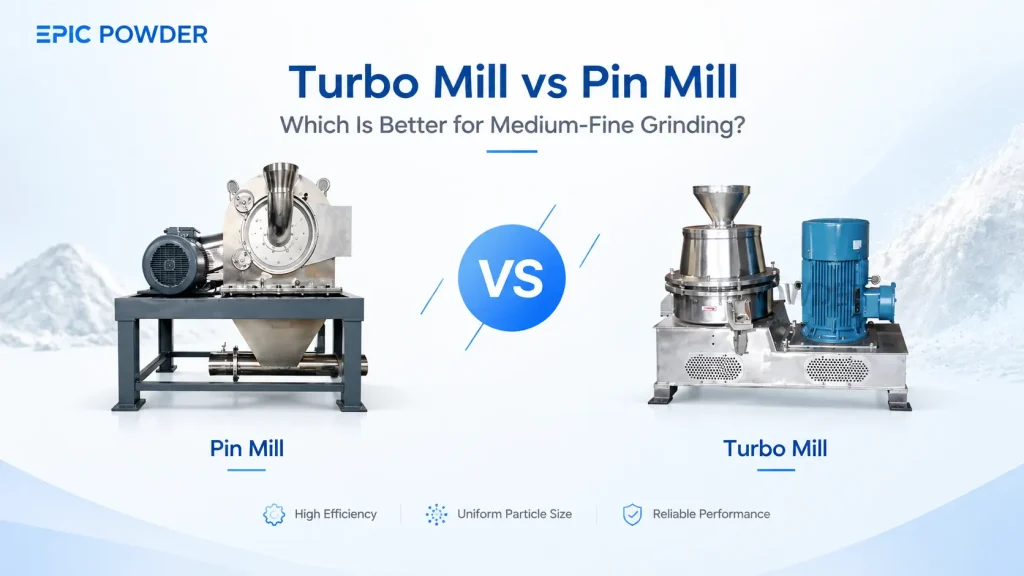
Choosing the right grinding mill affects particle size, energy use, and maintenance costs. If you are comparing impact mills for medium-fine powders, two designs come up again and again: the pin mill and the turbo mill.
Choose a pin mill when you need flexible medium-fine grinding, frequent product changeovers, and lower maintenance. Choose a turbo mill when you need continuous fine grinding with built-in air classification and better temperature control.
Both mills grind by impact. The difference lies in how they classify particles, manage heat, and fit into your production workflow.
What Counts as Medium-Fine Grinding?
Medium-fine grinding usually targets particle sizes between 5 microns and 150 microns. Industries such as food, pharmaceuticals, chemicals, battery materials, and minerals use this range to improve surface area, dispersion, or reactivity.
Your actual target depends on the application. Battery cathode powders often need D50 around 5–15 microns. Spice grinding may stop at 80–200 microns. Mineral fillers may aim for D97 around 10–45 microns.
How a Pin Mill Works
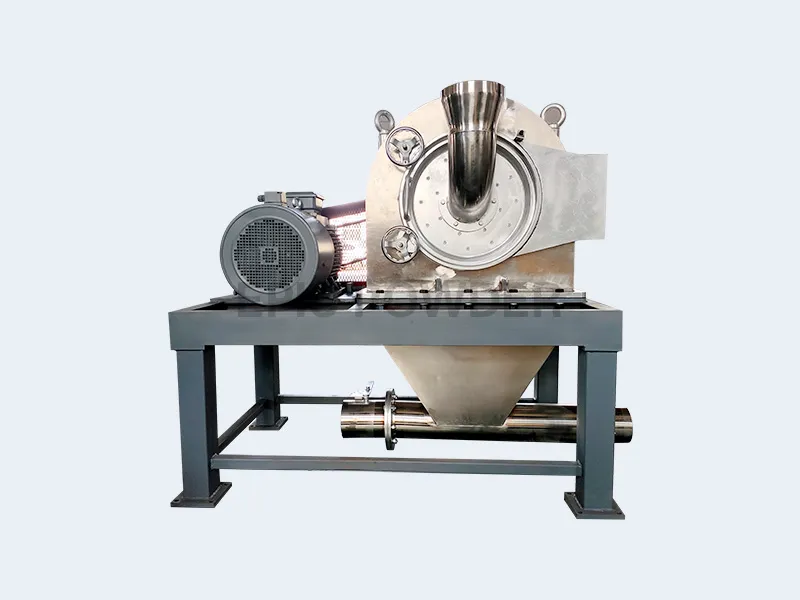
A molino de pasadores has two discs fitted with rows of pins. One disc spins at high speed; the other stays stationary or spins in the opposite direction. Material enters the center and moves outward through the pin rows. Particles break apart through repeated impact.
Discharge happens through a screen or an open periphery. To reach tighter particle-size distribution, a pin mill can be paired with an external air classifier. Fineness depends on rotor speed, pin design, feed rate, and whether classification is used.
How a Turbo Mill Works
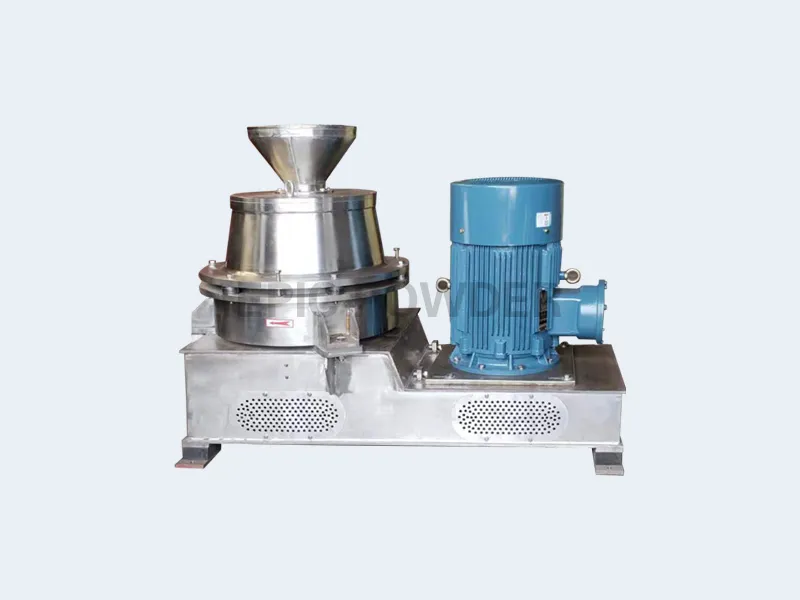
A turbo mill uses a high-speed rotor inside a casing. An air stream carries material through the grinding zone. A built-in classifier separates fine particles from coarse ones. Coarse particles return for further grinding; fine particles leave with the air stream.
This air-classified design gives continuous control over the cut point and produces a narrower particle-size distribution in one pass.
Direct Comparison
| Factor | Molino de pasadores | Turbomolino |
| Typical D50 range | 5–50 μm (with classifier) | 1–250 μm |
| Built-in classifier | No (external option) | Sí |
| Particle distribution | Broader without classifier | Narrower |
| Sensibilidad al calor | Moderate; cooling jacket or cold air helps | Better; air flow carries heat away |
| Mantenimiento | Simpler; pins and screen are easy to replace | More complex; classifier and rotor need care |
| Cleaning / changeover | Fast; open design and fewer internal parts | Longer; air ducts and classifier need attention |
| Capital cost | Más bajo | Más alto |
| Lo mejor para | Batch work, frequent product changes, flexible medium-fine grinding | Continuous fine grinding, heat-sensitive materials, tight PSD control |
When to Choose a Pin Mill
Pick a molino de pasadores for these situations:
· You run multiple products and need fast cleaning between batches.
· You want lower equipment cost and simpler spare-part inventory.
· Your target D50 is in the 5–50 μm range and you can add a classifier if needed.
· Your process is batch-based or semi-continuous.
· You need a compact machine for medium-capacity lines.
Food companies often prefer pin mills for sugar, spices, and starch because the open design lets operators inspect and sanitize quickly. Chemical plants use them for pigments and resins where flexibility matters more than built-in classification.
When to Choose a Turbo Mill
Pick a molino turbo for these situations:
· You need a built-in classifier in one machine.
· You need continuous fine grinding with tight top-size control.
· Your material degrades under heat.
· You process battery materials, pharmaceuticals, or fine chemicals.
· You want D50 control down to the 1–20 μm range without a separate classifier.
Battery material producers use turbo mills to grind cathode and anode precursors because the air-swept design limits temperature rise. Pharmaceutical manufacturers choose them when active ingredients need precise cut points.
Common Mistakes When Choosing
Buyers sometimes select a turbo mill for a simple medium-fine job and pay for classification they do not need. Others choose a basic pin mill for a tight particle-size target and then add a separate air classifier, increasing cost and floor space.
Run a grinding test with your actual material before deciding. Particle shape, hardness, moisture, and oil content all affect the result more than the machine name suggests.
Final Recommendation
For flexible, batch-oriented medium-fine grinding with frequent product changes, a pin mill is usually the more practical choice. For continuous fine grinding with built-in classification and temperature control, a turbo mill is the stronger choice.
Contact Epic Powder Machinery to arrange material testing and compare real particle-size data from both mill types.
Preguntas frecuentes
Can a pin mill reach the same fineness as a turbo mill?
Yes, in some cases. With an external air classifier, a pin mill can reach D50 values below 20 μm. However, a turbo mill reaches similar fineness in a single machine because it has a built-in classifier.
Is a turbo mill always more expensive than a pin mill?
Generally yes. The turbo mill has a more complex rotor-stator design and an integrated classifier. The higher cost is justified when you need continuous fine grinding or tight particle-size distribution.
Which mill is better for heat-sensitive materials?
The turbo mill is usually better because the air stream carries heat away. Pin mills can handle heat-sensitive materials too, but they often need a cooling jacket or cold air supply.
Polvo épico
Polvo épico designs grinding and classifying systems for minerals, chemicals, food, and pharmaceuticals. With more than 20 years of powder processing experience, we match the right mill to your target particle size and capacity. Tell us about your material and we will recommend a tested solution.

“Gracias por leer. Espero que mi artículo les sea útil. Dejen sus comentarios abajo. También pueden contactar al representante de atención al cliente en línea de EPIC Powder. zelda Para cualquier consulta adicional.”
— Jason Wang, Ingeniero