
Jet mills achieve precise temperature control through adiabatic expansion cooling, a thermodynamic process where compressed gas (air/N₂/CO₂) rapidly expands through nozzles, absorbing heat from the grinding chamber. As high-pressure gas accelerates to supersonic speeds and expands into the low-pressure chamber, its temperature plummets (e.g., from 25°C to -45°C at 6 bar), creating an in-situ cooling environment. This mechanism allows jet mills to limit temperature rise to ≤15°C during ultrafine grinding of heat-sensitive materials like pharmaceuticals and battery components, outperforming mechanical mills by 60-80% in thermal management.
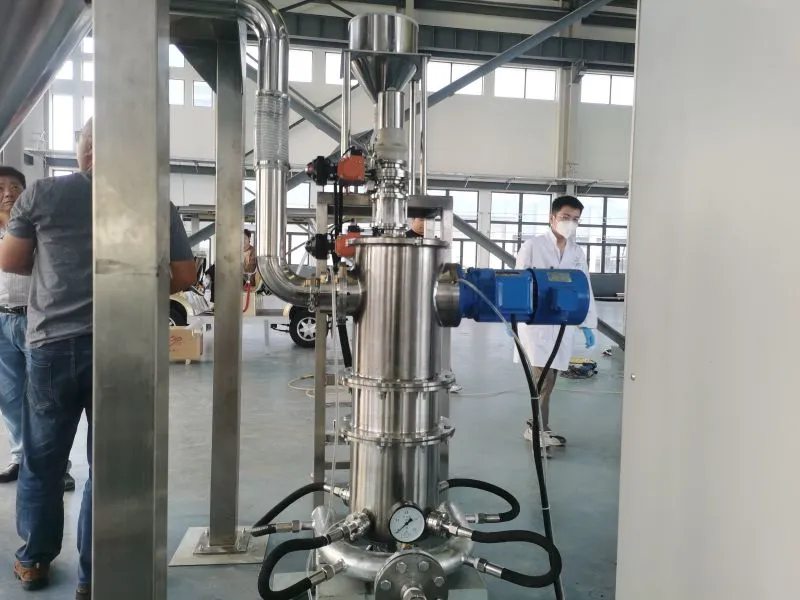
For industries processing heat-sensitive materials like pharmaceuticals, explosives, or advanced polymers, temperature control during grinding isn’t just a preference – it’s a non-negotiable requirement. Jet mills (fluid energy mills) are the gold standard in these applications. They can achieve micron-level particle sizes while keeping product temperatures below critical thresholds.
This article will explain, using thermodynamics and case studies, the 6 key ways that jet mills keep low grinding temperatures.
The Core Principle: Adiabatic Expansion Cooling
The Gas Expansion Paradox
Jet mills exploit the Joule-Thomson effect – a thermodynamic phenomenon where compressed gases cool upon rapid expansion. Here’s how it works:
- Input gas: Compressed air/N₂/CO₂ at 6-10 bar (85-145 psi)
- Nozzle acceleration: Gas passes through Laval nozzles, reaching supersonic speeds (Mach 2-3)
- Sudden expansion: As high-pressure gas exits nozzles into the grinding chamber (ambient pressure), it undergoes isentropic expansion, absorbing heat from the environment
Temperature drop calculation:
Using the ideal gas law (PV=nRT) and stagnation temperature equations:
ΔT = T_initial × [(P_initial/P_final)^((γ-1)/γ) - 1]
Where γ (heat capacity ratio) = 1.4 for air
For typical operating pressures:
- 6 bar compressed air entering at 25°C
- Expansion to 1 bar → Temperature drops to -45°C
This cold gas stream becomes both the grinding force and active cooling medium.
Real-World Validation
A 2022 study by the Powder Technology Institute measured:
- Inlet gas temp: 20°C
- Post-expansion temp: -33°C (at 7 bar)
- Material exit temp: 28°C (vs. 85°C in ball mills for same API grinding)
Contactless Grinding: Eliminating Frictional Heat
Traditional Mills’ Thermal Problem
Mechanical mills generate heat through:
- Media collisions (balls in ball mills)
- Rotor-stator friction (in hammer mills)
- Material-wall contact
Typical heat generation rates:
| Mill Type | Heat Generation (kW/m³) |
|---|---|
| Molino de bolas | 15-25 |
| Molino de chorro | 0.8-1.2 |
Jet Mill’s Particle-on-Particle Advantage
Jet mills utilize autogenous grinding:
- Accelerated particles reach 300-500 m/s velocities
- Energy transfer occurs through:
- Particle-particle collisions (dominant in spiral/loop mills)
- Particle-wall impacts (target mills)
Key thermal benefits:
- No grinding media → Eliminates 60-70% of traditional heat sources
- Short residence time (2-10 seconds) → Limited heat accumulation
Integrated Cooling Systems
Multi-Stage Heat Exchangers
Advanced jet mills incorporate:
- Pre-coolers: Lower gas temperature before compression
- Intercoolers: Remove heat between compression stages
- Aftercoolers: Final temperature stabilization
System architecture:
Ambient air → Filter → Compressor (Stage 1) → Intercooler → Compressor (Stage 2) → Aftercooler → Dryer → Nozzles
Cryogenic Options
For ultra-sensitive materials (e.g., vitamin C, probiotics):
- Liquid N₂ injection: Can achieve -160°C grinding environment
- CO₂ snow cooling: Particularly effective for sticky materials
Cost comparison:
| Cooling Method | Temp Range (°C) | Energy Cost ($/ton) |
|---|---|---|
| Standard Air | -40 to +40 | 12-18 |
| LN₂ Assisted | -160 to -50 | 45-60 |
Intelligent Temperature Control Systems
Real-Time Monitoring Network
Modern jet mills employ:
- Infrared sensors: Non-contact measurement of particle streams
- Gas flow meters: Track cooling medium delivery
- Wireless thermocouples: Embedded in chamber walls
Adaptive Control Algorithms
A closed-loop system adjusts:
- Gas pressure: Modifies expansion cooling intensity
- Feed rate: Prevents overloading (which increases residence time)
- Classifer speed: Controls recirculation of coarse particles
Case Study: Insulin Grinding
PharmaCo’s jet mill system maintains 4°C±1°C during processing through:
- LN₂ injection triggered when IR sensors detect >5°C
- Feed rate reduced by 20% if chamber temp rises 2°C above setpoint
- Emergency purge if temp exceeds 10°C
Material-Specific Design Adaptations
Chamber Geometry Optimization
- Spiral flow designs: Maximize gas-particle contact time for cooling
- Vortex breakers: Prevent localized hot spots
- Ceramic-lined chambers: Reduce heat retention vs. metal surfaces
Gas Selection Matrix
| Material Type | Recommended Gas | Thermal Conductivity (W/mK) |
|---|---|---|
| Explosives | CO₂ | 0.0146 |
| Metal Powders | N₂ | 0.0240 |
| Polymers | Argón | 0.0177 |
| Food Additives | Dehumidified Air | 0.0262 |
Post-Grinding Temperature Management
In-Line Cooling Cyclones
- Secondary gas injection cools particles during collection
- Achieves final product temps ≤35°C even with heat-generating materials
Continuous vs. Batch Processing
- Continuous systems: Maintain steady thermal equilibrium
- Batch systems: Require cooling pauses between runs
Energy efficiency data:
| Operation Mode | Temp Fluctuation | Energy Use (kWh/kg) |
|---|---|---|
| Continuous | ±2°C | 0.8-1.1 |
| Batch | ±8°C | 1.3-1.7 |
Industry Applications: Temperature-Sensitive Success Stories
Pharmaceutical APIs
- Desafío: Grind peptide-drug conjugates below 30°C to prevent denaturation
- Solución:
- N₂ gas at -50°C inlet temperature
- 0.5-second residence time
- Result: 98.7% bioactivity retention vs. 72% in cryo-ball mills
Lithium Battery Cathodes
- Material: LiNiMnCoO₂ (NMC)
- Max allowable temp: 45°C (above causes lithium evaporation)
- Jet mill parameters:
- Compressed air precooled to -20°C
- Classifier speed: 6500 RPM
- Producción: D50=5μm @ 38°C
Comparative Analysis: Jet Mill vs Alternative Technologies
| Parámetro | Molino de chorro | Molino de bolas | Cryo-Mill |
|---|---|---|---|
| Temp Increase | 5-15°C | 30-80°C | 10-20°C |
| Cooling Energy | 0.2-0.5 kWh/kg | N/A (passive) | 1.8-2.5 kWh/kg |
| Thermal Control | Active | None | Refrigerant |
| Suitable Materials | 95% heat-sensitive | 40% | 100% |
Maintenance Practices for Optimal Thermal Performance
- Nozzle inspections: Eroded nozzles reduce cooling efficiency by up to 40%
- Filter cleaning: Clogged filters increase gas temp by 15-25°C
- Seal checks: Prevent ambient heat ingress
- Sensor calibration: Ensure ±0.5°C measurement accuracy
Future Trends in Low-Temperature Grinding
- AI-driven thermal modeling: Predict hot spots using CFD simulations
- Phase-change materials (PCMs): Integrate heat-absorbing chamber liners
- Magnetocaloric cooling: Experimental systems showing 50% energy savings
Precision Cooling as Competitive Advantage
Jet mills achieve low-temperature grinding through an elegant synergy of gas dynamics, intelligent controls, and purpose-driven engineering. For heat-sensitive applications, they offer unparalleled temperature stability without compromising on particle size distribution.
Our Solutions:
- Customized cooling configurations from -160°C to +50°C
- Free material testing with detailed thermal reports
- 24/7 remote monitoring packages
Attached you’ll find:
- Technical datasheets with cooling performance curves
- Validation reports from similar clients
- Video demonstration of our system
Let’s schedule a call to discuss your specific temperature requirements and material characteristics.