
Kaolin is a type of mineral não metálico, mainly composed of kaolinite clay minerals, with the químico formula Al₂O₃·2SiO₂·2H₂O. According to geological origin, kaolin can be divided into primary kaolin and secondary kaolin. Based on industrial applications, it can be categorized as hard kaolin and soft kaolin. Among them, coal-series kaolin is a typical hard kaolin and is mainly used as a raw material for producing calcined kaolin. Soft kaolin mainly refers to secondary, sedimentary kaolin, which is mainly used in ceramics, paper, and coatings. Sandy kaolin, which contains a large amount of quartz sand, is used in different fields depending on its purity after sand removal.
According to processing methods, kaolin can be divided into washed kaolin, calcined kaolin, and modified kaolin.
Due to its unique physical and chemical properties, kaolin is widely used in various fields, including ceramics, paper, coatings, rubber, plastics, refractory materials, daily chemicals, agricultural inputs, fiberglass, catalysts, and pharmaceuticals.
Coal gangue is a solid waste generated during coal mining and washing. It is an associated mineral of coal-bearing sedimentary rock layers, with a mineral composition mainly of kaolinite and quartz. Typically, the kaolinite content is about 70%, making it a coal-series kaolin. Coal gangue can be used to produce kaolin products, especially high-quality calcined kaolin products.
Coal gangue has long been stockpiled as bulk industrial waste, occupying land and polluting the environment. Transforming coal gangue into high-quality kaolin products not only addresses the environmental problems caused by coal gangue but also meets the market demand for kaolin, generating both environmental and economic benefits.
Current Technologies for Producing Kaolin from Coal Gangue
China has abundant coal gangue resources, but the presence of iron, titanium impurities, and organic carbon has limited its development in kaolin production. In recent years, significant progress has been made in producing kaolin from coal gangue. The main production processes include ore beneficiation, purification, delamination, ultrafine grinding, calcination, and surface modification.
1. Ore Beneficiation and Purification
Ore beneficiation and purification involve manually or mechanically removing gangue and iron-containing minerals (such as pyrite) from coal gangue. Techniques such as heavy media separation and photoelectric sorting are commonly used. Further crushing, grinding, and strong magnetic separation are then applied to remove iron, titanium, and quartz impurities, thereby increasing the purity of the raw material.
2. Delamination
Delamination takes advantage of the layered structure of kaolinite crystals in coal gangue and their weak interlayer forces. Physical or chemical methods are used to separate kaolinite into ultrathin, fine flakes. Currently, mature methods include grinding-delamination, high-speed jet methods, and chemical delamination. Adding chemical agents during grinding allows the combined chemical and mechanical forces to overcome interlayer forces and remove colored impurities. Subsequent sedimentation, centrifugation, magnetic separation, or bleaching improves the whiteness and fineness of the kaolin.
3. Moagem Ultrafina
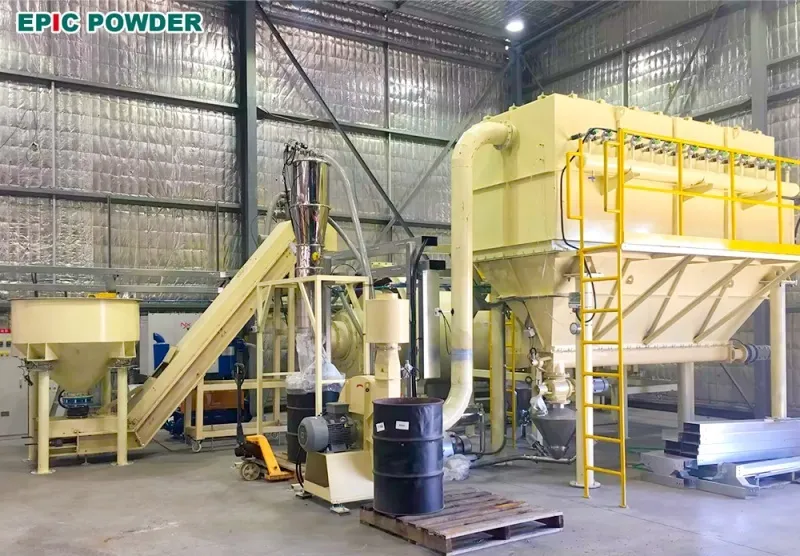
Ultrafine grinding of kaolin is a key step in deep processing and enhancing added value. Its purpose is to physically change the particle shape and size distribution of kaolin, significantly improving or imparting new physical and chemical properties. This allows kaolin to meet the requirements of high-end applications. Equipment such as ball mills, Raymond mills, European-style mills, and jet mills are commonly used, typically coupled with dispersion, de-agglomeration, and classification systems to ensure powder fineness.
4. Calcination
Calcination involves heat-treating the coal gangue powder, after beneficiation, delamination, and grinding, at specific temperatures. The objectives are to remove organic carbon and other minerals to improve kaolin whiteness, to remove water and hydroxyl groups from kaolinite to increase pore volume and chemical activity, and to improve physical properties. The resulting calcined kaolin can be directly used in various fields or further processed through surface modification and composite techniques.
5. Modificação de superfície
Surface modification of kaolin involves treating the powder’s surface by physical, mechanical, or chemical methods according to application requirements. The goal is to alter the physical and chemical properties to meet the needs of new materials and technologies. Commonly used agents include silane and titanate coupling agents. Modified kaolin finds applications in plastics, rubber, and coatings
Currently, coal gangue-based kaolin production faces the following limitations:
- High chemical composition requirements for coal gangue, requiring low-iron and low-titanium coal gangue as raw material.
- Strong acid leaching can improve impurity removal but generates large amounts of acidic wastewater, posing heavy environmental burdens.
- High process control requirements; improper calcination temperature or duration can lead to over- or under-calcined products, affecting whiteness and activity.
New Processes for Producing Kaolin from Coal Gangue
To address the limitations of traditional coal gangue kaolin production in China, researchers have developed a new process aimed at producing environmentally friendly, low-consumption kaolin with a whiteness >90%, tamanho da partícula <2 µm, and passing rate >90%—referred to as the “Double-90” high-quality calcined kaolin. The process uses ultrafine grinding + spray drying + rotary kiln calcination, and co-produces construction sand and polyaluminum ferric chloride. The process is as follows:
- Preliminary crushed coal gangue is sent for sorting. Manual sorting, heavy media separation, and photoelectric separation are combined to remove gangue and pyrite. The separated gangue is further processed into construction sand.
- Coal gangue, with gangue and pyrite removed, is sent to grinding. After crushing, grinding, and slurry preparation, the material is classified into fine and coarse slurries. The coarse slurry is returned for ultrafine grinding, and the fine slurry undergoes further ultrafine grinding.
- The ultrafine ground coal gangue slurry is sent to iron removal. Inorganic acids are used to remove trace iron and titanium, with a small amount of aluminum dissolving as well.
- The iron-removed slurry is filtered, pulped, and dispersed. Whitening agents are added, followed by spray drying to obtain coal gangue powder. The powder is then calcined using a rotary kiln or suspension calcination to produce “Double-90” kaolin meeting the required whiteness and fineness.
- The filtrate from iron removal contains aluminum salts and a small amount of iron salts. It is recycled as feed slurry for fine grinding. When the aluminum and iron concentration reaches the required level, it undergoes precipitation, filtration, and is processed into a mixed hydroxide of aluminum and iron. The mixed hydroxide is further acid-leached, polymerized, and dried to produce solid polyaluminum ferric chloride.
This process produces no waste residue or wastewater.
Conclusão
Producing kaolin from coal gangue is a mature and effective way to utilize coal gangue resources. Using coal gangue as a raw material for kaolin production not only expands resource utilization pathways but also provides a new path for industrial transformation in coal-producing areas. It also meets the demand for kaolin resources in national economic construction.
In particular, the new coal gangue-based kaolin process with zero emissions offers excellent environmental, economic, and social benefits. Its promotion and application will open broader prospects for the development of China’s coal gangue resource utilization industry.

Obrigado pela leitura. Espero que meu artigo tenha ajudado. Deixe um comentário abaixo. Você também pode entrar em contato com o suporte online da Zelda para quaisquer outras dúvidas.
— Publicado por Emily Chen