
Buyers of needle coke decide on three numbers: the coefficient of thermal expansion (CTE), sulfur, and ash. Everything else, including the raw material route, the coke drum used, and the calcining temperature, exists to move those three numbers into range for a specific end use.
This guide covers what needle coke is, how petroleum and coal based grades differ, which specs decide the price, and how to write a request that gets usable quotes.
What Needle Coke Is
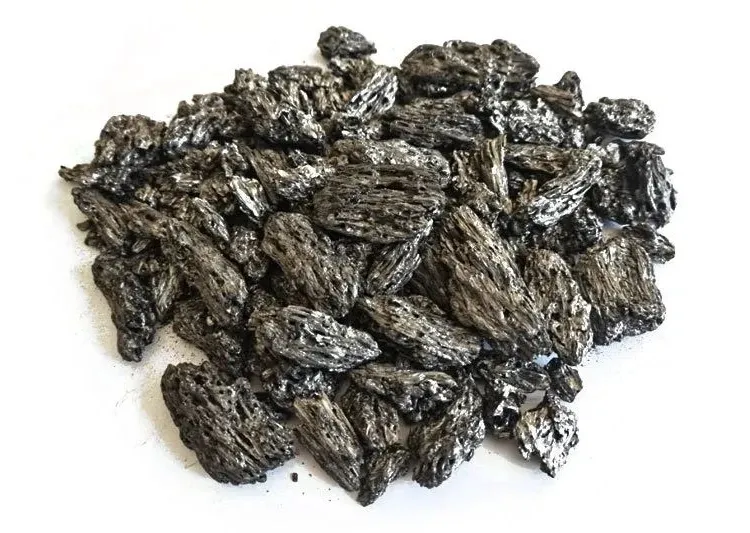
Needle coke is a high performance carbon material with a silver gray metallic luster and a needle-like surface texture. Inside, it carries small oval pores. Under a microscope the structure shows flat aromatic layers stacked with high orientation, following the Franklin model, which makes it a graphitizable carbon. Heated above 2000 °C, those layers rearrange into a graphite-like structure.
That ordered structure gives needle coke its value: high electrical and thermal conductivity, low thermal expansion, and resistance to thermal shock. Graphite electrodes and lithium-ion battery anodes both depend on those properties.
Petroleum Based and Coal Based: Which Route Fits
Two raw material routes produce needle coke, and they behave differently in downstream processing.
| Route | Raw materials | Typical strengths | Points to check |
|---|---|---|---|
| Petroleum based | Ethylene tar, vacuum and thermal cracking residue, catalytic cracking slurry oil | Low sulfur, low ash, low metal content, easy to graphitize. The main feedstock for artificial graphite today. | Higher cost, strict raw material requirements, supply tied to refinery output |
| Coal based | Coal tar, coal tar pitch, flash distillation oil | Widely available feedstock, suited to electrode applications | Needs stricter raw material pretreatment; sulfur and ash typically run higher than petroleum based |
Both routes share the same forming mechanism. Raw material passes through liquid phase carbonization, where mesophase spheres nucleate, grow, merge, and orient before carbonizing into the fibrous structure. The production chain runs from raw material pretreatment to delayed coking, where the coke forms in the drum, then calcination, which strips volatiles and moisture and raises true density.
The Five Specs That Decide the Price
Every quote you receive will be organized around these five numbers. Ask for each one on the certificate of analysis, not on the datasheet.
| Spec | What it controls | Why it moves price |
|---|---|---|
| CTE (coefficient of thermal expansion) | Thermal shock resistance of the finished graphite body | The single most important grade indicator. Lower CTE requires better raw material and tighter coking control. |
| Sulfur | Puffing and cracking during graphitization | Sulfur leaves the lattice at graphitization temperature and expands. Anode and large electrode grades demand low sulfur. |
| Ash | Final purity, electrochemical behavior in anodes | Ash carries metals. Battery grades hold it far lower than electrode grades. |
| Volatile matter | Degree of calcination | Residual volatiles shrink and crack during graphitization. Calcination cost shows up here. |
| True density | How completely the coke has graphitized structure | Low true density signals under-calcined material, and it drags down anode capacity. |
Anode Grade and Electrode Grade
The same material serves two industries with different priorities.
| Exigence | Graphite electrode | Battery anode |
|---|---|---|
| Primary concern | CTE and mechanical strength at large diameter | Purity, sulfur, and consistent particle size |
| Typical route | Needle coke blended with binder pitch, extruded, baked, graphitized | Needle coke graphitized to artificial graphite, then milled and coated |
| Metal content | Controlled, with wider tolerance | Treated as a critical impurity |
| Taille des particules | Set by aggregate formulation | Set by anode design, often micro or sub-micro scale |
Electric arc furnace steelmaking drives the electrode side. Furnaces have moved toward larger diameters and ultra high power operation, and the maximum allowable current rises with electrode diameter. Large diameter electrodes demand better needle coke, so steel industry demand pulls the top end of the quality range.
Battery anodes drive the other side. Artificial graphite holds about 80% of the commercial anode market, and its feedstock splits into oil based and coal based coke, with petroleum coke and needle coke inside the oil based branch. Needle coke based anodes carry good chemical stability, high capacity, and strong conductivity, and they support high compaction density designs.
Other Uses
Supercapacitors use needle coke for electrodes, where the device trades some energy density for far higher power density and cycle life than a secondary battery. Dye-sensitized solar cells have drawn research interest for their low material cost. Graphene preparation has used needle coke as a carbon source in laboratory work. These applications consume small volumes today compared with electrodes and anodes.
Grinding Changes What the Buyer Receives
Needle coke leaves the calciner in lumps, and every downstream use starts with particle size reduction. Anode producers typically target a D50 in the low single microns, and the mill choice decides both the size distribution and the purity of the powder that reaches the coating line.
Two things go wrong in needle coke milling. The needle structure breaks into slivers, so impact against metal smears the edges and sheds iron into the product. The material also carries residual volatiles, and a mill that runs hot drives them off unevenly and cokes the fines in the collector.
Jet milling solves both. Particles accelerate through LAVAL nozzles and grind against each other with no media and no fast-moving metal contact, and the expanding gas holds the process below ambient temperature. A case from our equipment division shows the result on this exact material: an American carbon manufacturer reached a stable D50 of 2 µm with no metal pickup and no thermal degradation. The full configuration is written up in the needle coke broyeur à jet case study.
What Drives Needle Coke Price
- Raw material availability. Petroleum based coke depends on refinery streams, so price follows the spread between ethylene tar or slurry oil and finished coke.
- Calcination cost. Energy intensive, and it sets true density and volatile matter.
- CTE class. A tighter CTE band costs more because yield drops at the coker.
- Application pull. Large diameter electrode demand and anode capacity expansion both tighten supply of the top grades.
How to Write a Needle Coke RFQ
Suppliers respond faster and with comparable numbers when the request carries five items:
- End use, stated as electrode or anode, plus the target part or cell design.
- CTE class and the test method used to measure it.
- Sulfur, ash, and volatile matter limits, with the basis (as received or dry).
- Particle size requirement, D50 and D97, plus whether you buy lumps or milled powder.
- Volume and delivery pattern, since coker campaigns run in blocks.
For buyers who purchase milled powder, add the milling route to the request. Powder ground on a jet mill and powder ground on a mechanical mill can pass the same D50 while behaving differently in coating, because the size distribution and the surface of the particles differ.
Send your specification and target particle size, and our engineers will match a grinding configuration and return a trial plan with the size distribution report. Reach the team through the contact page.

“Thanks for reading. I hope my article helps. Please leave a comment down below. You may also contact EPIC Powder online customer representative Molly for any further inquiries.”
— Jason Wang, Ingénieur