
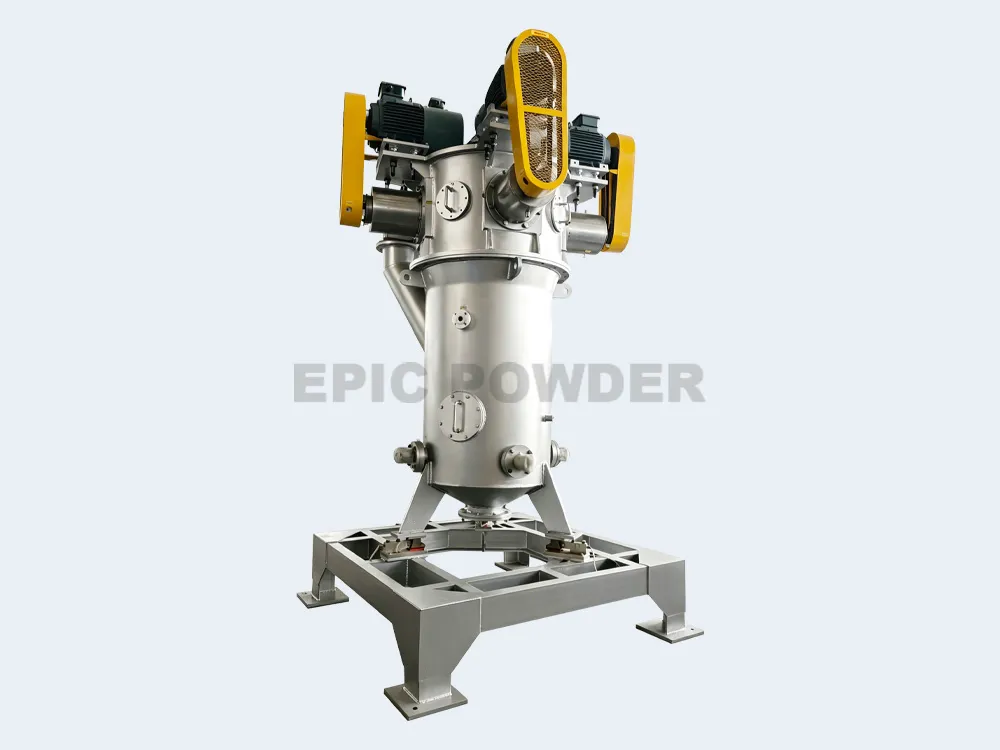
Buyers size a jet mill from the fineness it promises, and the price follows the fineness. The feed decides both numbers before the machine reaches the quotation. A fluidized bed مطحنة نفاثة grinds particles against each other in a gas stream. That stream can only accelerate so much mass per pass. Coarse feed slips through the chamber without breaking, and over-ground feed wastes gas the material never needed. This article sets out the jet mill feed size limits for each target band. It then prices the pre-grinding stage and the preparation steps past size. A trial on the real material closes the list.
What Limits the Feed a Jet Mill Takes
Three parts set the limit, and none of them is the grinding chamber. The venturi feeder meters powder into the gas stream, and it only meters particles that flow. The fluid bed needs free-flowing granules. Lumps above a few millimeters sink and leave unground, or they bridge the feeder and stop the line. The nozzles accelerate whatever reaches them, and acceleration falls as particle mass rises. A hard lump therefore rides through the jets and reports to the coarse side without breaking.
For most fluidized bed models the practical ceiling falls in the low millimeter range. Brittle granules up to about 3 mm shatter within their first passes, and the chamber treats them as ordinary feed. Hard lumps of the same size do neither, and they jam the metering or dilute the product with oversize. The ceiling belongs to the feeder and the fluid bed, and it moves with the material. Abrasive feeds raise a second concern, because the few hard lumps do most of the wear damage before they leave.
Feed Windows for the Target Cut
The feed window narrows as the target cut drops, because fine cuts leave no room for coarse survivors. The companion article on jet mill fineness limits reports two anchor points. A feed pre-ground below about 100 µm reached D97 3 µm at moderate pressure. A 2 mm feed drifted toward D97 8 to 10 µm on the same gas budget. The table turns those anchors into working bands for jet mill feed size.
| Target cut (D97) | Practical feed | What goes wrong outside the window |
|---|---|---|
| D97 45 to 10 µm | Brittle granules up to about 2 to 3 mm | Hard lumps leave as oversize and jam the feeder |
| D97 10 to 5 µm | Feed crushed to a few hundred microns | Gas cost climbs while yield slides |
| D97 below 5 µm | Feed pre-ground below about 100 µm | Agglomeration floor arrives before the target |
Each step down the table trims the feed size by roughly one order of magnitude. The cost of that trimming belongs in the comparison. A cut that reads fine on the spec sheet may be unreachable on the site. The jet mill feed size behind such a cut carries an upstream stage, and the quotation must price it.
Why Pre-Grinding Pays for Itself
Mechanical fracture does the coarse work at a lower energy cost than compressed gas, and that gap argues for pre-grinding. A ball mill with a classifier does it with steel, power and media. A jet mill does it with compressed gas, the most expensive energy the plant consumes. A mechanical stage does the coarse work, and the gas does the fine work. A pre-crushing stage ahead of the mill also steadies the feed, because crushed granules flow more evenly than run-of-mine lumps.
The saving reaches the gas bill before it reaches anywhere else. Gas per ton rises steeply as the target cut falls. Coarse feed spends that gas on fracture, and little of it reaches the fine end. The economics reverse at the coarse end, where the fineness article shows a ball mill circuit taking over. Between the two boundaries the split stays simple. The mechanical stage breaks the coarse feed, and the jet mill finishes the cut.
Feed Preparation Past Size
Size is the first preparation item, and moisture is the second. Damp powder bridges in the venturi, packs the classifier and pushes the distribution wide. Our article on feed moisture in grinding follows the same failure through humid weeks. Drying ahead of the mill costs far less than the downtime it removes. It also protects the yield that the classifier can hold at the target cut.
Sticky and heat-soft feeds need treatment before the feeder, because pressure cannot fix a bridging problem. Plants cool waxy materials or blend them with a free-flowing carrier so the venturi keeps metering. Feed rate stability belongs on the same list, because every surge reads as a load swing and widens the distribution. A steady feeder works as a classification aid as much as a grinding aid.
What the Trial Must Confirm
The jet mill feed size trial runs two settings on the same mill. One run uses the material as received, and one uses the material after pre-crushing. Both runs use the same nozzle pressure and the same wheel speed, so the feed is the only variable. Each run reports a full particle size distribution and the gas consumed per ton.
The pair of numbers prices the decision. When the pre-crushed run holds a finer cut at better yield, the upstream stage pays for itself. The trial report then carries that arithmetic into the quotation. When the runs land close together, the mill takes the material as it comes, and the project skips a stage. The two runs take one day on the trial mill, and they price a stage that no quotation can. ملكنا MQL fluidized bed jet mill runs both settings in one session. Nozzle pressure and wheel speed can be adjusted between runs.
التعليمات
What feed size can a jet mill take?
Brittle granules up to about 3 mm enter most fluidized bed mills directly. The venturi and the fluid bed set that ceiling. Hard or tough lumps need pre-crushing regardless of size, because the jets cannot fracture them in a single pass. The trial turns both statements into numbers for the actual material.
Does every jet milling project need pre-grinding?
No. Targets between D97 45 and 10 µm accept millimeter feed on most models. The upstream stage then adds cost without a fineness gain. Below about 10 µm the picture reverses. Fine cuts need pre-ground feed to reach stable yield at a survivable gas cost.
How does feed moisture affect jet milling?
Moist powder bridges in the feeder, packs the classifier and widens the distribution. The damage grows with every point of humidity. Drying ahead of the mill removes the failure at its source. The drying energy usually costs less than one lost shift.
مسحوق ملحمي
Epic Powder Machinery designs and manufactures powder processing equipment for minerals, chemicals, battery materials, and other industrial applications. Our product range includes ball mill and air classifier production lines, jet mills, impact mills, and air classifiers. Our team has more than 20 years experience in various powders processing. We supply both single machines and integrated grinding-classification systems, with engineering support for layout, commissioning, and after-sales service.

“Thanks for reading. I hope my article helps. If you are unsure whether your material needs pre-grinding, leave a comment with your feed size and target cut. You may also اتصل بـ EPIC Powder online customer representative مولي for any further inquiries.”
— Mark Dai, engineer