
In the rapid wave of new energy technology development, carbon materials are like a group of highly skilled martial arts heroes. They shine brilliantly in lithium-ion batteries, sodium-ion batteries, supercapacitors, fuel cells, and hydrogen storage. With their unique conductivity, hóa chất stability, and high specific surface area, they have become the core “weapons” driving the performance improvement of new energy devices. However, these “heroes” are not inherently perfectly sharp. In their preparation, modification, and application, there is an unsung yet crucial “behind-the-scenes hero”—New Energy Carbon Materials Grinding.
Through mechanical forces, it transforms coarse carbon feedstocks into fine, uniform particles or layered structures, significantly improving material dispersibility, specific surface area, and surface activity. This, in turn, plays a pivotal role in enabling large-scale production and performance optimization of new energy carbon materials. Methods like mechanical ball milling, vibratory milling, máy nghiền phản lực, and bead milling are commonly used for New Energy Carbon Materials Grinding.
Grinding/pulverization methods are essentially physical or mechanochemical processes. They utilize mechanical energy—such as impact, shear, friction, and compression—to break, refine, and modify solid materials. These devices can refine particle sizes from micron-level or even millimeter-level down to the nanoscale. At the same time, they achieve particle uniformity or layer exfoliation. Compared to chemical vapor deposition (CVD) or redox reactions, grinding/pulverization has distinct advantages: simple processes, low cost, scalability, and no need for high temperatures, high pressure, or large amounts of solvents. This makes it especially suitable for large-scale production of low-defect or functionalized carbon materials.
Graphene: The “Magician” of Mechanical Exfoliation
Graphene is a single-layer honeycomb lattice composed of carbon atoms. Natural graphite consists of countless stacked layers of graphene, held together by weak van der Waals forces.
Process Principle:
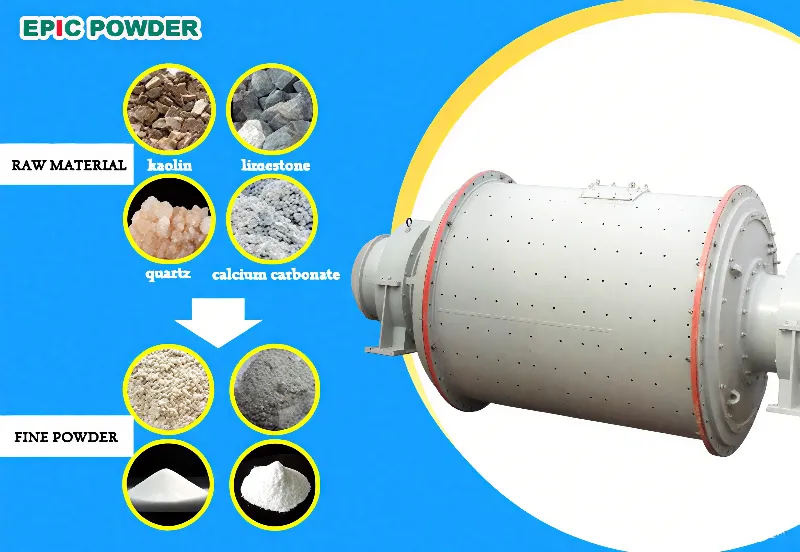
Mechanical grinding methods, especially wet nghiền bi, are currently among the most promising approaches for low-cost, large-scale production of graphene. Graphite powder is mixed with grinding media (such as high-hardness zirconia beads or stainless steel balls) and exfoliation aids (such as surfactants). Under the rotation and vibration of the ball mill, the grinding beads apply strong in-plane shear forces to the graphite.
Magical Effect:
These shear forces overcome the interlayer van der Waals forces. They peel graphite layer by layer, like tearing off pieces of adhesive tape, into single-layer or few-layer graphene. Graphene obtained through this mechanical exfoliation retains an excellent crystal structure. Its conductivity and mechanical strength are maximized.
Carbon Nanotubes: Key to Dispersion and Refinement
Carbon nanotubes (CNTs) have extremely high aspect ratios and usually exist as tangled “nests.” To function as one-dimensional conductive channels in electrode slurries, they must be cut short and disentangled.
Process Principle:
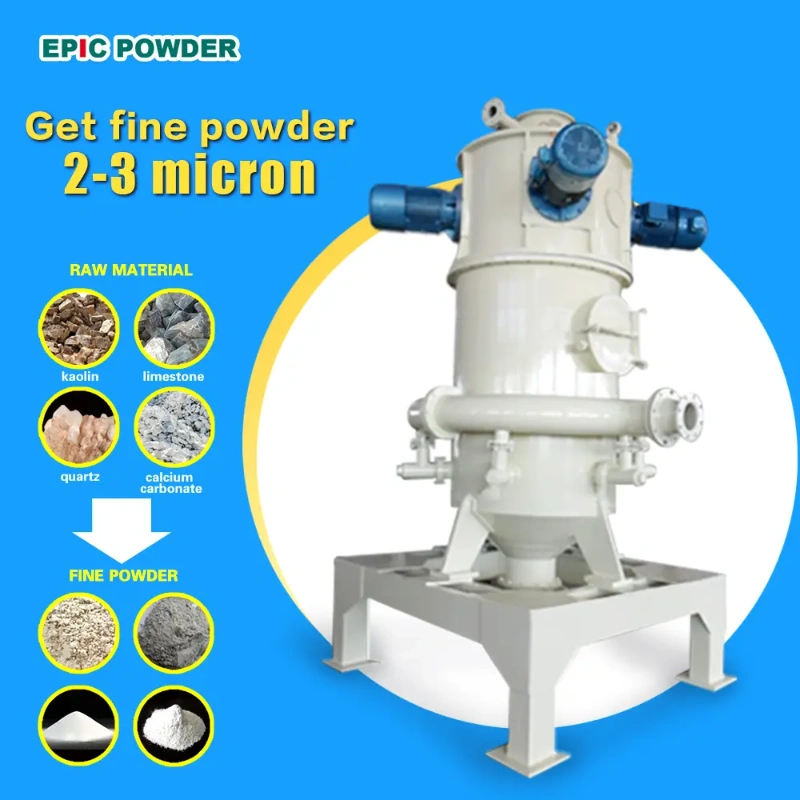
Pulverization of carbon nanotubes often uses nhà máy phản lực or high-speed mechanical impact mills. For example, in a máy nghiền phản lực, dry compressed air enters the milling chamber through supersonic nozzles, driving CNT particles to move at high speeds. Collisions, friction, and shearing occur between particles and between particles and chamber walls.
Phân loại độ chính xác:
Jet mills are usually equipped with a closed-loop classification system. Centrifugal force separates the ultrafine CNTs, which are carried out by the airflow, while coarser particles remain in the milling chamber for further pulverization. This method achieves high purity without introducing secondary contamination from metallic grinding media.
Conductive Carbon Black: Fine-Tuning the “Seasoning”
Dẫn điện muội than is commonly used as a non-active conductive additive in batteries. Its primary particles are very small but tend to form chain-like aggregates.
Process Principle:
Vibratory mills or bead mills apply strong physical shear forces to break down carbon black aggregates.
Performance Leap:
Grinding reduces the secondary kích thước hạt of carbon black. It also improves its wetting behavior in solvents such as NMP or water. This creates a dense, multidirectional “electronic highway” within electrodes.
Extended Applications for Other Carbon Materials
The role of grinding/pulverization extends beyond these three materials. In hard carbon preparation (a mainstream anode material for sodium-ion batteries, often derived from biomass such as glucose, coconut shells, or resins), grinding can regulate microcrystalline structures. It can also introduce defects or seal pores, optimizing sodium storage sites. Mechanical ball milling can induce different microstructural evolution on hard/soft carbon surfaces. This enhances capacity and rate performance.
In silicon-carbon composite anodes, ball milling is used to mix and refine silicon particles with carbon sources (e.g., polyacrylonitrile or graphene). This achieves uniform lớp phủ and mitigates silicon’s volume expansion. Surface modification of carbon fibers or activated carbon also often relies on mechanical friction or grinding. Functional groups are introduced, improving compatibility with polymers or electrolytes.
Additionally, in supercapacitors, grinding and activating carbon materials can increase specific surface area and porosity. In fuel cells, modified carbon supports improve catalyst dispersion. Mechanochemical grinding can achieve dual benefits: refinement and surface functionalization simultaneously. For example, ball milling carbon black in air or NH₃ can introduce carboxyl or nitrogen-doped groups, enhancing wettability and electrochemical activity.
The “Seasoning” Role of Grinding: Sửa đổi bề mặt and Green Processes
Grinding is not just a “pulverizer”; it is like a “master chef.” Mechanical forces generate fresh fractured surfaces, and local transient high temperature and pressure promote chemical reactions, achieving mechanochemical modification. For example, dry ball milling of carbon black can oxidize it in a green manner, introducing oxygen functional groups; wet milling or additive-assisted methods can dope nitrogen or sulfur atoms, tuning electronic structures.
Such modifications enhance hydrophilicity/hydrophobicity, adhesion to matrices, and electrochemical activity, while avoiding the pollution associated with traditional acid oxidation processes. Advantages include room-temperature operation, low energy consumption, solvent-free or minimal solvent usage, and scalability. However, excessive milling may cause amorphization or contamination, so precise control of parameters—such as media-to-material ratio, milling time, and atmosphere—is critical.
Compared to other methods, grinding has clear cost and environmental advantages: no expensive catalysts or vacuum equipment are needed, making it suitable for treating low-cost biomass carbons. Nevertheless, for ultra-high purity or perfect crystal requirements, other technologies may still be required.

Challenges
Despite its remarkable contributions, engineers face several “demons” when applying grinding/pulverization in industrial production:
- Contamination: During prolonged, high-energy friction, grinding media (e.g., steel balls) and equipment linings inevitably wear. Released iron, chromium, or other metallic impurities can enter battery carbon materials, potentially forming metallic dendrites on the anode during charging, piercing separators, and causing short circuits or fires. Therefore, the new energy industry often uses high-purity ceramic linings (e.g., silicon carbide, silicon nitride) and zirconia grinding media.
- Over-milling and Structure Damage: Too much is as bad as too little. Excessive milling time or energy can completely destroy the crystal structure of graphene, converting it into amorphous carbon, thereby reducing conductivity.
- Energy Consumption and Efficiency: Ultrafine grinding is notorious for high energy usage. Optimizing media ratios and rotor designs to reduce energy consumption per ton remains a key technological battleground for equipment manufacturers.
Phần kết luận
Grinding/pulverization in new energy carbon materials acts like a low-profile but highly efficient martial arts master. It silently polishes materials such as graphene, carbon nanotubes, and conductive carbon black. This enables new energy devices to achieve higher energy density, power density, cycle life, and safety. From mechanical exfoliation to surface modification, from basic refinement to composite construction, this method runs through the entire life cycle of carbon materials. It provides solid support for breakthroughs in batteries, supercapacitors, and other core devices.
Looking ahead, as new energy technologies evolve, grinding/pulverization methods will continue to innovate: lower energy consumption, more precise control, and environmentally integrated processes. Whether in domestic substitution of lithium-ion battery conductive additives or large-scale hard carbon production for sodium batteries, grinding will continue to contribute. Behind the “heroic tales” of new energy carbon materials, the story of this “whetstone” hero deserves continuous attention and in-depth exploration. It reminds us that many great achievements often arise from seemingly ordinary foundational processes. Only by continuously optimizing these “behind-the-scenes” techniques can the dreams of new energy truly become reality

Cảm ơn bạn đã đọc. Tôi hy vọng bài viết của tôi hữu ích. Vui lòng để lại bình luận bên dưới. Bạn cũng có thể liên hệ với bộ phận chăm sóc khách hàng trực tuyến của Zelda nếu có bất kỳ thắc mắc nào khác.
— Đăng bởi Emily Chen