
Kiểm soát hình thái hạt bột là một trong những công nghệ cốt lõi trong chế tạo vật liệu tiên tiến. Nó quyết định trực tiếp mật độ đóng gói, khả năng chảy, hoạt tính thiêu kết, cũng như cấu trúc vi mô và hiệu suất cuối cùng của sản phẩm gốm. Mục tiêu của việc kiểm soát hình thái là thu được các hình dạng hạt cụ thể, đồng nhất và có thể tái tạo.
Các phần sau đây trình bày chi tiết các phương pháp chuẩn bị chính và các nguyên tắc cơ bản đằng sau những phương pháp này để kiểm soát kích thước hạt bột.
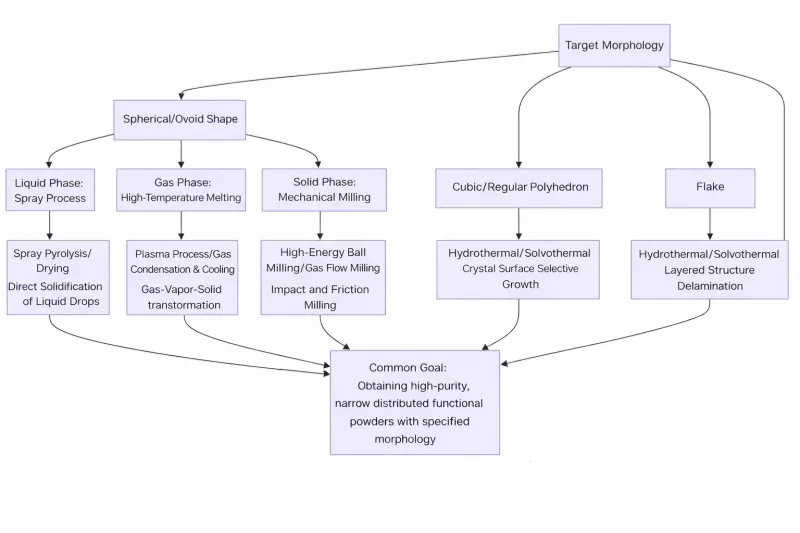
Các hình thái chính và chiến lược kiểm soát
Bảng dưới đây trình bày chi tiết các đặc điểm, phương pháp chuẩn bị thông thường và nguyên tắc kiểm soát cốt lõi của các hình thái mục tiêu khác nhau.
Bảng chiến lược kiểm soát hình thái
| Hình thái mục tiêu | Đặc điểm và ưu điểm | Các phương pháp chuẩn bị điển hình | Nguyên tắc cốt lõi của kiểm soát |
| Hình cầu / Gần hình cầu | Mật độ đóng gói cao, độ lưu động tuyệt vời, hoạt tính thiêu kết thấp. Tạo điều kiện thuận lợi cho hàm lượng chất rắn cao, độ nhớt thấp và các sản phẩm thô đồng nhất trong quá trình chuẩn bị dạng huyền phù (ví dụ: đúc màng). | 1. Phương pháp phun: Phun nhiệt phân, phun sấy. 2. Pha khí: Plasma tần số vô tuyến, hóa chất Sự ngưng tụ hơi nước. 3. Pha lỏng: Kết tủa đồng nhất + nung. 4. Cơ khí: Năng lượng cao máy nghiền bi (làm tròn). | 1. Sự chi phối của sức căng bề mặt: Các giọt chất lỏng hoặc vật chất nóng chảy tự nhiên co lại thành hình cầu dưới tác động của sức căng bề mặt. 2. Giảm thiểu năng lượng giao diện: Kiểm soát tốc độ phản ứng để đạt được sự tăng trưởng đẳng hướng. 3. Gia công cơ khí: Làm tròn các cạnh sắc nhọn thông qua va chạm và ma sát. |
| Hình lập phương / Đa diện đều | Cấu trúc tinh thể hoàn chỉnh, tính dị hướng có thể kiểm soát. Đối với các vật liệu perovskite như BaTiO3, các hạt lập phương được sắp xếp chặt chẽ, làm giảm ứng suất thiêu kết và cải thiện độ tin cậy của MLCC. | Nhiệt thủy nhiệt / Nhiệt dung môi Các phương pháp này là những con đường cổ điển và hiệu quả nhất. | Sự phát triển dị hướng tinh thể học: Kiểm soát chính xác nhiệt độ, áp suất, thời gian, chất khoáng hóa (ví dụ: OH-) và chất hoạt động bề mặt để ức chế hoặc thúc đẩy các mặt tinh thể cụ thể (ví dụ: {100}), cho phép các hạt phát triển theo các hướng ổn định về mặt nhiệt động học. |
| Dạng tấm / Nhiều lớp | Cấu trúc 2D đặc trưng. Được sử dụng cho gốm sứ có kết cấu (ví dụ: vật liệu áp điện) để tăng cường hiệu suất định hướng; cũng được sử dụng làm lớp chắn trong lớp phủ hoặc vật liệu composite. | 1. Nhiệt thủy nhiệt/Nhiệt dung môi (sử dụng các tiền chất nhiều lớp). 2. Phương pháp muối nóng chảy. 3. Tẩy tế bào chết (ví dụ, tẩy tế bào chết bằng các hydroxit kép nhiều lớp – LDH). | 1. Hướng dẫn cấu trúc nội tại: Đảm bảo sự phát triển chủ yếu diễn ra trong mặt phẳng 2D đồng thời ức chế sự phát triển theo chiều dày. 2. Hướng dẫn mẫu: Sự phát triển ngoại vi trên các khuôn mẫu dạng tấm (ví dụ: mica). 3. Môi trường muối nóng chảy: Cung cấp không gian giới hạn 2D. |
| Cấu trúc lõi-vỏ / rỗng | Vật liệu composite đa chức năng, diện tích bề mặt riêng lớn, trọng lượng nhẹ. Được sử dụng trong chất xúc tác, hệ thống vận chuyển thuốc và vật liệu điện cực hiệu năng cao. | 1. Tạo mẫu (Mẫu cứng/mềm). 2. Quá trình chín Ostwald. 3. Tự lắp ráp từng lớp (Layer-by-Layer - LbL). | 1. Giới hạn mẫu: Lớp phủ Đặt các vật liệu cần nhắm mục tiêu lên một khuôn mẫu hình cầu, sau đó loại bỏ khuôn mẫu đó. 2. Kiểm soát khuếch tán: Tận dụng sự khác biệt về tốc độ khuếch tán giữa các chất bên trong và bên ngoài để tạo thành các khoang (hiệu ứng Kirkendall). |
Các yếu tố phổ quát của kiểm soát hình thái
Bất kể phương pháp nào, việc kiểm soát hiệu quả các hạt bột đều phụ thuộc vào việc điều chỉnh chính xác một số yếu tố then chốt:
- Cân bằng nhiệt động lực học so với cân bằng động năng:
- Kiểm soát nhiệt động lực học: Trong điều kiện gần trạng thái cân bằng (ví dụ: quá trình thủy nhiệt kéo dài, nhiệt độ thấp), các hạt có xu hướng hình thành các hình dạng đều đặn, có năng lượng bề mặt thấp (ví dụ: hình lập phương).
- Kiểm soát động học: Trong điều kiện xa trạng thái cân bằng (ví dụ: kết tủa nhanh, phun ở nhiệt độ cao), các hạt tạo thành các hình dạng không cân bằng (ví dụ: hình cầu, hình nhánh cây). Điều chỉnh tốc độ phản ứng (nồng độ, nhiệt độ) cho phép chuyển đổi giữa các chế độ này.
- Năng lượng bề mặt và tính đặc thù của mặt phẳng tinh thể:Các mặt phẳng tinh thể khác nhau có năng lượng bề mặt khác nhau. Các chất phụ gia (chất hoạt động bề mặt, chất tạo phức) có thể hấp phụ chọn lọc lên các mặt phẳng có năng lượng cao cụ thể, ức chế sự phát triển của chúng và làm lộ ra các mặt tinh thể mong muốn. Ví dụ: PVP thường được sử dụng để thúc đẩy sự phát triển của các thanh nano bạc.
- Phân tách quá trình hình thành mầm và quá trình phát triển:“Sự hình thành mầm đột ngột” là một chiến lược quan trọng. Bằng cách tạo ra trạng thái siêu bão hòa tức thì, một lượng lớn mầm hình thành đồng thời. Sự phát triển được kiểm soát sau đó đảm bảo các mầm này phát triển đồng đều, tạo ra các hạt đơn phân tán với hình thái nhất quán.
- Môi trường và phương tiện phản ứng:
- Dung môi: Tính phân cực ảnh hưởng đến độ hòa tan và tốc độ khuếch tán của chất phản ứng.
- Giá trị pH: Ảnh hưởng đến dạng hóa học và khả năng phản ứng của các chất tiền thân.
- Chất khoáng hóa: Trong quá trình tổng hợp thủy nhiệt, các bazơ mạnh (như $NaOH$) đóng vai trò là chất khoáng hóa, làm tăng độ hòa tan của tiền chất và thay đổi tốc độ tăng trưởng tương đối của các mặt tinh thể khác nhau.
Tóm tắt và tầm quan trọng đối với ngành
Kiểm soát hình thái bột đóng vai trò là cầu nối giữa hóa học tổng hợp phân tử/nguyên tử với hiệu suất vật liệu vĩ mô.
- Dành cho gốm sứ điện tử: Bari titanat lập phương (BaTiO3) là tiêu chuẩn cho các tụ điện đa lớp (MLCC) cao cấp; alumina/nhôm nitrua hình cầu là nền tảng cho các chất độn dẫn nhiệt hiệu suất cao.
- Dành cho Xúc tác & Năng lượng: Các cấu trúc rỗng hoặc xốp có diện tích bề mặt lớn sẽ bộc lộ nhiều vị trí hoạt động hơn.
- Dành cho ngành Y sinh học: Hình dạng hạt cụ thể ảnh hưởng đến thời gian lưu thông và hiệu quả nhắm mục tiêu trong cơ thể.
Nắm vững kỹ thuật kiểm soát hình thái học đồng nghĩa với khả năng “tùy chỉnh” cấu trúc cơ bản của vật liệu – một con đường thiết yếu hướng tới các vật liệu hiệu năng cao và có chức năng. Xu hướng tương lai hướng tới các kỹ thuật thân thiện với môi trường hơn, chính xác hơn và có khả năng mở rộng quy mô hơn (như lò phản ứng dòng chảy liên tục) và sự hiểu biết sâu sắc hơn về mối tương quan “hình thái học - hiệu năng”.

Cảm ơn bạn đã đọc. Tôi hy vọng bài viết của tôi hữu ích. Vui lòng để lại bình luận bên dưới. Bạn cũng có thể liên hệ với bộ phận chăm sóc khách hàng trực tuyến của Zelda nếu có bất kỳ thắc mắc nào khác.
— Đăng bởi Emily Chen