
Microesferas ocas de vidro (HGM), como carga em materiais compósitos, têm sido amplamente aplicadas em áreas como revestimentos e pinturas, materiais especiais e exploração de recursos devido às suas propriedades de leveza, estrutura oca, isolamento térmico e estabilidade química. Nos últimos anos, na indústria de revestimentos, pesquisadores têm se dedicado a superar desafios como a baixa compatibilidade interfacial e a fraca adesão interfacial entre as HGM e as matrizes de resina por meio de tecnologias de modificação. Esses avanços têm gradualmente mitigado diversos defeitos em revestimentos reforçados com HGM, resultando em escopos de aplicação cada vez mais amplos e características de desempenho mais notáveis. Este artigo analisará brevemente as diversas aplicações de microesferas ocas de vidro na área de revestimentos e explorará suas perspectivas futuras.
Thermal insulation coating
HGM is low in density and has high fluidity. It also has low thermal conductivity. Because of these traits, it serves as an important filler in thermal insulation composite materials. Its small, hollow sphere shape changes how light travels when it hits the shell. This improves backscattering and light reflectivity of the coating. As a result, it reduces external thermal radiation energy from passing through and keeps heat out. Also, the thin-walled hollow structure of HGM has a thermal conductivity near that of air [0.026 W/(m·K)]. This feature helps to reduce heat conduction on both sides of the coating effectively.
Recently, researchers have used HGM in different thermal insulation coatings.
The thermal insulation effect relies on a few key factors:
- Tamanho da partícula
- Particle density
- Coating thickness
- Amount added
Thicker thermal insulation coatings usually improve the thermal insulation effect of HGM. However, they can also lead to severe shrinkage of the wet film as it dries, which significantly reduces coating adhesion. Reducing coating thickness while improving adhesion is a key challenge. We need effective surface modification and a uniform dispersion of HGM. Also, we must ensure the coating maintains excellent thermal insulation performance. This balance is critical in current research.
Fire retardant coating
HGM is an inorganic material. It is non-combustible and flame-retardant. Because of these traits, it can be used to make fire retardant coatings. HGM works as a fire retardant by slowing heat transfer. Its low thermal conductivity delays external heat from reaching the inside. This helps slow down flame spread on the coating surface. As a result, it reduces the rate of thermal decomposition in the substrate. Also, the light weight of HGM lowers the density of thick, non-expanding fire retardant coatings. This helps reduce the load on steel structure substrates.
Studies show that fire retardant coatings with HGM as a filler work better than those with expanded perlite or sepiolite. This is true even with the same amount added. Other researchers combined HGM with fillers. These included nano-silica, hollow silica microbeads, and boron carbide. They found the best mix for fire retardant performance. HGM in intumescent fire retardant coatings also prevents other flame retardants from expanding. This can cause the coating to peel off and reduce its fire retardant strength. Therefore, when used as a fire retardant filler, HGM is more used in non-expanding fire retardant coatings.
Anti-corrosion coating
O HGM possui alta resistência à compressão e excelente resistência à corrosão. Apresenta também boa estabilidade química, podendo ser utilizado na fabricação de revestimentos anticorrosivos. Aumenta a resistência ao desgaste e ao impacto do revestimento, além de reduzir a porosidade, dificultando a penetração de sal e umidade. Como resultado, a estrutura de aço dura mais tempo. Em revestimentos anticorrosivos, o HGM auxilia na distribuição uniforme do pó de zinco. Seu formato esférico, semelhante ao de uma esfera de rolamento, melhora a fluidez do revestimento, impede a sedimentação do material de enchimento e aumenta a eficiência da aplicação do pó de zinco.
Researchers discovered that swapping some zinc powder for HGM can cut coating costs. It still meets anti-corrosion standards, but salt spray resistance will be lower. HGM and thixotropic agents work well together. They stop zinc powder from clumping or settling. This helps keep anti-corrosion coatings stable during storage. HGM has a positive spherical structure. This means it absorbs less oil than other fillers. So, it helps lower the coating’s viscosity. As a result, it improves construction performance. HGM can improve coating fluidity. This helps zinc powder disperse evenly. It also prevents paint film cracks and promotes self-repair of those cracks.
Radar Absorbing Coatings
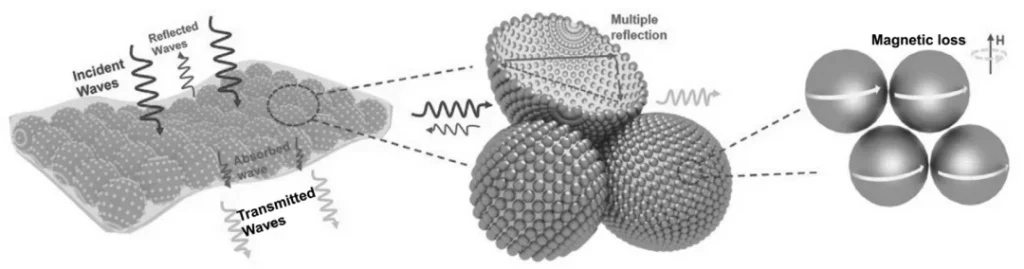
Absorbing coatings have important applications in military weapons. Traditional absorbing coatings often use fillers like ferrites and metal powders. These materials are dense, which makes it hard to reduce the weight of weapons and equipment. HGM doesn’t absorb on its own. However, if you plate it with metals like Ag, Ni, Co, or Cu, it becomes a good absorbing material. The hollow structure of HGM can reflect electromagnetic waves several times. The metal on its surface creates hysteresis loss and ferromagnetic resonance loss. This combination effectively provides electromagnetic shielding.
Current studies show that chemical metal plating on HGM mainly aims to create absorbers. It’s uncommon to see it used as a filler or adhesive for absorbing coatings. Coating HGM with metal or ferrite can improve its use in absorbing coatings. This approach aims to create materials that are thin, light, wide, and strong.
HGM has made significant breakthroughs in research and development. They have advanced in several areas, including thermal insulation coatings, fire retardant coatings, anti-corrosion coatings, and radar absorbing coatings. HGM has exciting plans for the coatings field. They will focus on improving functional quality. They also aim to cut production costs. Optimizing modification methods is another key goal. Plus, they want to enhance dispersion and mechanical properties. Lastly, HGM is set to expand in the low-density coating market.