
Barium sulfat terdesak (BaSO4) ialah sebatian bukan organik berfungsi yang tipikal kimia material. It is widely used in coatings, plastics, inks, and polymer composites due to its high whiteness, excellent hiding power, and outstanding chemical stability. However, in practical applications, its performance is often limited by a core issue—particle agglomeration. Agglomeration not only causes ultrafine particles to lose their unique interfacial advantages, but also leads to reduced mechanical properties and diminished surface gloss. Therefore, how to effectively disperse Barium Sulfate powder has become a critical challenge in advanced material processing. To fundamentally solve this problem, it is necessary to start from thermodynamic causes. At the same time, it requires the combination of efficient mechanical dispersion equipment and chemical surface modification processes.
I. The “Gravitational Storm” in the Microscopic World: Root Causes of Barium Sulfate Agglomeration
Agglomeration is a thermodynamically spontaneous process. It occurs when the attractive forces between particles exceed the repulsive forces.
For precipitated barium sulfate, the smaller the saiz Zarah, the larger the specific surface area. This results in higher surface energy. Consequently, the system tends to reduce free energy through particle stacking, making it increasingly difficult to disperse Barium Sulfate powder effectively.
1. Van der Waals Forces: The Universal Physical “Shackle”
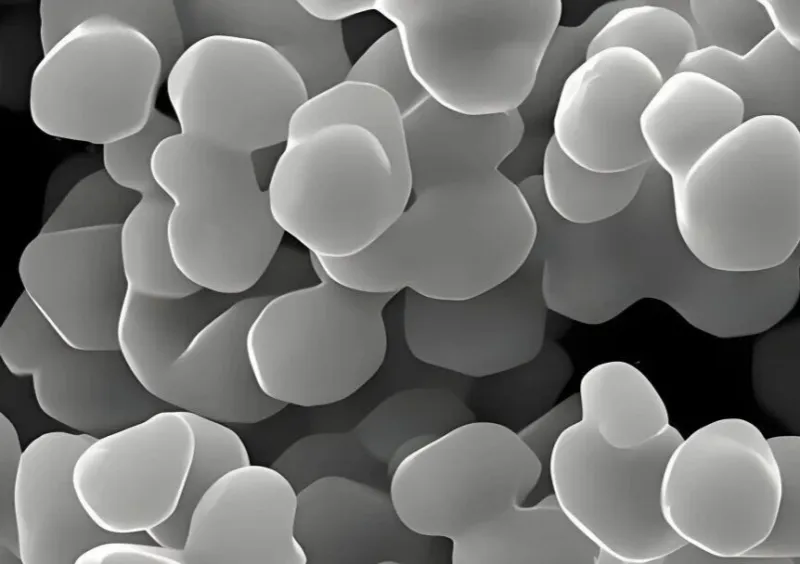
Van der Waals forces are the primary cause of soft agglomeration in ultrafine barium sulfate.
When particles reach the micron or even nanometer scale, gravitational forces become negligible. Weak intermolecular electromagnetic attractions begin to dominate. These forces increase exponentially as the distance between particles decreases. As a result, adjacent particles are tightly bound together.
2. Liquid Bridges and Solid Bridges: Environmental “Binders”
Liquid bridge force:
Barium sulfate particles have strong surface polarity. They easily adsorb moisture from the air. When two particles approach each other, the capillary force formed by the water film acts like a “strong adhesive,” pulling them together.
Solid bridge formation:
During drying, if washing is insufficient, residual salts or impurities remain in the liquid bridges. As water evaporates, these substances crystallize at the contact points between particles. This forms rigid solid bridges.
This is the main cause of hard agglomeration, which is difficult to completely break by mechanical force.
3. Electrostatic Attraction: Charge Traps from Friction
During pneumatic conveying, packaging, or grinding, barium sulfate particles frequently collide with equipment surfaces. This generates uneven surface charge distribution.
The Coulomb force between opposite charges causes particles to rapidly cluster into agglomerates.
II. Performance Degradation: Negative Impacts of Agglomeration
Coatings and inks:
Agglomerates form coarse particles. This leads to surface defects such as “pitting” in coatings. It significantly reduces gloss and hiding power. In severe cases, it may even clog spray nozzles.
Engineering plastics:
Uniformly dispersed barium sulfate can provide reinforcement. However, once agglomeration occurs, the interfacial bonding between particles and the polymer matrix becomes very weak. These agglomerates act as defect points under stress. This greatly reduces impact strength and elongation at break.
III. Breaking the Barrier: Coupling Mechanical Dispersion with In-Line Modification
Natural dispersion alone cannot overcome the microscopic forces mentioned above.
The solution lies in applying high-intensity mechanical stress to forcibly break agglomerates. At the same time, surface modification should be performed to form a protective layer on particles. This prevents secondary agglomeration and ensures long-term stability when you disperse Barium Sulfate powder.
1. Core Deagglomeration Equipment: Kilang Pengelas Udara -MJW Series Modifier
In industrial processing of precipitated barium sulfate, the MJW series modifier is a mainstream dispersion device.
Prinsip kerja:
This equipment integrates dispersion and classification. After entering the dispersion zone, the material is subjected to intense impact, shear, and collision. These are generated by a high-speed rotating rotor (linear speed exceeding 120 m/s). As a result, van der Waals forces and liquid bridges are forcibly broken.
Advantages of in-line modification:
In the strong turbulence generated by high-speed rotation, surface modifiers are sprayed as fine droplets. They instantly contact the particles.
This “mechano-chemical” effect enables the modifier to chemically bond with freshly exposed active surfaces.
2. High-Efficiency Kilang Pin Dispersion Equipment
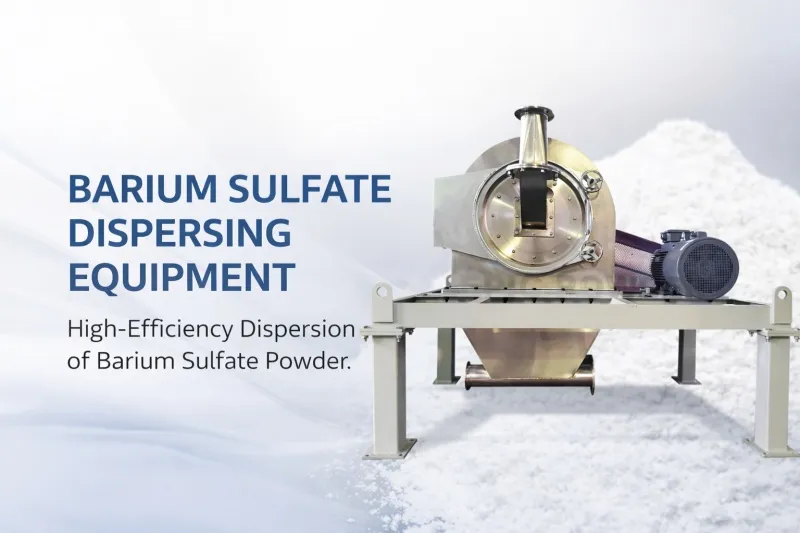
For applications requiring higher shear frequency or dealing with highly viscous or strongly agglomerated barium sulfate, the Kilang Pin demonstrates excellent performance.
High-frequency impact mechanism:
A Pin Mill consists of two counter-rotating discs, or one rotor and one stator. Dense arrays of pins are arranged on the discs.
As particles pass through the high-speed pin field, they undergo tens of thousands of collisions and intense shear forces.
Deagglomeration characteristics:
The Pin Mill generates extremely high instantaneous energy. It is especially effective for breaking hard lumps formed after drying.
Due to its highly dynamic internal flow field, it is ideal for continuous surface salutan modification. Under the intense mixing of the pins, modifiers can be distributed uniformly at the nanoscale.
This ensures that every dispersed particle is fully passivated. It effectively prevents re-agglomeration during storage.
IV. Advanced Deagglomeration Process: From “Aggregation” to “Independence”
To achieve optimal dispersion, the following closed-loop process is recommended:
1. Raw material preheating:
Hot air is used to remove physically adsorbed moisture. This weakens liquid bridge forces.
2. Forced deagglomeration:
The material enters the MJW modifier or Pin Mill dispersion zone. The applied mechanical force must exceed the fracture strength of agglomerates.
3. Chemical coating:
During dispersion, modifiers are injected via metering pumps. At this moment, particles reach maximum specific surface area, ensuring the highest coating efficiency.
Prinsip:
One end of the modifier reacts with hydroxyl groups on the particle surface. The other end extends outward, creating steric hindrance. This prevents particle reattachment.
4. Precision classification:
This integrated approach significantly improves efficiency when attempting to disperse Barium Sulfate powder at an industrial scale.
V. Key Indicators for Evaluating Dispersion Quality
Evaluating dispersion performance should not rely solely on median particle size (D50). The following parameters are also critical:
Oil absorption:
Severely agglomerated particles have higher porosity and oil absorption. After proper dispersion, oil absorption decreases significantly. This indicates better flowability in downstream applications.
Activation grade:
This refers to the proportion of particles whose surface has been transformed from hydrophilic to hydrophobic. High-quality modified barium sulfate can float on water.
Particle size distribution width:
A narrow distribution indicates uniform dispersion. It also suggests the absence of large agglomerates.
VI. Kesimpulan dan Tinjauan
Agglomeration of precipitated barium sulfate is an inherent characteristic of fine powders. However, it is not irreversible.
By understanding van der Waals forces, liquid bridges, and electrostatic interactions, and by utilizing high-efficiency dispersion equipment such as the MJW series and Pin Mills, it is possible to generate strong shear fields. Combined with targeted surface modification chemistry, these methods can completely overcome microscopic attractive forces.
In the future, deep processing of barium sulfate will continue to evolve toward integrated dispersion–modification systems and intelligent continuous production.
Only when every barium sulfate particle becomes an independent “microscopic warrior” can its full value be realized in high-end industrial materials.

"Terima kasih kerana membaca. Saya harap artikel saya membantu. Sila tinggalkan komen di bawah. Anda juga boleh menghubungi wakil pelanggan dalam talian Zelda untuk sebarang pertanyaan lanjut."
- Dihantar oleh Emily Chen