
There has been a large amount of research both domestically and internationally on the preparation and controllability of silver powder for crystalline silicon solar cell silver paste. Common synthesis methods include chimique reduction, microemulsion, electro-reduction, mechanical ball milling, and physical evaporation. Among them, chemical reduction is currently the main method for preparing silver powder for crystalline silicon solar cell electrodes. This is due to its convenient operation, simple equipment, and good controllability.
However, even the raw powder prepared by the commonly used chemical reduction method still cannot meet the performance requirements for silver powder used in crystalline silicon solar cell silver paste. Firstly, due to the small size and high surface energy of silver powder, particles tend to agglomerate during drying. Once agglomerated, they are difficult to break mechanically. This results in poor dispersion and severely affects the physical properties and functionality of the silver powder.
More critically, untreated silver powder particles easily form soft agglomerates in the carrier. This reduces the dispersion, stability, screen printing rheology, film formation, and curing properties of the paste. It also adversely affects the performance and storage of conductive silver paste.
Therefore, post-treatment of the prepared silver powder is a key step for its application. The main post-treatment method is surface modification of silver powder. Currently, research on silver powder surface modification is still not systematic, and only a few manufacturers have mastered the relevant technology. This leads to high prices for silver powder and silver paste. It also seriously affects the further development of crystalline silicon solar cells.
The main methods for silver powder surface modification include:
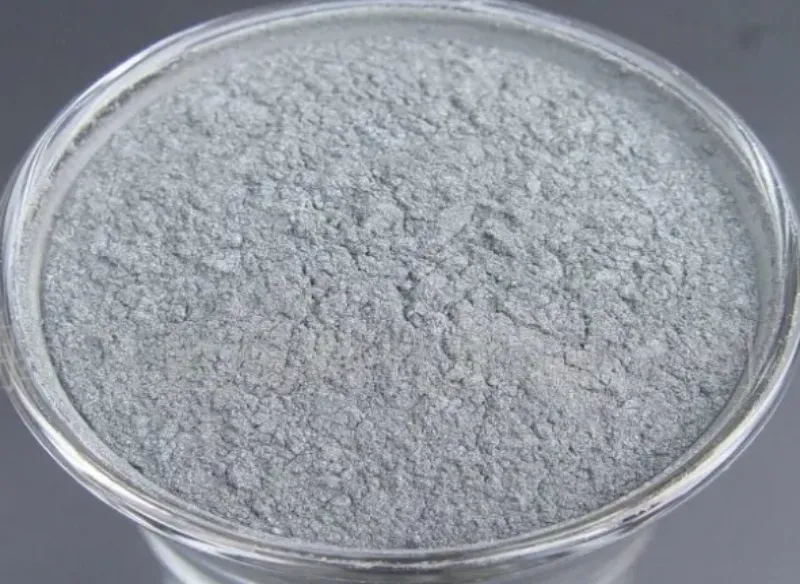
Organic Coating Method
The organic revêtement method refers to coating and modifying the surface of silver powder with specific organic surface modifiers. Through adsorption or chemical reaction between the organic substances and the powder surface, organic molecules are grafted onto the powder surface. Ultrafine silver powder is modified from hydrophilic to hydrophobic. This enhances the wettability of solvent on powder particles and provides good printability and leveling of the prepared paste. In addition, introducing polar groups can effectively reduce the surface energy of silver powder. It also enhances the electrostatic barrier between particles, improves paste dispersion and stability, and prevents sedimentation.
The general process of organic coating modification is to mix the organic modifier with the powder, stir for a period, then separate, wash, and dry. This method is simple to operate, efficient, and suitable for micron, submicron, and nanometer spherical or flake silver powders.
In organic coating modification for crystalline silicon solar cell electrode silver powder, the selection of organic coating agents is critical. Generally, the most important characteristics of organic modifiers are the head group charge, molecular chain length, and size. These factors affect the coating effect, hydrophobicity, and compatibility with the organic carrier in the paste.
Moreover, the water solubility or oil solubility of surfactants is an important basis for their selection. Common modifiers for silver powder surface chemical modification include organic acids, fatty amines or alkanolamines, lipid compounds, coupling agents, and long-chain alcohols or ethers.
To improve the overall performance and applicability of conductive silver paste, organic acids, organic amines, and lipid compounds are often used in combination for surface modification.
Mechanical Composite Method
The mechanical composite method uses mechanical means to grind and crush silver powder to obtain specific surface morphology or structure. During mechanical processing, organic additives are often added to enhance powder dispersion and surface chemistry.
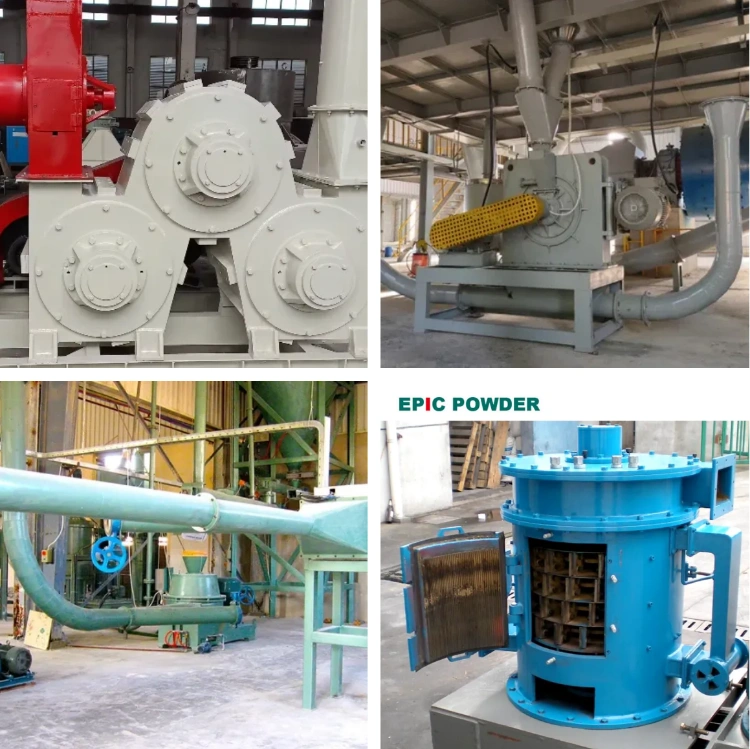
This method is efficient, low-cost, simple, and easily industrialized. Ball milling and fraisage par jet d'air are the most commonly used methods for silver powder surface modification. Equipment such as three-roller coating machine, machine de revêtement par broyeur à broches, et turbo mill coating machine can also be used. These machines achieve uniform surface modification of silver powder through mechanical collision, shear, and friction. This further enhances dispersion and surface functionality.
Ball milling involves strong impact, extrusion, and grinding of powder by the rotation or vibration of hard balls (such as zirconia or agate balls). This method can significantly refine grains and enhance sintering activity. However, the extrusion and grinding may destroy the spherical structure of near-spherical silver powder. Therefore, it is usually suitable for flake silver powder preparation and modification.
Air jet milling uses high-pressure airflow to drive powder circulation in the milling chamber. This causes particle-particle and particle-wall collisions and friction, achieving crushing, dispersion, and improved sphericity. This method does not require additional additives. The processed powder is smooth, uniformly dispersed, and free of impurities. Compared with ball milling, air jet milling is more suitable for spherical powder surface treatment. It minimally affects powder morphology and structure, prevents agglomeration, and has higher efficiency. It is the most commonly used mechanical surface modification method for crystalline silicon solar cell electrode silver powder.
Surface Particle Coating Method
With the development of new high-efficiency cell technologies such as TOPCon and HJT, silver powders are required to have higher sintering activity at lower temperatures to meet the sintering process of crystalline silicon solar cells. A common solution is to use submicron and flake silver powders as conductive fillers.
Additionally, some studies propose compounding nanosilver with microsilver, particularly coating nanosilver onto microsilver surfaces. This ensures uniform mixing at the microstructure level and imparts a new nanoscale surface structure to microsilver, providing both high conductivity and high sintering activity. Common methods for surface coating of nanoparticles include physical (mechanical coating) and chemical (in-situ particle generation) methods.
Mechanical coating involves strong mechanical stirring or high-speed airflow impact to mix nano- and microsilver particles, causing collisions, grinding, and extrusion, ultimately embedding nanosilver on the surface or voids of microsilver. This method requires no additives, is simple, and pollution-free, but high-quality pre-dispersed nano- and microsilver powders are needed. The uniformity and dispersibility of nanosilver critically affect the coating consistency. Equipment used may include three-roller coating machines, pin mills, and turbo mills, which increases system complexity and cost.
The in-situ particle generation method forms nanosilver particles on the surface of micro- or submicron silver powders via chemical reduction. This creates a composite conductive system. The nanosurface structure enhances contact between conductive particles after low-temperature sintering. It forms a more complete conductive network and improves the conductivity of silver paste.
Compared with mechanical coating, in-situ particle generation achieves more uniform coating and better dispersion. However, its process is more complex. The technical difficulty is higher, and there is still a significant gap for industrial-scale production.
Conclusion
In summary, optimizing the performance of silver powder for crystalline silicon solar cell silver paste relies on a combination of preparation and post-treatment techniques. Chemical reduction provides the base powder, but surface modification is essential for high-performance silver paste. Methods include organic coating, mechanical composite, and surface particle coating, each with advantages and limitations. Future development should focus on efficient and controllable surface modification processes. Industrial-scale production of multi-scale composite silver powders is also needed. These improvements aim to reduce cost and enhance conductive paste performance, meeting the requirements of new high-efficiency crystalline silicon solar cells.

« Merci de votre lecture. J’espère que cet article vous sera utile. N’hésitez pas à laisser un commentaire ci-dessous. Pour toute question, vous pouvez également contacter le service client en ligne de Zelda. »
— Publié par Emily Chen